
How do you clear the retweets from one stretch of time without deleting your tweets, your likes, or your whole history? X has no native bulk control for this, so the reliable method is a tool that lists your retweets and lets you select a window. This guide walks that method end to end, including the safety details that keep your account clean.
What this guide gives you.A way to pull your full retweet history into a reviewable list.A method to target and clear one specific period, nothing else.The safe, official-access workflow that protects your account.
It is built around Circleboom's tool, the fastest way to remove retweets from a specific period without touching your original posts.
I have run retweet cleanups for my own accounts and for clients moving on from old campaigns. The method is always the same: separate retweets from tweets, review before removing, and work in safe daily batches. Skip any of those and you either delete too much or risk the account.
Why retweets get cleaned separately from tweets
A retweet is amplification, not authorship. Removing one pulls back your boost of someone else's post without deleting that post or notifying its author. That makes retweets a distinct category of cleanup with much lower stakes than deleting your own words.
The practical upside is precision. You can clear a period's worth of amplifications, accounts you no longer want to promote, a campaign that ended, a topic you have left, while keeping every original tweet you still stand behind. Treating the timeline as one block, and deleting everything, throws away that precision and the value with it.
X provides no bulk retweet remover, and undoing reposts individually through the timeline is slow and easy to lose track of, as the platform's repost FAQs make clear. A dedicated tool is what turns an unmanageable manual chore into a controlled selection.
The reason the separation matters so much in practice is that the two cleanups have different reversibility. A deleted tweet is gone for good, so it deserves caution and review. A removed retweet can simply be re-shared, because the original post still exists on X, so it is a far lower-stakes action. Bundling them, as a delete-everything wipe does, forces the cautious standard onto the low-stakes action and the careless standard onto the permanent one, which is exactly backwards. Keeping retweet cleanup separate lets you move quickly on the reversible part and carefully on the permanent part, which is how the cleanup should actually be paced.
How to remove retweets from a specific period, step by step
The method splits into two phases: connect and load your history, then target and clear the window. The free plan removes up to 50 retweets a day, so larger periods span a few sessions.
Connect your account and load your retweets
1. Log in to Circleboom Twitter and connect your X account with official authorization.

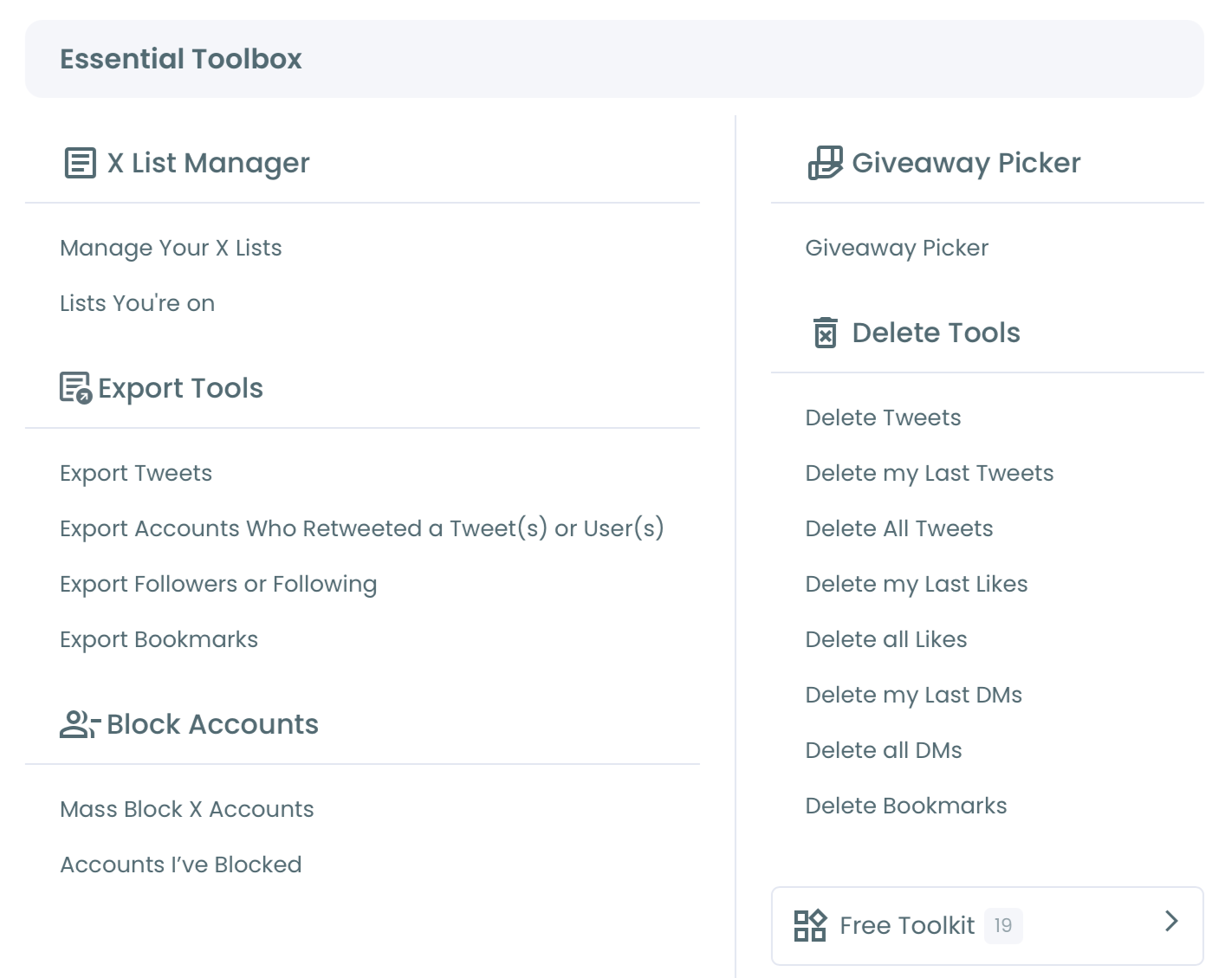
2. Open Delete your ReTweets from the Essential Toolbox menu, then let Circleboom fetch your retweet history.
Target the window and remove
- Review the retweet list Circleboom displays, with each retweet's context shown for identification.
- Select the retweets from your target period, leaving everything outside the window untouched.
- Confirm the removal, up to 50 per day, and return on later days to finish a larger cleanup.
This order works because it makes review mandatory before removal. You connect through official access, see your real retweet history, and select a defined window, so nothing outside the period is ever at risk. The daily cap keeps the operation gradual, which is safer than one large irreversible sweep.
Watch the flow: deleting all retweets quickly without removing your tweets.
A quick decision: period, all retweets, or full cleanup
Before you start, decide what you are actually trying to achieve, because the right scope changes the approach. Picking the wrong scope is the most common mistake.
- A specific period: review the list and select only that window. This guide's default.
- All retweets, any date: select the full history in daily batches for a complete amplification reset.
- Tweets and likes too: use the separate tools so each content type is cleared deliberately.
If your goal extends to original posts, the delete all tweets workflow adds date and keyword filters, and for likes the unlike and delete all Twitter likes tool handles those. Matching scope to intent up front prevents both over-deleting and half-finished cleanups. The broader reasoning is in how to remove retweets.
Why the official-access detail matters
Any tool that acts on your account at scale should run through sanctioned channels. Circleboom is an official X Enterprise developer, so removals process through official X access rather than scraping, keeping the account compliant throughout.
This is not a formality. Scraping-based tools risk your account to save time, while official access plus a gradual daily pace makes the cleanup something X recognizes as legitimate. If you are on mobile, the same logic applies, and deleting retweets on iPhone covers that path, while deleting old tweets on iPhone handles original posts from a phone.
Keeping your retweet history clean over time
A one-time cleanup fixes the current problem, but a small habit prevents the next one. Retweet history accumulates quietly, and the accounts that end up wanting to delete everything are usually the ones that never did any ongoing maintenance.
The simplest habit is a periodic review. Every so often, open your retweet list and clear anything tied to finished campaigns, topics you have left, or accounts you no longer want to promote. Because you are only clearing a small recent window each time, it takes minutes and never builds into the kind of backlog that makes a full wipe tempting. This is the same targeted method as a one-off period cleanup, just applied as routine maintenance rather than emergency repair.
It also helps to decide your own rule for what a retweet means on your account. If a retweet is a lasting endorsement, you will keep fewer and review more often. If it is a casual signal-boost, you may clear more aggressively when contexts change. Either rule is fine, but having one turns retweet cleanup from a reactive scramble into a deliberate practice. For the fast bulk version when a backlog has already built up, deleting all retweets in one click shows the controlled approach, and the same gradual, official-access safety applies whether you clear ten retweets or a thousand.
What to Do Next
Targeting a period is a precise operation, so treat it precisely. Decide your scope, review before you remove, and let the daily batches keep it safe.
- Decide whether you want a period, all retweets, or a full cleanup.
- Connect through official access and load your retweet history.
- Select only the window you mean to clear.
- Remove in daily batches of up to 50.
- Leave your tweets and likes alone unless you deliberately target them too.
Frequently Asked Questions
Can I really target just one period?
Yes. Circleboom lists your retweet history so you can review it in order and select the stretch you want gone, leaving the rest in place. The review step is what makes period-targeting precise rather than a blanket delete.
Will my original tweets be affected?
No, not unless you deliberately use the separate tweet tool. Delete your ReTweets only removes amplifications, so your authored posts and your likes stay intact while you clear retweets.
How long does a large period take?
It depends on volume, since the free plan removes 50 retweets a day. A small window finishes in one session, a large one spans several days, and the pace keeps the operation safe and gradual.
Is there any way to undo a removed retweet?
You can retweet the original again, because the post still exists on X. That makes retweet cleanup reversible in spirit, unlike deleting your own tweets, which is permanent. Knowing it is reversible is exactly why you can move faster on retweets than on your own posts, since a mistake costs you only a few seconds to re-share rather than a lost original.