Manual winner selection from a long like list is slow, prone to bias, and difficult for the audience to trust. Automated random selection through a documented methodology is faster, fair, and verifiable. This guide walks through how to use a random picker from Twitter likes through Circleboom Giveaway Picker, what filters compound with the selection, and how to handle the announcement.
Quick Answer:Publish a giveaway tweet with a clear like-to-enter requirement.Let the campaign run for 5-10 days.Log in to Circleboom Twitter and open Giveaway Picker.Enter the tweet URL, set the entry condition to "like," apply filters, and run the selection.The workflow uses the official X Enterprise API for participant data.
Why Use a Random Picker Instead of Manual Selection?
Three structural reasons.
Reason one: speed. A random picker handles selection in seconds. Manual selection across a long like list takes substantial time and produces the same outcome quality at much higher operational cost.
Reason two: bias removal. Random selection eliminates conscious or unconscious favoritism. Manual selection inherently introduces selection effects, even when the account holder intends to be fair.
Reason three: audience verifiability. Random selection through a documented methodology can be audited by participants. Manual selection cannot, regardless of how honest it was. The verifiability is what builds participation trust over multiple campaigns.
For accounts that have previously run manual selections and want to transition, the change usually produces immediate improvement in next-campaign participation rates because the audience trust calculation shifts in favor of participation.
The framework for the trust dynamics is documented at how to run a successful Twitter contest.
How the Random Picker Retrieves the Like List
Circleboom Giveaway Picker retrieves the list of accounts that liked a tweet through the X Enterprise API. The retrieval is automated and complete; the user does not need to manually copy or scrape the list.
The like list is the participant pool for the selection. The list includes all accounts that liked the campaign tweet during the eligibility window. The pool is verifiable because the source is X’s own data.
For tweets with high like counts, the retrieval scales without performance degradation. A tweet with 10,000 likes produces a 10,000-entry pool that the selection algorithm runs against in seconds.
Step-by-Step: How to Use the Random Picker
The flow runs in six sequential steps.
Step 1. Publish the giveaway tweet
State the prize, the entry condition (like this post to enter), the deadline, and the selection mechanism (Circleboom Giveaway Picker).
Step 2. Let the campaign run for the deadline window
Typical duration: 5 to 10 days. Likes accumulate as the tweet circulates.
Step 3. Sign in to Circleboom Twitter
Open Circleboom Twitter and authorize the X account.
Step 4. Open Giveaway Picker
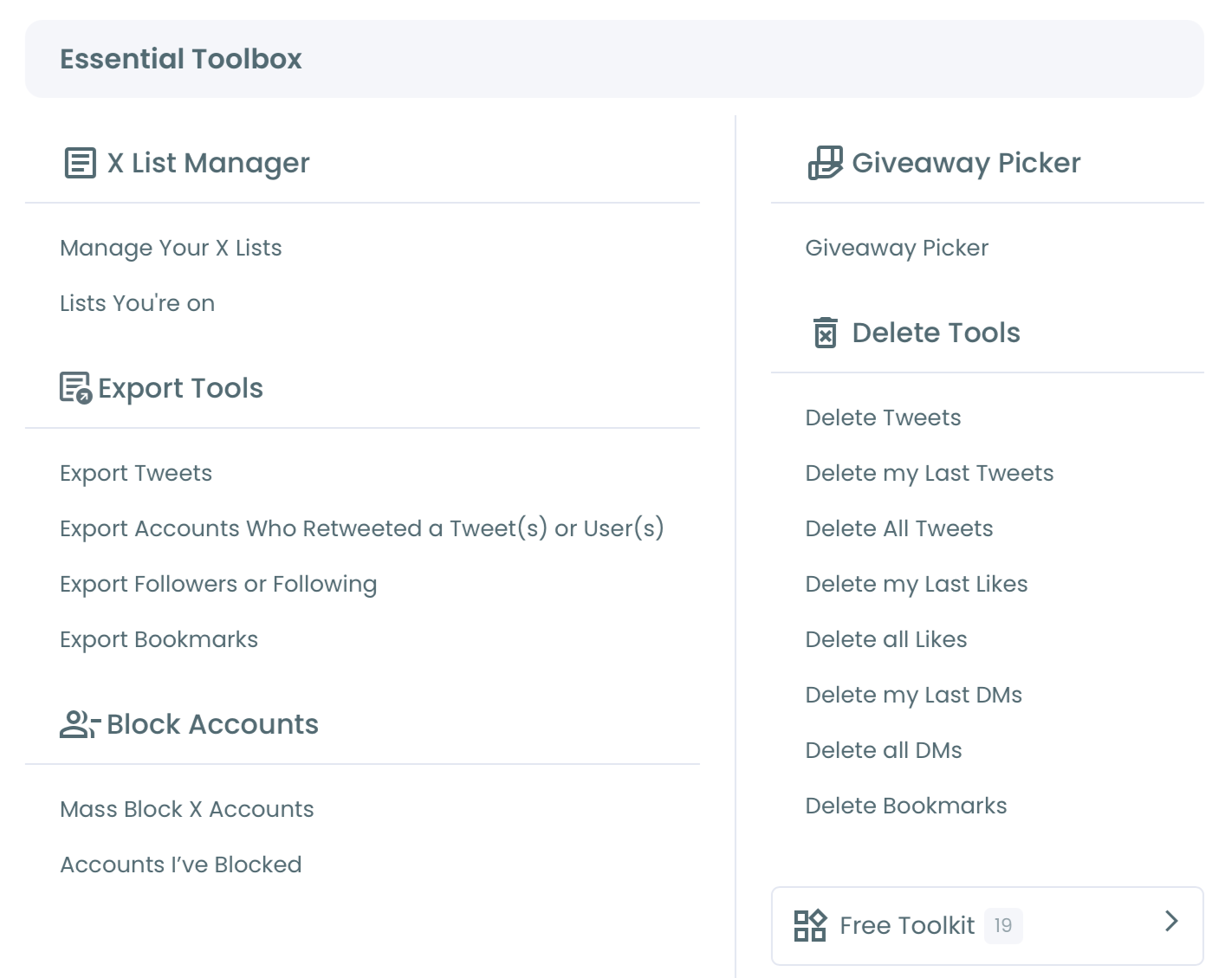
Navigate to Giveaway Picker from the Essential Toolbox section.
Step 5. Enter the tweet URL and configure the selection
Paste the campaign tweet URL. Set the entry condition to "like." Apply quality filters (exclude bots, set minimum age, etc.).
Step 6. Run the selection and announce the winner
Run the random selection. The output includes the winner identity and a result image. Post the winner announcement publicly with the result image.
The full operational workflow takes 10 to 15 minutes including the public announcement.
Filters That Compound With the Like-Based Selection
Four filter categories add quality control.
Bot exclusion. Filters out accounts identified as bots based on profile signals and behavior patterns.
Account age threshold. Excludes accounts created within a specified recent window, narrowing to established accounts.
Follower count threshold. Requires participants to have a minimum follower count, narrowing to non-trivial accounts.
Engagement history. Optional filter for accounts that have previously engaged with the running account, narrowing to repeat participants.
The filters narrow the participant pool to verified human accounts that match the campaign’s audience-quality criteria. The narrowing happens before the random selection, so the final draw is from the pre-filtered pool.
For accounts running detailed campaigns, the patterns in the Twitter tweet engagement rate calculator provide context on which engagement signals correspond to higher-quality audience.
Why Like-Based Selection Has a Different Profile From Retweet-Based
Likes and retweets are different participation actions with different operational implications.
Likes are low-friction. The participant taps once and is entered. The action does not propagate to the participant’s followers. Like-based campaigns produce broad participation but constrained reach.
Retweets are higher-friction but propagate. The participant’s retweet appears in their followers’ feeds, which extends the campaign’s reach. Retweet campaigns produce broader reach but narrower participation.
The choice between like-based and retweet-based campaigns depends on the goal. Like-based works for broad participation and audience-quality goals. Retweet-based works for viral reach and discovery goals.
For broader campaign strategy context, the framework in how to go viral on Twitter covers the reach side that complements like-based participation.
How the Methodology Builds Trust Across Multiple Campaigns
Each campaign run through Giveaway Picker reinforces the trust calculation for the next campaign. The pattern works through three mechanisms.
Mechanism one: methodology familiarity. The audience becomes familiar with the Giveaway Picker workflow. By the third or fourth campaign, participants expect the methodology and trust it without further explanation.
Mechanism two: result image archive. Each campaign produces a result image. The accumulated archive serves as social proof for future campaigns; participants can see that previous winners were real accounts.
Mechanism three: zero rigging accusations. Verifiable selection produces zero plausible accusations of rigging. The audience response to subsequent campaigns is correspondingly positive.
The combined effect is that the random picker becomes the account’s standard giveaway methodology, with participation growing over multiple cycles because the trust is established.
How Circleboom Giveaway Picker Stays Inside X Policy
The tool operates through the X Enterprise API. The like list retrieval uses sanctioned endpoints. The selection methodology is documented. The workflow follows X’s rules on giveaway operations.
The X help center documentation on X rules and policies defines the giveaway requirements. The Enterprise API path handles the data layer compliantly.
Watch the Twitter Like Picker walkthrough on YouTube for a visual demonstration.
Common Mistakes With Random Pickers
Three errors recur.
Mistake one: not announcing the methodology in the campaign tweet. Participants who do not know the selection process is automated assume it is manual. The methodology should be stated in the campaign tweet itself.
Mistake two: skipping the public result image. The result image is the verifiable artifact. Skipping it removes the social proof that builds trust for future campaigns.
Mistake three: not applying filters. Unfiltered pools include bot accounts that should not be eligible. The minimum filter set should exclude bots and very-new accounts.
For accounts running their first random-picker campaign, the patterns in how to handle public engagement events provide related context.
Frequently Asked Questions About Random Pickers From Twitter Likes
How is the random selection performed?
The tool generates a random number within the range of the filtered participant pool. The participant at that index becomes the winner. The randomness source is documented and verifiable.
Can I select multiple winners from the same campaign?
Yes. The picker supports multi-winner selection from the same participant pool, with each winner drawn through independent random selection.
What is the minimum like count for a meaningful selection?
50 likes is a reasonable floor. The selection is mathematically random at any count; the floor is about the perceived fairness of the draw.
Does the picker work for tweets that are not from my own account?
Giveaway Picker works on tweets from the connected X account. For multi-account configurations, each account is configured separately.
Can the random selection favor specific account types?
The selection itself is random. Audience-quality filters narrow the pool before selection, but within the filtered pool the draw is uniform random.
What happens if the winner has not followed the account?
If the campaign requires following, the follower filter excludes non-followers before the selection. If the campaign is like-only, the winner may not be a follower; this is a known characteristic of like-only campaigns.
How does the tool handle deleted or suspended accounts in the like list?
Deleted and suspended accounts are filtered out automatically before the selection. The eligible pool contains only active accounts.