
The belief used to be that the loudest followers were the most loyal ones. The accounts that replied to every post, quoted every thread, and showed up in every notification window were the obvious loyalists, and the audience-strategy work assumed those were the followers the brand had earned. The belief had held for years across multiple accounts, and the engagement reports that came out of it tended to highlight the same dozen or two dozen handles every month.
The belief broke on the audit where the engagement history was loaded into a structured view and the loyalty signal was measured across a 90-day window rather than across the most recent post or two. The loud followers turned out to be a small fraction of the actually-engaging audience. The much larger group was the quiet-but-consistent followers, the accounts that liked or reposted three or four times a month without ever surfacing in the operator's mental model.
A defensible loyal-follower audit measures engagement consistency over a fair window, separates the loud-but-shallow followers from the quiet-but-consistent ones, and runs through the official X Enterprise APIs so the data is reliable and the analysis is policy-compliant. The Circleboom workflow produces a ranked list of engaging followers, an exportable CSV for downstream segmentation, and an audience view the operator can act on. → Find your most engaging followers
Why the Loud-Equals-Loyal Heuristic Fails
The loud-equals-loyal heuristic is the default because it is cheap. Replies and quote posts surface in the notification window; likes and reposts surface more quietly and often slip past the operator's attention. The brain pattern-matches on what is visible, and what is visible is the loud subset.
The subset is biased in three predictable ways. It over-weights followers whose communication style is conversational on platform. It under-weights followers whose engagement is amplification-driven (reposts, quote-shares) rather than reply-driven. And it misses entirely the followers whose engagement is read-and-respond-privately, which often correlates with the highest commercial-value segments.
Circleboom's piece on what engaging and loyal followers actually are on Twitter covers the definition layer in detail and walks through why the broader engagement signal is the right one to optimize for, rather than the conversational subset.
What Loyalty Should Actually Be Measured Against
A defensible loyalty signal uses three measurements over a fair window.
The first is engagement frequency. A follower who interacts with three or more posts in a rolling 30-day window is engaging consistently rather than randomly. The threshold is calibrated to the account's posting frequency: an account that publishes daily uses a higher threshold than an account that publishes weekly.
The second is engagement diversity. A follower who likes, reposts, and replies (rather than just one of the three) is engaged across multiple surfaces and is statistically more likely to remain engaged across the next quarter. The diversity signal catches the followers whose engagement is broad-based rather than one-dimensional.
The third is engagement persistence. A follower who has been engaging consistently for the prior 90 days is a higher-confidence loyalty signal than a follower whose engagement appeared in the last 30 days and may fade. The persistence test rewards durability over recency.
When all three signals fire, the follower is in the loyal core. When one or two fire, the follower is in the engaging-but-not-yet-loyal cohort, which is a useful segment in its own right. The compound test produces a defensible ranking rather than a noise-dominated leaderboard.
Circleboom's piece on your most engaging followers on Twitter covers the operator-side workflow for acting on the ranked list, and the framing about engagement compounds applies one-to-one to the loyalty audit.
How to Find Your Most Loyal Twitter Followers Step by Step
The workflow runs in two phases: the engagement audit, then the loyal-core export. The first run takes 15 to 25 minutes depending on follower-list size; subsequent runs are faster because the saved filter does most of the work.
Phase 1: Build the Engagement Audit
Log in to Circleboom Twitter
- Log in to Circleboom Twitter with the X account whose audience you want to audit. OAuth keeps the credentials with X directly.
Open the Follower-Following menu
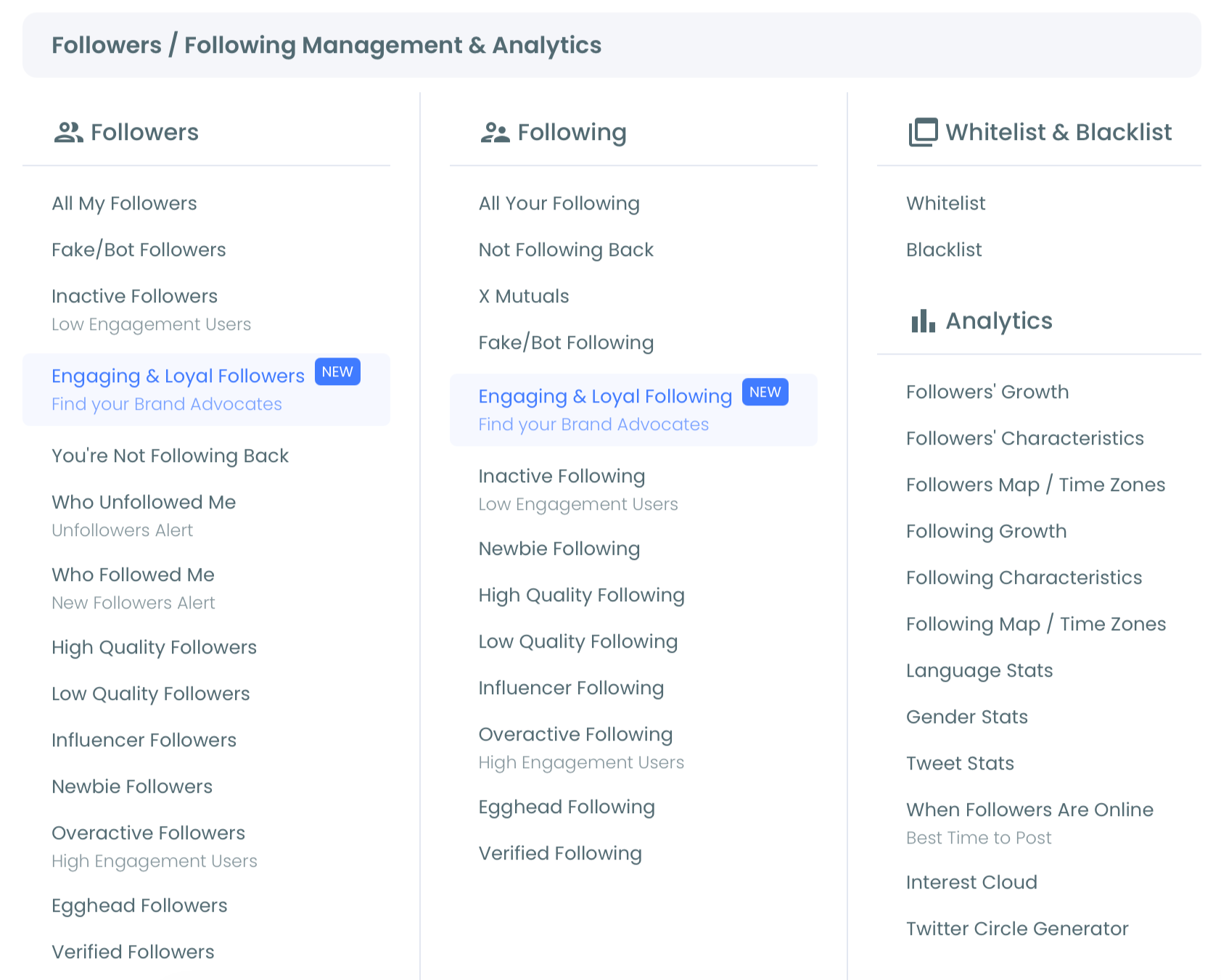
- Open the Follower-Following menu in the left navigation and find the Engaging & Loyal Followers report. This is the surface where the engagement-history audit lives.
Set the engagement window and the compound thresholds
- Set the engagement window to a rolling 90 days and configure the compound thresholds: minimum three engagement events in 30 days, at least two distinct engagement types across the window, and engagement persistence flag enabled. The report rebuilds against these settings and produces the ranked loyal-follower list.
Phase 2: Review and Export
Review the top 50 entries of the ranked list
- Review the top 50 entries of the ranked list. The top of the list will surface familiar names (the loud-and-loyal subset), and the deeper rows will surface the quiet-but-consistent followers the operator has not been mentally tracking. The deeper rows are the larger and often more valuable cohort.
Export the loyal-core list to CSV
- Export the loyal-core list to CSV for downstream segmentation. The export captures username, user ID, engagement-count breakdown, engagement-type diversity flag, and the persistence signal. The CSV opens in Google Sheets or any CRM that accepts CSV import.
Apply the first downstream filter
- Apply the first downstream filter the audience strategy needs. A bio-keyword join produces the loyal-core-by-segment view; an industry filter produces the loyal-core-by-vertical view. The CSV supports any filter the downstream tool can apply.
The six-step sequence is the full workflow. The OAuth login earns sanctioned API access. The menu navigation reaches the audit surface. The compound thresholds define the loyalty signal. The export produces the working CSV.
Video walkthrough: the engagement-history audit, the compound thresholds, and the ranked loyal-follower list.
What the Audit Produces
The output is a ranked list of engaging followers with the compound loyalty signal applied, a CSV export ready for downstream segmentation work, and an audience view that replaces the loud-equals-loyal heuristic with a measurement-based ranking.
The Circleboom workflow uses the official X Enterprise Developer access for both the engagement-history retrieval and the loyalty-signal computation. The data is policy-compliant and the column set is stable across runs.
Two adjacent surfaces extend the workflow. The Twitter follower tracker landing covers the daily-tracking variant for operators who want to monitor the loyal-core composition over time. The high-quality followers landing covers the quality-filtered variant that pairs with the engagement audit when the downstream segmentation needs both signals.
Related Circleboom reading on the loyal-follower theme.
- Why are my followers not engaging on Twitter on the inverse case where the engagement signal is weak and the audit reveals the structural reason.
- Twitter interaction circle: most engaged connections on the visual-circle view of the same loyalty data.
Where the Audit Goes Next
A first audit typically surfaces a loyal core of 200 to 800 followers depending on account size and engagement velocity, which is usually 5 to 15 percent of the total follower count. The split between the loud subset and the quiet-but-consistent subset usually runs 20-80 in favor of the quiet group, which is the part that surprises operators on the first run.
The audit informs three downstream decisions. The first is content tuning: the topics and formats that the loyal core engages with most frequently are the content patterns to lean into for retention work. The second is outreach prioritization: the loyal core is the highest-conversion target for direct outreach, partnership invitations, and beta-feature access. The third is churn detection: a follower who drops out of the loyal core in a future audit is a churn signal worth investigating.
By the third monthly audit, the workflow is on a maintenance cadence and the loyal-core composition is tracked across time. The audit takes 15 minutes and produces the input to the next month's audience-strategy work. Find your most engaging followers and the loyal core stops being a guess and starts being a measurement.
Still Wondering?
How is the loyal-core list different from the verified or influencer-follower lists?
The loyal-core list is built from engagement behavior; the verified list is built from platform-confirmed identity; the influencer list is built from follower count. The three lists overlap partially but answer different questions. The loyal core is the right list for retention and content-strategy work; the verified list is the right list for credibility and reach quality; the influencer list is the right list for amplification potential.
What if my account has very low overall engagement?
Low-engagement accounts often have a small loyal core (perhaps 50 to 200 followers) that is identifiable with the same compound test, just with lower absolute thresholds. The thresholds adjust to the account's actual engagement distribution rather than being fixed numbers. Operators rebuilding an account from low engagement typically use the audit to identify the existing loyal core and build content patterns that reinforce that core's interests.
How often should the audit run?
A monthly cadence is the default because audience loyalty changes slowly enough that weekly snapshots are noise-dominated and quarterly snapshots miss meaningful shifts. Accounts with high growth or churn velocity sometimes benefit from a biweekly cadence; stable accounts often run quarterly. The right cadence is the one that produces a useful differential at each run.
Can I exclude bots and inauthentic accounts from the loyal-core list?
Yes. The compound test can be combined with the bot-filter signal so that accounts flagged as probable bots are excluded from the ranking. Most operators run the loyal-core audit with the bot filter enabled by default, on the principle that an inauthentic account's engagement is not a real loyalty signal regardless of frequency.
What is the relationship between loyalty and follower-to-following ratio?
The follower-to-following ratio is a separate signal that correlates weakly with loyalty in most account types. A follower with a high follower-to-following ratio is statistically more likely to be a public figure or a curated account, which sometimes correlates with broader amplification reach but not necessarily with deeper engagement. The loyalty audit treats the ratio as one column among many rather than as a primary signal.