
A heart that was red yesterday can look empty today, but that visual change does not prove X unliked the post for you. The first task is to separate a real account-state change from a post, access, or display problem.
Why does a Twitter like seem to disappear?
A missing like can result from an unavailable post, account restrictions, a stale app view, an X service problem, or an actual unlike. Circleboom lists recent liked posts on X and removes only the items you select through official Enterprise APIs.
→ why does Twitter unlike my likes
The short answer: X may not have removed the like
The question why does Twitter unlike my likes bundles several different symptoms into one conclusion. X documents how to like and unlike a post, but it does not describe a normal feature that periodically reverses valid likes on a user's behalf. If a heart appears empty, collect one more piece of evidence before treating it as an unlike.
The post may have been deleted. The author may have protected the account, blocked you, deactivated, or been suspended. The X app may also be showing an old local state while the server holds a different one.
During a service problem, a post, counter, or Likes view can fail to load consistently.
That diagnostic order matters. Repeatedly tapping the heart during a display delay can create the very state change you were trying to investigate. A calm check in another client or browser is safer than using the icon as a test button.
If your real goal is to inspect and clean recent activity, Circleboom's recent-like removal gives you a reviewable list rather than a memory test. That workflow is deliberate: it does not claim to explain or cause likes that disappeared elsewhere.
Five causes that look like automatic unliking
The useful diagnosis asks whether the post is available, whether your account can access it, whether X confirms the state elsewhere, and whether any authorized person or app acted on it. Each cause leaves a different clue.
The original post was deleted
When an author deletes a post, the post is no longer available through the normal X interface. X's official deletion instructions say deletion removes it from the author's account, follower timelines, and X search. Your former engagement can therefore vanish from view even though X did not independently choose to reverse your preference.
This is the cleanest distinction in the list: there is no longer an accessible object on which to display your like. If you saved the URL, open it while signed out or in a private browser window. A deletion or unavailable-post message points to the post, not your Likes setting.
This also explains why an old count can change. The visible total on a profile or post is not a permanent ledger of every historical action. It reflects items X can currently show under the applicable access rules.
Access to the post changed
The post may still exist while your permission to see it has changed. X's explanation of public and protected posts confirms that protected posts are limited to followers. A block, suspension, or deactivation can also make past activity inaccessible. In that situation, the like may appear to have disappeared because the underlying post no longer loads for your account.
Test the post URL before testing the heart. If the URL fails only while you are logged into one account, access is the stronger explanation. If it fails for everyone, deletion or a broader account-state change becomes more likely.
Readers who cannot locate older activity at all may find why Twitter likes are not visible useful. Visibility and state are related, but they are not interchangeable.
The app is showing stale state
Mobile apps keep local data so timelines feel fast. A delayed refresh, interrupted connection, or cached post can temporarily show an empty heart even when the server-side state has not settled or has already changed in the other direction.
Open the same post in x.com on a desktop browser. Refresh once, wait briefly, and compare the result with the mobile app. Logging out should be a later test because it disrupts the session and can hide protected content.
I treat cross-client agreement as stronger evidence than a single animation. If the app and web view agree after a clean refresh, the state is probably real. If they disagree, stop tapping and give synchronization time to finish.
X is having a partial service problem
An outage does not need to take the whole platform offline. Authentication, timelines, engagement counters, and action endpoints can fail separately. A person may therefore read posts normally while likes fail to register or appear inconsistent.
Check the official X service status before changing passwords or removing connected applications. A known incident is a reason to pause. It is not evidence that the platform permanently erased the likes.
Retrying an action many times during an incident creates noisy evidence. Record the post URL and approximate time, wait for service recovery, and check again from the web interface.
A person or authorized session actually unliked it
A genuine unlike can come from your own tap, another person who manages the account, or an authorized workflow that was instructed to remove selected likes. For a shared brand account, review the team process before assuming a platform bug.
Account security becomes relevant when other unexplained activity appears with the missing likes. New follows, posts, direct messages, profile edits, unfamiliar sessions, or password-reset notices point toward access review rather than a like-display diagnosis.
One isolated missing heart is weak evidence of compromise. A cluster of unrelated actions is stronger evidence and deserves prompt attention through X's account-access and security controls.
A diagnostic matrix for missing X likes
Use the smallest test that can distinguish one cause from another. The matrix below keeps the investigation from turning into random troubleshooting.
| What you observe | Most likely category | Best next check |
|---|---|---|
| The post URL says it no longer exists | Deleted post | Confirm the URL in a private browser |
| The post opens for another account but not yours | Access or account relationship | Check protection, block, or suspension context |
| Mobile and web show different heart states | Client synchronization | Stop tapping, refresh once, and recheck later |
| Many users report failing engagement actions | Service incident | Review X's official status information |
| Other account actions also changed | Account access | Review active sessions and authorized access |
| The post opens and every client shows an empty heart | Genuine unlike is plausible | Check who had account access and whether cleanup was run |
The key insight is simple: visibility evidence should come before action evidence. Prove that the post is accessible and that two clean views agree before investigating who removed the like.
For people who use likes as saved reading, download Twitter likes before a planned cleanup. A private record cannot restore an engagement, but it can preserve the reference that made the post useful.
How to verify whether a like really disappeared
To verify a suspected unlike, identify the exact post, test whether it still exists, compare the server state in a second client, check X's service condition, and review account access only if the evidence points there. This sequence avoids changing the state during the investigation.
Watch: review and remove recent X likes with a controlled workflow
Identify one post you can test
- Save the post URL or find it through the author's profile, a notification, browser history, or a message where it was shared.
- Note whether the post opens and whether the author account remains available to you.
- Avoid tapping the heart while gathering evidence. The icon is both an indicator and a control, so using it as a probe changes what you are measuring.
Compare a clean X web view
- Open x.com in a desktop browser and visit the exact post while signed into the same account.
- Refresh once and compare the heart state with the mobile app. A consistent empty state makes a genuine unlike more plausible; disagreement suggests a client or synchronization issue.
- Check the official status page if several posts or engagement actions behave strangely at once.
Review the account and recent likes
- Log in to Circleboom Twitter with the account you are checking, using the standard authorization flow.

- Open the Essential Toolbox and choose the recent likes option.
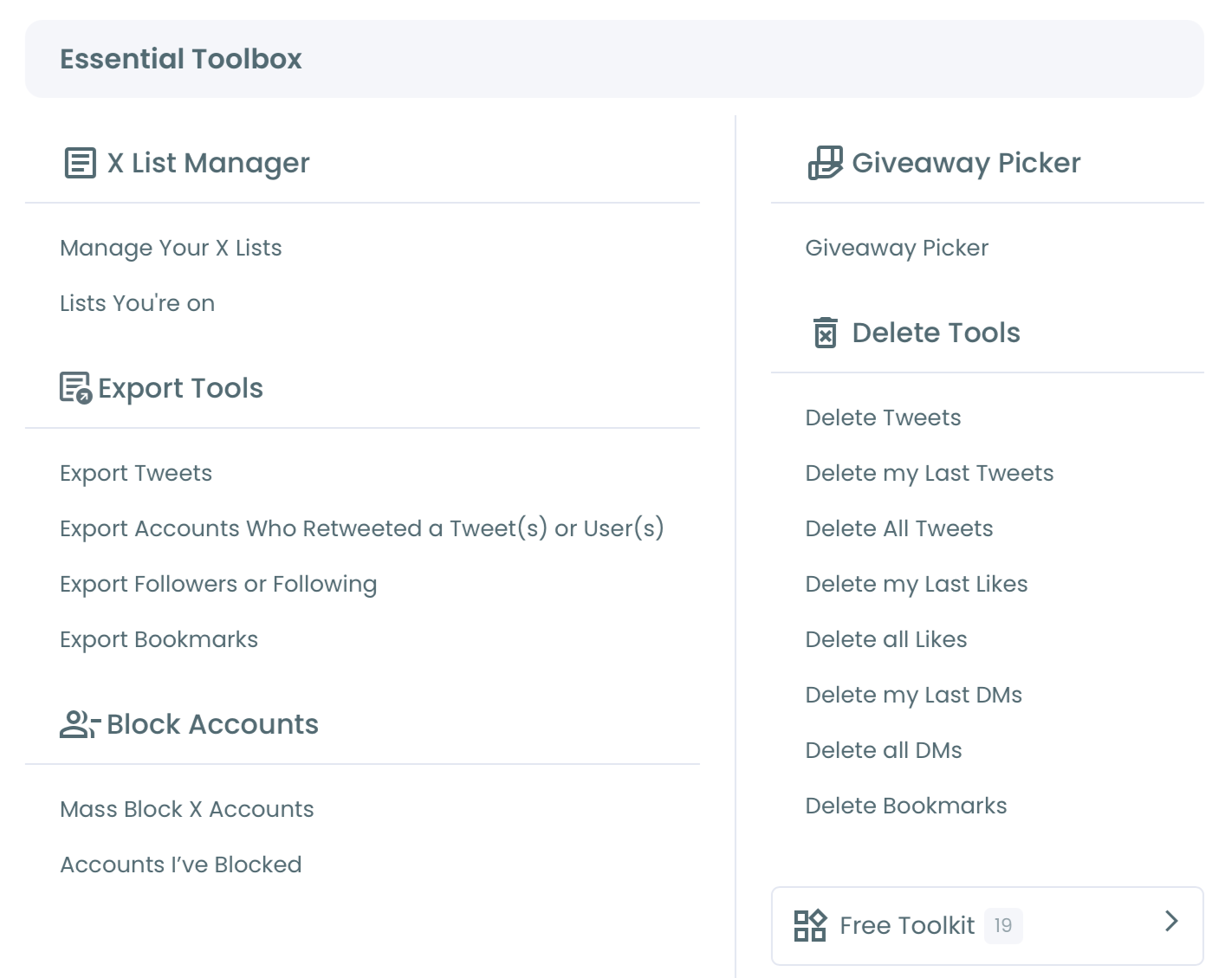
- Review the loaded recent liked posts. Circleboom can retrieve up to the latest 3,200 likes available through the API and present them in a filterable table.
- Filter by date, keyword, username, hashtag, language, media, or engagement ranges when you are trying to locate a known cluster.
- Use the external-post control to compare an item with X before removing anything. Choose individual items or a reviewed selection only when cleanup is your actual goal.
This workflow does not reconstruct an authoritative audit log of every like and unlike. It gives you a current, inspectable view of recent liked posts and a controlled way to remove selected ones. That distinction prevents a useful cleanup feature from being misrepresented as forensic proof.
At a glance: locate the post, prove access, compare clients, check service health, and only then review account activity.
What Circleboom can and cannot tell you
Circleboom can show recent likes that X makes available through the API, let you filter them, and remove the likes you approve. The Delete My Last Likes feature is built for intentional recent-history cleanup without an archive upload.
Circleboom cannot prove why a particular old heart disappeared if the post was deleted, access changed, or X no longer returns the item. It also should not be treated as evidence that Circleboom automatically unliked anything. An unlike action occurs only when the account owner authorizes the relevant removal workflow.
The Essential Toolbox provides the broader menu for related account-maintenance tasks. Use it after the diagnosis identifies a management need, not as evidence of what caused the symptom.
Circleboom is listed among X Enterprise customers, and its supported actions use official API access. That trust signal explains the connection method; it does not erase X's own visibility limits or turn API results into a complete historical audit log.
For a current-history cleanup, review and delete recent X likes after you have separated missing content from unwanted content. On a phone-led workflow, delete Twitter likes on iPhone covers the device-specific route.
When the problem is old history rather than missing likes
Sometimes the investigation reveals a simpler need: the likes are still present, but you no longer want them associated with the account. Recent and full-history cleanup require different inputs.
Delete My Last Likes works without an archive and covers up to the latest 3,200 likes returned through the API. A full-history operation for older items requires the appropriate data from your X archive. Keep those scopes separate so a recent concern does not become an unnecessary full wipe.
Before removing a large set, decide whether likes function as endorsements, bookmarks, research notes, or relationship signals for your account. The same click can play all four roles. A filter based on date or topic often protects more value than an indiscriminate reset.
You can also find the oldest tweet you liked when the question concerns the boundary of the history rather than a single missing item.
If the worry is an accidental tap, whether a quick unlike still sends a notification addresses a different consequence.
A measured response protects the evidence
A missing heart is a symptom, not a diagnosis. The post must exist, your account must be able to access it, and clean views must agree before you can reasonably call the event a genuine unlike.
Use this order:
- Preserve the post URL.
- Test availability and access.
- Compare mobile with x.com.
- Check official service status for widespread trouble.
- Review account sessions when other changes support concern, and use cleanup controls only when you intend to remove likes.
That sequence answers the immediate question without turning uncertainty into more account changes. When the diagnosis becomes a deliberate cleanup decision, manage recent Twitter likes with Circleboom and approve only the set you have reviewed.
Questions people ask after a like disappears
Does X automatically remove old likes after a set time?
X does not document a normal expiration period for likes. An old like may stop appearing when the post or account becomes unavailable, access changes, or the interface does not load the complete history.
Can Circleboom show who unliked a post for me?
No. Circleboom Twitter can list recent liked posts available through X and remove items you authorize, but it is not a person-by-person audit log of who changed a shared account.
Why does the heart change when I switch between the app and web?
Different clients can briefly show different cached or synchronized states. Stop tapping, refresh the web version once, and recheck after any known X service problem has cleared.
Can I recover a like after removing it?
Circleboom cannot automatically restore a removed like. If the original post remains accessible, you can choose to like it again directly on X.






%3A%20a%20step-by-step%20guide)
%3A%20a%20step-by-step%20guide)