

A flat response on a growing follower count is usually an arithmetic problem before it is a content problem. The number sitting under your username counts every account that ever pressed follow, including the ones that stopped opening X years ago.
What most people check first: the post, the hook, the hashtags, the hour. What the base usually shows: Circleboom sorts your X followers into active, inactive, fake and verified segments through official X API access, so you can see how many of them are still in any position to respond.
→ Check followers but no engagement on Twitter
The number you divide by decides whether you are looking at weak content or a padded denominator.
How to fix followers but no engagement on Twitter, step by step
Order matters here, because the first measurement disappears the moment you remove anybody.
Read the composition before you touch a single account
- Log in to Circleboom Twitter. Official OAuth handles the handshake, so your password never changes hands.

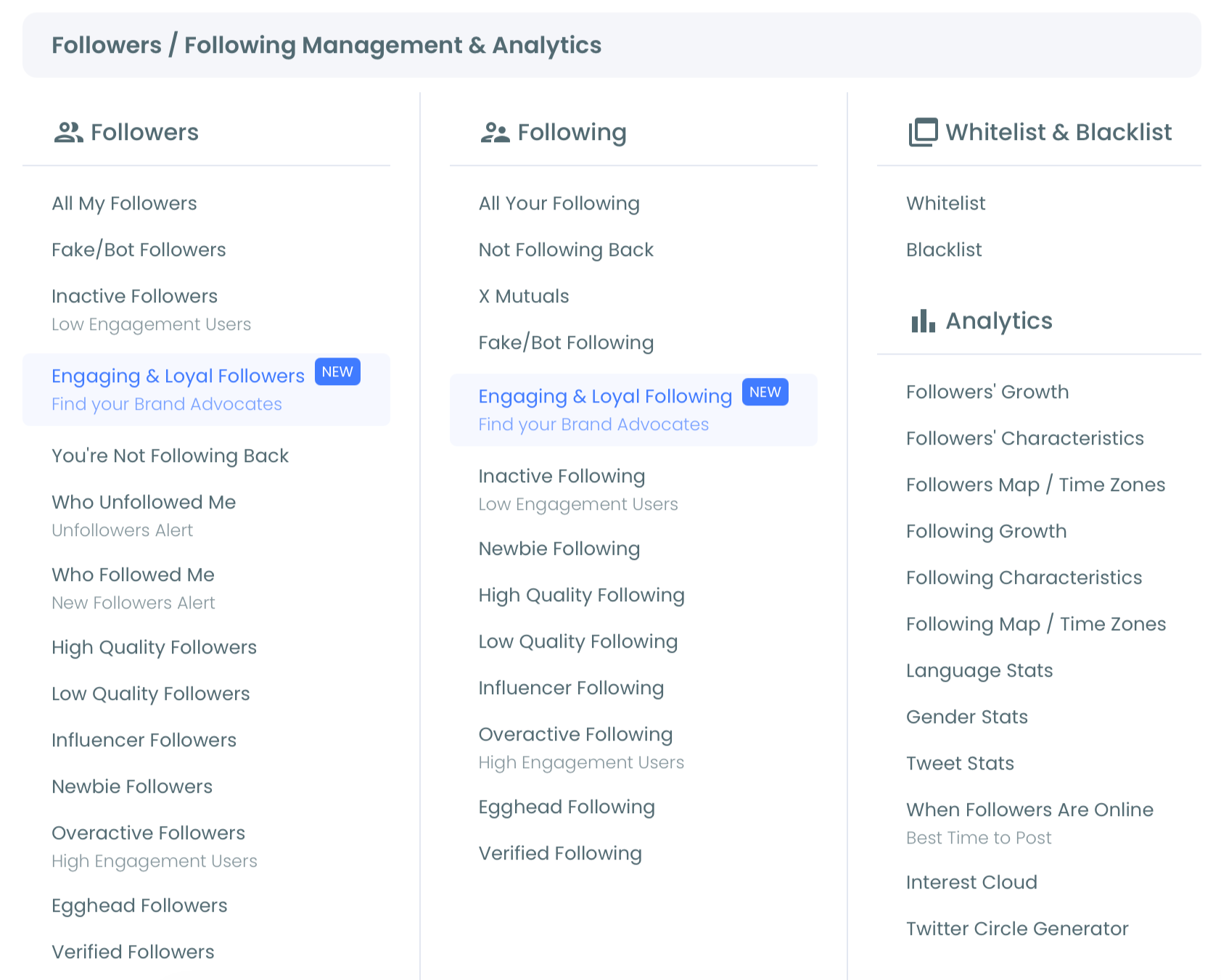
- Open Followers' Characteristics. You will find it filed under Follower / Following Management and Analytics.
- Read the four splits on the "Followers in a nutshell" dashboard. Circleboom sorts every X follower on four axes: Human or Fake/Spam, Active or Inactive, Ordinary or Overactive, Ordinary or Verified.
- Export the dashboard from the "..." button in the top right as a PNG, JPG or PDF. That file is your dated baseline, and it is the only copy of the composition you had before cleanup.
Turn the largest segment into a reviewable list
- Switch to Inactive Followers, filed in that same menu. It renders each account as a row: display name, total tweets, join date, the following and follower counts, follow ratio, and the Active & Inactive classification.
- Narrow the list in Filter Options. Set a low maximum on Tweet Count, pull Join Date back a few years, and add a Follow Ratio ceiling so the weakest accounts group together.
- Whitelist the quiet accounts that still matter to you. Customers, partners, journalists and investors often read without posting, and a whitelist label shields them from any bulk action you later run in Circleboom.
Act at a pace that keeps the account safe
- Export the reviewed segment as a CSV before you stage anything. Exports draw on a token balance, and whatever is left is displayed beside the button.
- Stage the rest with Remove Follower. Circleboom's Remove Twitter/X Followers extension handles the queue in Chrome. It pauses on its own when the X rate limit is reached, showing a message that the process will continue in N minutes and asking you to keep the browser open. Those pauses run between 1 and 20 minutes.
- Rerun Followers' Characteristics and set the new reading beside the export you saved in step 4.
That sequence protects the two things you cannot get back later. The baseline reading vanishes as soon as the first account leaves, and a quiet follower removed by mistake can only return by choosing to follow you again.
At a glance: read the composition, isolate the inactive segment, protect the exceptions, export, remove, then measure again.
What your engagement rate is actually dividing by
There are two engagement rates in this conversation and they do not share a denominator.
The one you compute in your head divides responses by your follower count. The one X reports in its own analytics divides responses by impressions. X says so in its Activity Dashboards help page, which defines engagement rate as the number of engagements divided by the number of impressions.
Your follower total never enters that calculation.
Most people never notice the split, because both numbers get called the same thing. A benchmark article quotes one, your dashboard shows the other, and the two get compared as though they described the same quantity.
They do not. A Twitter follower analysis is how you find out how far apart the two readings sit on your own account.
Run a scenario through both. An account has 15,000 followers and a post collects 200 likes, replies and reposts.
- Against the follower count: 200 ÷ 15,000 = 1.33%.
- Against a base with 30% of those followers classified inactive, so 10,500 accounts: 200 ÷ 10,500 = 1.90%.
- Against 4,000 impressions on that post: 200 ÷ 4,000 = 5%.
Three rates, one post, and only the first two move when you clean the base.
That is the part worth sitting with. Removing dormant accounts changes the arithmetic you do on your own audience. It does not touch the rate X shows you, because impressions were never a function of your follower count in the first place.
Knowing which number bothers you is the fork in the road.
Why the wrong denominator costs you outside your own dashboard
Benchmarks make this worse. Most published figures for what is a good engagement rate on Twitter do not say which denominator they used. If you have been measuring yourself against an impressions-based benchmark using a follower-based rate, you have been losing a comparison that was never fair.
The same mismatch shows up whenever the number leaves your screen. A sponsor evaluating your account divides by the follower count, because that is the only figure they can see from outside. So does a partner, a client, and anyone building a shortlist.
You cannot change the denominator they use. You can change what is in it. Every dormant account you remove is one fewer account inflating the figure a stranger will divide by, which makes a cleanup less a vanity exercise than a correction to the only number other people can check.
Why an inactive follower on X is not the same as a fake one
Inactivity is a measure of behavior, and fakeness is a measure of authenticity. They pull apart constantly.
A fake account was built to inflate somebody's numbers. An inactive follower can be a real person with a real job who opened X in 2019, followed you, and drifted away. Both sit in your follower count. Neither will respond to anything.
But they need different treatment, because one of them might come back.
Circleboom classifies inactivity from account age and total tweet frequency, and it uses two definitions at once. An account that posted recently but showed no activity for the past year counts as inactive. So does an account that posts sporadically even with something recent on the timeline.
A fake followers audit on Twitter runs on a different signal set entirely, weighing profile completeness, follow ratio and creation patterns.
Treat the Inactive list as a candidate list, not a verdict. X does not publish an inactivity flag for third parties to read.
Its own inactive account policy treats a login as the activity signal and expects a sign-in every 30 days. That page also warns that you may not be able to tell whether an account is currently inactive, because not all signs of account activity are publicly visible.
So the classification reads the signal that is visible, which is posting. A follower who reads every morning and has not tweeted since 2021 will land in the Inactive column, and X would not agree.
Is low engagement on X a content problem or an audience problem?
Compute both rates and let the gap answer it. If your raw follower-count rate looks poor but the reachable-base rate lands in a normal band, the problem is composition. If both readings are low, the base is not what is holding you back and the content deserves the attention.
That test only works once, in that order, which is why the export in step 4 matters. Once the inactive segment is gone you have a single rate and no way to reconstruct the comparison.
Circleboom is an official X Enterprise Developer company, so every follower record behind that comparison comes through sanctioned API access rather than scraped page reads. When the whole argument rests on a percentage, the completeness of the underlying list is the argument.
A composition read also tells you where to start. If Fake/Spam is 4% and Inactive is 38%, there is no point opening the bot tools first. Working out why you have followers but no engagement on Twitter begins with knowing which segment is actually large.
Watch it run: the engagement arithmetic before and after a dormant segment leaves the base.
https://www.youtube.com/watch?v=98vUhoyxDDg
What changes after the cleanup, and what does not
Three things genuinely change. Your own engagement arithmetic gets a denominator that reflects who could plausibly respond. A media kit or sponsorship deck stops quoting a number you would have to caveat in the meeting. And the follower total starts tracking something closer to reach.
Two things do not, and both are worth being blunt about. Nobody outside the company can tell you how X treats a weak rate internally, and I will not pretend otherwise. What the cleaned rate gives you is a better read of your own audience, not a lever on distribution.
The other honest limit is scope. Removing a follower does not stop them re-following, and it does not prevent the next wave of dormant accounts from accumulating.
This is maintenance, not a one-time fix. Run the composition read on a schedule so the drift stays visible while it is still small.
Which view you open next depends on which share is growing. When the weak accounts are spread across several quality signals at once, Twitter follower quality and following quality gives you the wider read.
When the inactive share alone is what keeps climbing, the dedicated view for unfollow inactive Twitter accounts is the faster route into that one segment.
Plenty of accounts also carry the reverse problem, where the base is healthy and the reading is still weak. That is where Twitter insights to increase followers and engagement earns its place, and where posting habits rather than audience composition deserve the work.
Your next move on the follower base
Leave this alone and the gap compounds quietly. Every year an aging account adds dormant followers, the raw rate slides a little further from the real one, and the gap between what you report and what your audience actually is gets wider.
Nothing announces it. The follower count keeps climbing, which is exactly what makes it easy to ignore.
Fix the denominator and the rest of your reporting becomes defensible. You can name the share of your audience that is active, show a dated before-and-after, and stop guessing whether the posts or the base are responsible.
One reading takes minutes. The composition it gives you settles an argument you have probably been having with yourself for months, and it costs you nothing but the login.
→ Start with your Twitter followers with no engagement
Questions readers ask next about the follower base
Can I get a follower back if I remove the wrong one?
No. A removal that the extension has already put through is permanent on our side. That account can follow you again whenever it likes, but nothing here restores the relationship, which is why the whitelist pass and the CSV export belong before the removal rather than after it.
Do I need the Chrome extension just to see these numbers?
No. Followers' Characteristics and the Inactive Followers list are both read-only views inside Circleboom and need nothing but your logged-in session. Circleboom's Remove Twitter/X Followers extension is only needed for the removal itself, since that operation runs through the extension in an open Chrome session rather than in the web interface.
How often should I rerun the composition read?
Whenever something moves the audience. A viral post, a large account mentioning you, a campaign, or a cleanup all change the mix. The dashboard shows the state of the base at the moment it was retrieved, not a live figure.
Run a quick 1-minute Twitter audit to find your real followers after each of those events. That keeps the picture current without turning it into a chore.





%3F)

