
The hardest part of running an X account is not writing the posts. It is deciding what this week's posts are about, and that one unsolved decision is what sends most people shopping for a Twitter ghostwriting agency.
Agency: a kickoff call, a monthly retainer in the four figures, and a junior writer holding your voice. Circleboom: a topic-filtered feed of the highest-performing tweets in your niche on X, rewritten in your own writing style through official API access, in about twenty minutes a week.
→ X ghostwriting without an agency
A retainer bundles four separate jobs. Three of them are already software.
What a Twitter ghostwriting agency actually does
A Twitter ghostwriting agency runs four distinct jobs under one invoice: topic selection, drafting in your voice, reaction volume, and publishing cadence. Almost every proposal in the category covers the same four, which is why comparing agencies on features tells you so little.
Topic selection is the discovery layer. Someone watches your subject area and decides which conversations are worth entering this week.
Drafting is the voice layer. A writer reads your archive, learns your sentence patterns, and produces posts that sound close enough to you that followers do not notice the handoff.
Reaction volume covers the replies and quote posts that keep an account visible between original pieces. Cadence is the last job and the least glamorous: making sure it all publishes on schedule instead of piling up in a shared doc.
Naming the four separately is the whole point, because they do not carry equal value and they do not carry equal difficulty. Anyone stuck on the first one is really asking what to tweet, not who should type it. That is a research question with a research answer.
Circleboom collects the top-performing tweets from your own topic areas on X into a single feed with their engagement numbers visible, which is the same evidence an agency would gather before its first content call. You can read Circleboom's trending-tweet Inspiration feed without signing anything.
Which of the four jobs software already covers
Three of the four are repeatable pattern work, which is precisely the category tooling has closed fastest. Discovery, voice matching, and reaction drafting now run inside a single workspace. The fourth job, your original opinion, transfers to neither software nor an agency.
Reaction volume is the clearest case. Watch how prolific accounts actually behave and originals turn out to be a minority of their output: in Pew Research Center's data on heavy U.S. users of the platform, originals came to roughly 14 percent of everything they posted, with reposts and replies filling nearly all the rest.
Buy volume from an agency and roughly four fifths of what arrives is commentary on other people's material.
Discovery is the second case, and it is measurable rather than intuitive. X states plainly that its For You ranking runs on a neural network continuously trained on interactions like likes, reposts, and replies. Posts that already carry those interactions in your topic area are the clearest available signal of what the ranking system is currently rewarding there.
Voice is the third. An agency learns your tone from your published archive. A voice-matching model reads the same archive. The agency version degrades when your account gets reassigned to a new writer; the model version does not have staff turnover. Teams weighing why to use an AI tweet generator usually land on consistency rather than speed as the real argument.
The one job that never transfers
That leaves the opinion, which an agency cannot supply either. Their process for obtaining it is a call where you talk and somebody takes notes. The byline changes; the origin does not.
The practical consequence is that the value of a retainer sits almost entirely in the fourth job, while the price is set by all four. Split the invoice against the split of the work and the ratio stops looking defensible for a solo founder or a two-person marketing team.
There is a scheduling version of the same argument. Once the drafting layer is fast, planning ahead becomes trivial, and you can generate future tweets in one sitting rather than paying somebody to keep a queue warm on your behalf.
Is hiring an X ghostwriter ever the right call?
Yes, in three situations. An agency is worth the money when you need an outside read on positioning, when you need someone whose job is to chase you for input, or when you need volume beyond what you would personally sustain.
Those are real services and they are not what most people think they are buying. Notice that none of the three is writing. They are strategy, accountability, and throughput.
The test is simple. If the gap between having an idea and having a published post is wider than about fifteen minutes, a person standing in that gap earns their fee. If it is narrower, you are paying a retainer to rent your own opinions back.
One cost never appears in a proposal. Handing the account over means somebody else does the daily reading, and audience understanding decays quietly on that schedule. A year of outsourced attention leaves you guessing at questions you could once answer instantly.
The founders who get the most out of X read it every day. Outsourcing the reading is a completely different decision from outsourcing the typing, and most retainers bundle both without ever separating them on the page.
A hybrid arrangement usually beats either extreme. Keep discovery and the opinion in-house, hand off production volume, and brief the agency against evidence you picked rather than a blank monthly allocation. Agencies do better work under that arrangement for an obvious reason: the guesswork about audience taste has already been removed.
Where the discovery layer and the voice layer already live in software
Inspiration lives inside the X Post Planner and scopes its trending results to the interest topics saved on your account, which is what separates it from a generic trending tab. Cards arrive with hard numbers attached: views, replies, reposts, likes, bookmarks.
See it live: how a topic-filtered trending feed replaces the weekly content call an agency would otherwise run for you.
https://www.youtube.com/watch?v=7bP7RDOAVDU
Three actions sit behind each card on hover. Rewrite builds a fresh post on the same subject in your style. AI Reply gets you into the thread. AI Quote frames the source material with your own take. The handoff between finding something and publishing something disappears.
Circleboom retrieves that content through official API access as a company listed on X's Enterprise customer directory. Nothing in the workflow depends on scraping or unofficial access to your account.
Voice is handled by five style options in the Rewrite modal. My Style reads your account's own tweet history back to you. The other four, Minimalist, Listicle, The Hook and Bridge, and Contrarian Split, hand you a structure for the times when the shape of a post matters more than its tone.
A live preview and an improvement field sit beside the result, which is the reason nothing ever has to ship on a first generation. That review step is where trending tweets in your own topic areas turn into posts that are genuinely yours.
Want a clean draft with no source tweet behind it? You can generate your next tweet from a prompt instead.
How to write your own Twitter posts without a ghostwriting agency
To replace a ghostwriting retainer, work backwards from evidence rather than forwards from a blank composer. Open a topic-filtered feed of high-engagement posts in your subject area, pick the cards worth reacting to, convert the strongest one into your own post in your own style, and schedule it. The sequence below runs that loop in three phases and takes about twenty minutes a session.
Connect your X account and open the planner
- Open Circleboom Twitter and authorize your X account.

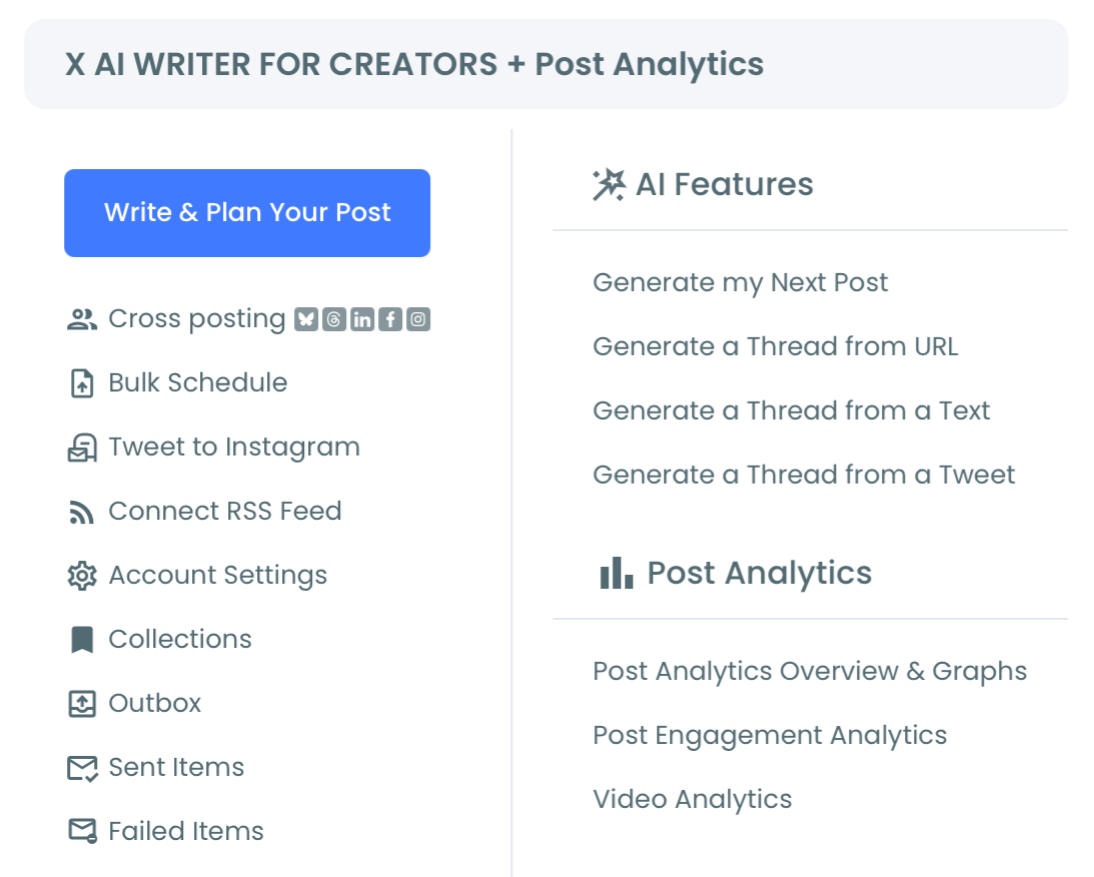
- Go to the X Post Planner menu. The composer, the AI writing surfaces, and the Inspiration carousel are all grouped there.
- Check that your content interest topics match what you actually post about. A feed full of off-topic cards is a settings problem, not a product problem, and it is the single most common reason the discovery layer underperforms.
Read the feed as data, not as a timeline
- Compare the engagement numbers across cards before picking one. Heavy replies signal an argument worth entering; heavy bookmarks signal a reference format worth copying; heavy views with thin replies usually means a topic people watch but do not discuss.
- Choose the action that matches your intent: Rewrite for an original post on the same topic, AI Reply to join the conversation, AI Quote to add your own commentary on top.
A useful ratio while you find your footing: one Rewrite for every three or four reactions. That roughly matches how the highest-volume accounts already publish, and it stops the account reading like a broadcast channel with nobody home.
Match your voice and schedule the result
- Select My Style, refine the draft in the improvement field, then set the schedule with cross-post toggles enabled for any other channels you keep active.
Sequence is doing the work here. Evidence first means you never spend craft on a subject your niche finished with last week. Review last means the draft leaves the workspace carrying a position instead of a pattern. Run those two out of order and the account starts sounding like every other one in its category, which is the outcome an agency was hired to prevent.
At a glance: connect, open the planner, tune your topics, read the numbers, pick an action, match your style, schedule.
What you gain when the retainer becomes a routine
You gain a queue that fills from evidence instead of from a blank page, which is the outcome the retainer was meant to buy. The difference is that the evidence stays in front of you rather than arriving as a monthly report.
You also gain reaction volume you would not otherwise sustain. Replies and quote posts stop being extra work once they take one click from a card you were already reading, and those are frequently the posts that pull new profile visits. Accounts running educational tweets that build authority on X see this most clearly, because teaching formats invite replies by design.
You gain a feedback loop, too. Checking Twitter content performance analysis against the topics you reacted to tells you which parts of the feed are worth your attention next week.
And you gain the budget back. A monthly retainer becomes a software line item, which is the least interesting benefit and usually the one that gets the decision approved.
The gain I did not expect was calibration. Reading engagement numbers twice a week trains a fairly accurate instinct for what your niche will respond to, and after a month that instinct starts arriving before you open the feed. An agency report cannot install that in you, because the reading is the training.
Cadence gets easier too. Circleboom's Inspiration carousel sits directly under the Post Editor with a View All button, so topping up a thin queue happens inside the same screen where you compose. Removing the tab-switch is a small change that decides whether a content routine survives its third week.
Which path fits your account
If your problem is that you do not know what to post, run the discovery loop yourself. That gap closes with a topic-filtered feed and twenty minutes twice a week, and no retainer will teach you your own audience faster than reading it will.
If your problem is that you know exactly what to post and never do it, buy accountability. That is a person problem, and software has never solved it for anyone. A ghostwriter who chases you for input is worth the fee.
If your problem is that you need fifty posts a week across five executives, buy throughput and keep the discovery layer in-house anyway, so the agency writes against evidence you selected rather than guesses you approved. Whichever fork you take, start by looking at what is already working in your niche.
Common questions about X ghostwriting
Can readers tell when posts are AI-assisted?
They notice tone drift, not tooling. Output that matches your existing tweet history and carries a specific opinion reads as yours, which is why the refinement pass matters more than the model does.
Will using a third-party tool put my X account at risk?
No, provided the tool uses approved access. Circleboom is an official X Enterprise developer, so trending content and tweet history are retrieved through sanctioned channels rather than scraping.
What is the biggest mistake people make when they drop the agency?
Scheduling the first generation. I have watched more accounts fail on that habit than on any other, because a raw draft in the wrong register does more damage to trust than posting nothing at all.
Does this work for an account with almost no posting history?
Partly. Discovery works immediately because it reads the platform, not you, but style matching has little to learn from a thin archive, so early drafts need heavier editing until the account builds a body of published work.