
You can replace most of what a Twitter ghostwriting agency does in about twenty minutes, twice a week. A retainer covers four separate jobs, and three of them now run inside one workspace. The fourth was always yours, and no writer could have supplied it.
Posting consistently on X does not require a Twitter ghostwriting agency. Circleboom pulls the best-performing tweets from your own topic areas, shows each one's views, replies, retweets, likes, and bookmarks, and turns any of them into a post written in your style using official API access. Choosing the subject and matching the voice, the two jobs a retainer is really covering, both move in-house.
→ Twitter content ghostwriting you run yourself
The four-job breakdown below shows exactly which parts of a retainer you are replacing.
What you are really buying from a Twitter ghostwriting agency
A ghostwriting retainer is four services sold as one. Read three proposals side by side and the same four appear in every single one, dressed in different language.
- Topic selection. Deciding which conversation in your niche is worth entering this week.
- Voice drafting. Converting that decision into text a follower would believe you wrote.
- Reaction volume. Producing the replies and quote posts that fill the days between originals.
- Cadence. Getting all of it onto the timeline instead of into a shared doc.
Those four do not cost the same to produce, but they are priced as a single line.
The bundling is where the money goes. A team that genuinely cannot write pays the same rate as a team that writes perfectly well and simply never decides what to write about, and the second team is far more common than the first.
Before signing anything, work out which layer is actually broken. Most accounts that feel like a writing problem are a discovery problem, and the difference matters because discovery is the cheapest of the four to fix. Anyone still deciding what type of content people like most on X is describing a research gap, not a talent gap.
Research gaps close with data, not with hiring. Circleboom gathers the best-performing tweets across your chosen X topics and shows each one's engagement figures, which is exactly the homework a new agency would bill you for in month one. Pull up the Inspiration feed and let those numbers tell you where the attention currently sits.
The three jobs you can take back
Discovery, voice drafting, and reaction volume all reduce to repeatable patterns, which is why software handles them well. That leaves a single job on the human side, and it never appears as its own line on an invoice.
Discovery is the easiest to hand over because the evidence is public. X open-sourced the recommendation algorithm behind its ranked timeline, and the short version is that engagement signals drive what gets shown. Posts already collecting replies and reposts in your topic area are the clearest read available on what the system is rewarding there this week.
Voice drafting is next. An agency learns your tone by reading your archive, which is exactly the input a voice-matching model uses. The agency's copy of your voice lives in one writer's head and leaves when your account gets reassigned; the model's copy does not resign.
Reaction volume is the third, and it is quietly the largest share of the work. Most of what an active account publishes is a response to somebody else rather than something written from nothing.
The "volume" an agency delivers is therefore mostly triage: find the thread worth entering, write two sentences, move on. Comparing the best AI tweet generator tools mainly tells you which ones handle that triage without flattening your tone.
The fourth job is your opinion, and no agency ever had it to sell. A kickoff call is the mechanism for getting it out of your head and onto their document. What the retainer buys is transcription with a distribution schedule attached.
The onboarding lag nobody prices in
Every retainer starts with a delay that the proposal treats as free. Somebody has to read your archive, interview you, draft a voice document, and produce a first batch you will almost certainly send back. A month or two of ramp is normal before the posts stop reading like a stranger describing your job.
Style matching skips that ramp entirely, because the input is the same archive and the read takes seconds. That is not an argument that the output is better on day one. It is an argument that the first bad draft costs you thirty seconds instead of a month, and iteration speed is what actually converges on a voice.
The same lag returns every time an agency reassigns your account, which happens more often than anyone mentions at signing.
How Circleboom covers the discovery and voice layers
Inspiration sits in the X Post Planner and narrows trending X content down to the interest topics saved on your account. Topic scoping is the whole difference between this and a generic trending tab. Each result arrives with its own performance numbers, which turns selection into a reading exercise rather than a guess.
Video walkthrough: the rewrite modal that turns a high-engagement tweet into a post written in your own style.
https://www.youtube.com/watch?v=-YYzw9S6JnQ
Each card carries three actions on hover. Rewrite produces a standalone post on the same theme, written to match how you already write. AI Reply drops you into the thread underneath. AI Quote wraps the original in your commentary. One workspace now covers both halves of a job that used to need two people.
All of that content comes through official API access, because Circleboom is a verified Enterprise partner of X rather than a scraper. That distinction decides whether your business account is exposed to policy risk every time a queue runs.
Five style options handle voice. My Style trains on your account's existing tweets, while Minimalist, Listicle, The Hook and Bridge, and Contrarian Split each impose a structure for the times when shape matters more than tone.
The live preview and the improvement field keep first generations off your timeline. Anything unfinished hands off from Circleboom's Inspiration to AI Writer for a longer working session.
For drafts with no source tweet behind them, the AI Tweet Generator covers the same ground from a plain prompt.
How to write your own X posts without a ghostwriting agency, step by step
Four actions, in order.
Run the evidence-first posting loop
- Log in to Circleboom and connect the X account you write from.
- Navigate to the X Post Planner menu and verify that your content interest topics describe what you genuinely write about. Off-topic cards are almost always a settings problem.
- Compare engagement numbers across the feed before choosing a card. Heavy replies mark an argument worth entering, heavy bookmarks mark a reference format worth copying, and heavy views with thin replies mark a topic people watch without discussing.
- Pick Rewrite, AI Reply, or AI Quote, select My Style, refine the draft, then schedule it with the cross-post toggles switched on for any other channel you maintain.
Order is what makes the loop hold up. Numbers before words keeps you off subjects your niche already finished with. Edit before schedule keeps a real position inside the post. Skip either guard and the account drifts toward the interchangeable output you were trying to avoid in the first place.
Quick recap:
- Connect the account you actually publish from.
- Tune your content interest topics until the feed stops wasting your time.
- Read engagement numbers before picking anything.
- Match your own style, refine, then schedule.
Keeping tweets worth posting on Twitter in a running queue means the loop never has to run under deadline pressure, which is when tone slips hardest.
What does a Twitter ghostwriting agency get right?
Three things a good agency delivers are genuinely worth paying for. It reads your positioning from outside your own head. It assigns somebody whose entire job is extracting input from a busy founder. It produces at a rate no individual keeps up alone. Writing does not appear on that list.
The outside read matters most for founders too close to their own message to hear how it lands. The chasing matters for anyone who has already proven to themselves that they will not publish without a deadline attached. Raw throughput matters when five executive accounts need feeding rather than one.
What none of that changes is the source of the ideas. I have never seen a retainer produce a point of view the client did not already hold, and the honest ones do not claim otherwise. They organize your thinking, they do not originate it.
The split arrangement usually wins. Hold discovery and opinion yourself, contract out the production volume, and hand over briefs built from evidence you already read. It raises the quality of their output too, since the taste question gets settled with data before anybody starts drafting.
Teams that want the drafting half covered without a retainer often begin by learning to generate my next tweet automatically and outsource only what is left.
One warning about the hybrid, though. It only works if you keep reading the feed yourself. The moment discovery moves out of your hands, you lose the calibration that made your briefs useful, and within a quarter you are approving content you can no longer judge.
That is the quiet risk in every full-service arrangement. You can outsource typing without much cost. Outsourcing attention costs you the thing that made the account worth reading, and it is far harder to buy back than it was to give away.
What to measure once you take it in-house
Track reply rate before you track follower count. Replies are the signal that you picked the right conversation to enter, and they move within days rather than months, which makes them the only fast feedback available on your topic selection.
Watch the split between originals and reactions, too. An account that publishes only originals reads like a broadcast channel; an account that publishes only reactions reads like it has nothing of its own. Somewhere around one original for every three or four reactions matches how active accounts naturally behave.
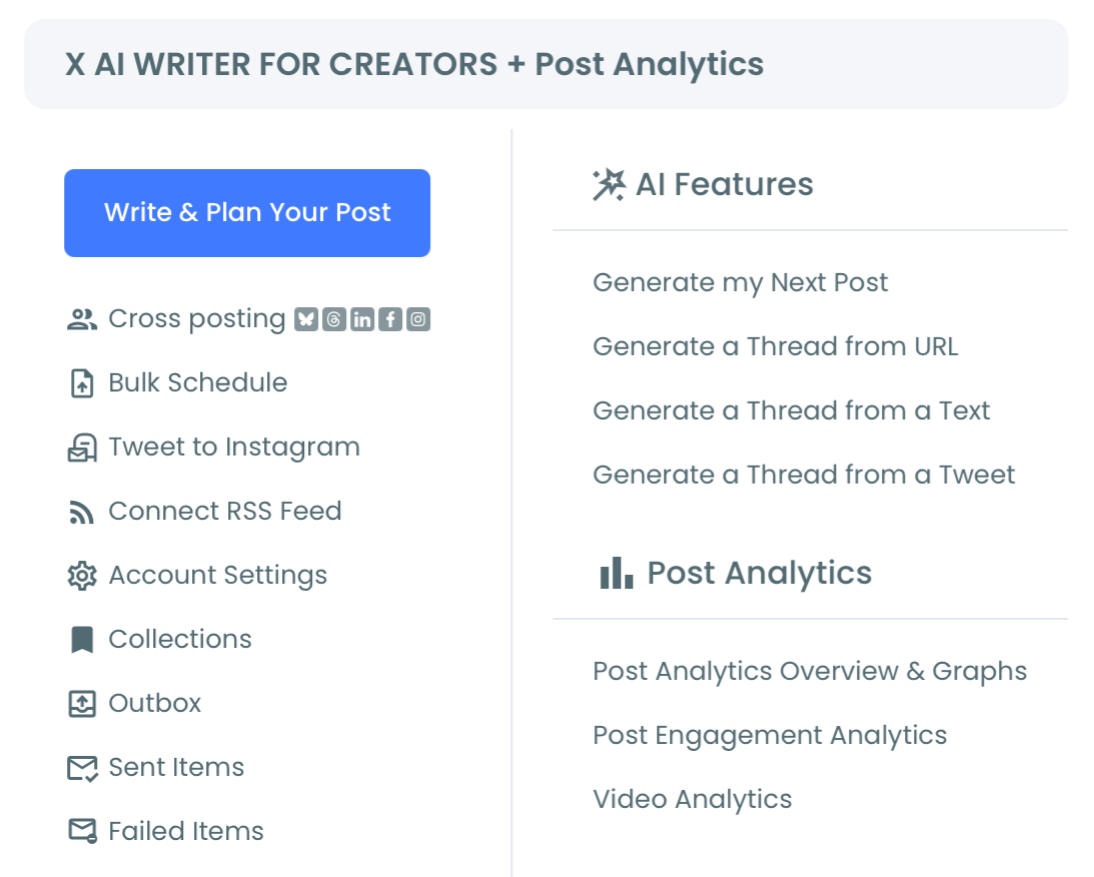
Then check whether the topics you reacted to actually earned attention. Engagement Analytics closes that loop by showing which posts pulled real interaction, which tells you what to weight more heavily in the feed next week.
The one number I would ignore for the first month is impressions. Impressions move for reasons that have nothing to do with your judgment, and chasing them early pushes accounts toward the kind of generic content a ghostwriter would have written anyway.
There is a qualitative check worth running alongside the numbers. Read back a week of your own posts and ask whether any sentence in them could only have come from you. If the answer is no, the workflow is producing competent output with nothing at stake in it, and that is the exact failure mode people blame on tooling when it is really a briefing problem.
The fix is small: add one line per post that carries a position, a number from your own work, or a disagreement. That single line is the part no agency and no model can produce for you, and it is also the part readers remember.
Wrapping up
A Twitter ghostwriting agency bundles topic selection, voice drafting, reaction volume, and cadence into one monthly fee, and three of those four now run inside a workspace you control. The discovery layer closes with a topic-filtered feed of high-performing tweets. The voice layer closes with style matching trained on your own archive. The reaction layer closes with one-click replies and quote posts on cards you were already reading.
What stays with you is the opinion, which is the thing you were paying for all along without ever seeing it itemized. Run the loop for two weeks before you sign anything. Two weeks is enough to tell you whether you had a writing shortage or only a decision shortage.
→ Turn a trending tweet into your own tweet
What to know before you cancel the retainer
Do AI-assisted posts perform worse than fully human-written ones?
Not on their own. Performance tracks topic choice and tone match far more than authorship method, which is why picking from an engagement-ranked feed matters more than who typed the sentence.
What if the Inspiration feed keeps showing me irrelevant tweets?
Update your content interest topics. The feed is scoped entirely to those settings, so off-target results mean the topic configuration no longer matches what you post about.
Can I run this workflow on a client's X account instead of my own?
Yes. Connect the client account, set its interest topics to that client's niche, and the style matching learns from their tweet history rather than yours.
Does anything publish automatically without my approval?
No. Every rewrite, reply, and quote lands in a review step, and nothing goes out until you queue, schedule, or post it yourself.
What happens to a rewritten tweet when I cross-post it elsewhere?
Each destination enforces its own character limit, so anything over that limit has to be shortened in the per-platform editor before the schedule confirms.