
A high English share on a rival's X account is usually read as proof that the market is English. It proves less than that: the figure counts the language detected on profiles, and the more useful signal often sits in the smaller buckets or on the other side of the Followers / Following toggle.
Which languages do a competitor's followers use on X?
Circleboom shows each compared account's followers on X in six fixed language buckets, calculated from profile data it retrieves through official Enterprise APIs. Up to 5 public accounts sit in one dated report, your own included.
→ Twitter follower languages
What a language bucket shows on X, and what it does not
A language bucket is a share of an audience whose profiles were detected in one language. Everything else people read into it is interpretation, and most reading errors come from asking the bucket a question it was never built to answer.
The table below separates the two sides.
| A language bucket shows | A language bucket does not show |
|---|---|
| The language detected on each account's profile | The language each follower prefers to read |
| A share of the whole audience, as a group figure | Anything about one named follower |
| At 0%, that no accounts were detected in that language in this sample | A gap or failure in the measurement |
| In the Followers view, the people who follow the account | In the Following view, an audience at all: those figures describe the accounts the brand follows |
| That a language is present in an audience | Demand or buying intent in that language's market |
Read the left column as fact and the right column as the list of claims to keep out of your report.
Each row matters at a different moment. The first two matter when you present the numbers, and the third when a bucket comes back empty.
The fourth matters the moment you flip the toggle, and the fifth when someone asks for a translation budget.
How each row gets misread in practice
The commonest misreading turns a group share into a personal fact. "Their followers speak German" is a sentence about people; "a share of their followers' profiles were detected as German" is the sentence the data supports.
The second misreading treats presence as appetite. A competitor's Twitter follower languages show that an audience exists in a language, and they stop there: the panel carries no information about whether that audience buys or wants localized posts.
The third is the quietest. A strategist exports the Following view, forgets which side of the toggle was on, and reports a brand's reading list as its audience.
Why a profile on X tells you nothing about a rival's audience language
A profile page on X exposes only follower count, following count, and the engagement visible on recent posts. None of the three says which languages the audience uses.
Teams fill that gap with impressions: the rival's bio is in English, most visible replies are in English, so the audience must be English. Each of those observations describes the account or its loudest commenters, not its followers.
The consequence is a localization decision made on a hunch. Either a second language gets funded because a rival "seems international," or it gets rejected because nobody could show a number.
A same-basis comparison removes the hunch. Circleboom lets you pull a competitor's follower languages on Twitter next to your own, on one date, so the two rows can be held against each other.
How Circleboom calculates Twitter follower languages for five accounts
Circleboom's X Competitor Analysis & Benchmark Report retrieves the followers and following lists of up to 5 public X accounts and calculates a language breakdown for each one. The breakdown appears in a panel named Language breakdown, inside the report's audience demographics block.
Each compared account gets one stacked bar and one table row, so every bucket can be read across the whole set in one look.
The six fixed buckets in the panel
The panel always uses the same six buckets:
- English
- Chinese
- German
- Spanish
- French, with every remaining language grouped as Other
Two properties make the buckets comparable. They are fixed, so they do not change between accounts or between reports, and every bucket is shown on every row even when its value is 0%.
That fixed list is different from the report's geography panel, where the named countries are built from the data and can change from one report to the next. With Twitter follower languages, a Spanish figure on one row always sits in the same column as the Spanish figure on the row beside it.
How a comparison run is started
The report is the first item in Circleboom's Monitoring menu. Its start screen has a panel headed Account Handles with a counter that reads "0 of 5 competitors added" before you begin.
You enter one handle per slot and add slots with the + button. The set holds your own account plus up to 4 competitors, or up to 5 other accounts if you leave your own out.
Clicking Start Competitor Analysis leads to one choice: a single report with today's data, or the same report refreshed every month. Each run is dated and saved, so a later run never overwrites an earlier one.
Two limits apply before you choose accounts. Analysis works on public accounts only, and a comparison will not accept an account with more than 3,000,000 followers.
Why the source of the records matters
Circleboom is listed on X's Enterprise customer directory, which means the follower records behind each row arrive through X's official API and not through scraping. For a localization lead, that is the difference between a figure that can go into a budget paper and one that cannot be sourced when questioned.
The report's landing page is where a read of X follower languages for your category starts.
How does the report detect a follower's language on Twitter?
The report calculates language from the profile data in the official X API records for each account. Circleboom does the calculation, because the X API returns no audience-language figure for an account.
That point is easy to verify in X's own documentation. The X API data dictionary lists a detected language on a post, and profile fields such as description and location on a user.
It lists no field that states the language of an account's audience.
So every tool that reports Twitter follower languages is calculating them, whatever its interface suggests. The question worth asking a vendor is which records the calculation starts from and how those records were obtained.
Why the result is a group figure
The breakdown describes the audience as a group. It does not label any individual account, and it should never be quoted as a fact about one follower.
This limit shapes how the figure is used. A bucket can justify writing for a language; it cannot justify assumptions about what a specific person in that bucket wants to read.
Profile-level detection is still the right basis for localization work, because it describes the account as a whole and not one passing post.
What a 0% bucket means
When a bucket reads 0%, no accounts in that language were detected for this sample. It is a measured zero.
The panel shows all six buckets on every row for that reason. A missing column would leave you unsure whether a language was absent or simply not checked, while a printed 0% settles it.
A zero on your rival's row and a non-zero figure on yours is a finding in itself: you hold a segment that the rival does not.
What the Following view says about the accounts a competitor follows on X
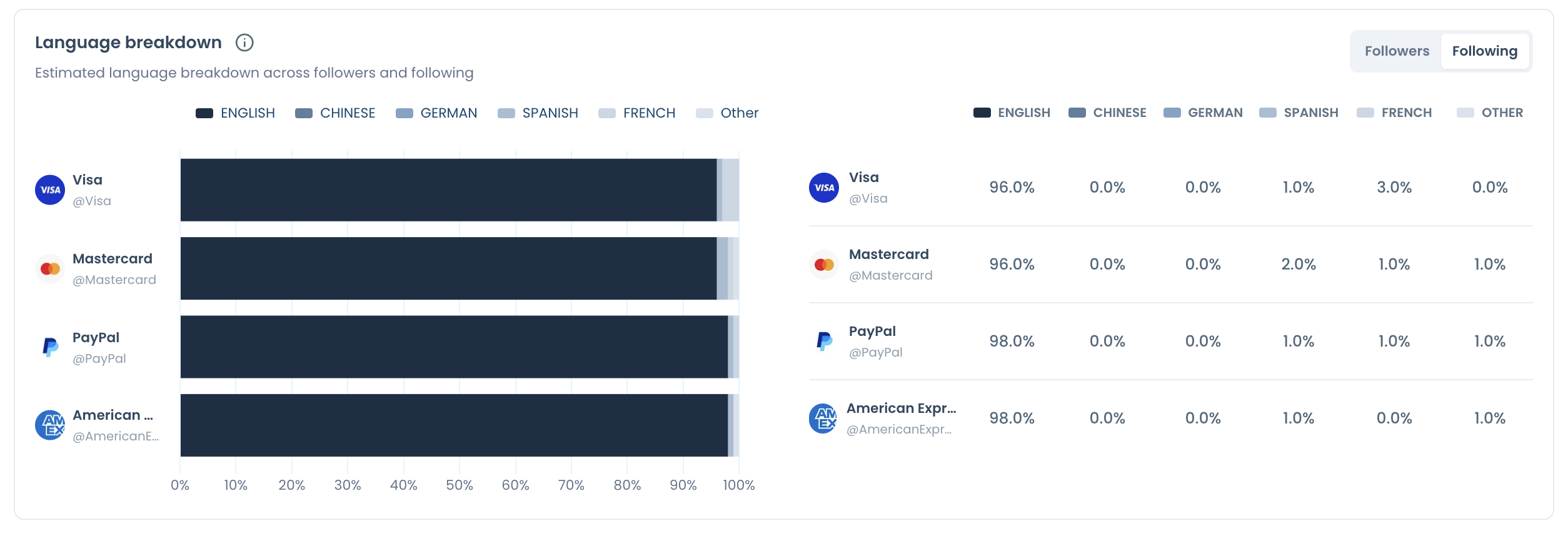
The Following view shows the languages of the accounts a competitor has chosen to follow, and it reads as a relationship map, not as an audience. The Followers / Following toggle sits on the language panel and on every other panel in the report's audience block.
Why a following list is not accumulated like a follower list
Followers accumulate over years without the account choosing them. A following list is the opposite: every entry is a decision somebody at the brand made.
That makes the two sides of one account differ sharply, and the difference is the point. The pattern shows in Circleboom's documented sample export, which compares four large public brand accounts from one sector.
On the follower side of that sample, English ran from 75% to 81% across the four accounts. On the following side of the same accounts, English ran from 96% to 98%.
Verification moved even further in that sample. Verified accounts made up 2% to 3% of the followers, and 25% to 47% of the accounts those brands follow.
Treat those figures as a demonstration of the pattern only. They are not current facts about any brand.
What the language of a following list tells a strategist
A following list that is almost entirely in one language shows where a brand's chosen relationships sit: the press it reads and the properties it sponsors. The broader method for both sides of an account is covered in how to analyze somebody's followers and following on Twitter.
The signal to look for is a mismatch. A competitor whose followers include a sizeable second-language bucket, while the accounts it follows stay in one language, may have an audience in a market where its chosen relationships are thin.
The reverse mismatch is the stronger one. A rival that follows a visible share of accounts in a language its followers barely use deserves a closer look, because nobody follows accounts in a second language by accident.
For the full list behind the percentages, Circleboom has a page for the competitor report's following export.
The trap in the Following view
The trap is reporting following-side percentages as audience data. Those figures describe the accounts the brand follows, never the people who follow the brand.
The toggle also has a boundary. It changes the audience panels only, and every post-based section of the report stays identical in both views.
If the relationship side is your main question, a related read is who follows who on Twitter.
Reading a rival's Twitter follower languages against your own row
A rival's language split only becomes a decision once it sits beside your own row in the same report. With Twitter follower languages for the whole set on one screen, three checks carry most of the reading.
- Share against size. A smaller share of a much larger audience can be more accounts than a bigger share of a small one.
- The Other bucket. Any language outside the five named ones lands there, so a large Other figure is a prompt to look closer.
- Flat buckets. When every account in the set shows nearly the same split, language is not what separates them.
The third check is the one I return to most. In the sample export above, the English share sat within six points for all four accounts, which says that language was not a point of difference in that set.
A flat result ends an argument as cleanly as a wide one. It tells you to stop looking at language and move to the panels that do separate the accounts.
Comparing two dated runs of the same set
Follower languages on Twitter shift slowly, so the second run of a set is where a trend first becomes visible. Each run is a snapshot as of its pull date, and a re-pull adds a new dated result instead of editing the old one.
Compare like with like. The reading holds only when both runs cover the same handles, because a replaced account turns the comparison into a different group.
For a localization team, the useful movement is in your own row. If a second-language bucket grows on your side while the rivals' rows stay level, your content is the likeliest cause, and the next run will confirm or contradict it.
A single-account baseline before the next run: how many of your X followers use a language other than English.
Language also has two neighbours in the same block of the report. The country and time-zone panels answer where and when, and a language bucket should be read with both before a posting schedule is built on it.
The same row screens a creator's audience
The language row works on any public account, including a creator you are about to pay. Place the candidate's handle in a slot, and the panel shows whether that audience sits in your language before a contract is signed.
If you are still building the shortlist, Circleboom's Find Twitter Influencers search is the place to start.
The selection side of that work is its own topic: how to find Twitter influencers for your brand.
One caution applies to every use of the panel. Reading Twitter follower languages tells you who is present, and presence in a market is not the same as demand in it.
Checklist for a first language comparison on Twitter
A first comparison takes five decisions, and most of them trace back to the table at the top of this page.
- Put your own account in the set, so both rows share one date and one method.
- Read the Followers view first and write down the widest gap in a named language.
- Check every 0% as a measured zero before calling a market empty.
- Flip to the Following view and label those figures as followed accounts in your notes.
- Present each bucket as a group share detected on profiles, with the run date beside it.
Run those five in order and the report turns Twitter follower languages into a claim you can defend: which language segments exist around your category on X, who holds them, and how your own row compares.
→ Check the follower languages of your rivals on X
Frequently asked about language buckets and other routes
Doesn't X's own analytics show a competitor's audience languages?
No, X's analytics cover only the account owner's own posts. Its Post and Video Activity Dashboards track impressions and engagements for each post you send, with nothing about another account's followers. Circleboom fills that gap on X by calculating the split for any public account you add to a comparison.
How do I see what languages my own followers speak?
Use Circleboom's Twitter language stats, the own-account view of the same question, with no competitor in the frame. In my experience the own-account read comes first and the comparison second, and the wider method sits in the best way to analyze your Twitter followers.