
The question came up at the end of a planning call with a content director who was three weeks into a strategy review. "Our engagement rate has been flat for two quarters, but our follower count is up 18%. Something's off and I can't tell what."
The operator who had run a language audit on his own account six months earlier asked the diagnostic question: "Do you know what languages your followers actually speak?" The content director paused, then admitted he had been assuming the audience was 85%+ English-speaking because the content was English-only.
The Language Stats audit that ran that afternoon surfaced the gap. The audience had grown into Latin America and Brazil over the prior eighteen months; the language distribution was now 54% English, 22% Spanish, 14% Portuguese, and 10% long-tail. The English-only content strategy was speaking to roughly half the audience the operator was paying production cost to grow. The flat engagement rate had a structural cause, and the audit produced the diagnosis in under ten minutes.
Language Stats produces five strategic outputs in a single audit.The dominant-language share, which confirms or refutes the operator's assumption about the audience composition.The second-language share, which signals whether bilingual content would pay for itself.The long-tail aggregate, which signals the global-audience dimension for sponsorship and positioning.The change-over-time trend, which shows whether the audience is becoming more or less linguistically diverse.The per-language engagement breakdown, which shows which language segments respond disproportionately.
The workflow runs through Language Stats and the official X Enterprise APIs, pulling the language distribution from sanctioned audience metadata. → Read your follower language distribution
Why Audience Linguistic Drift Is the Most Common Hidden Cause of Flat Engagement
Linguistic drift is the silent variable in engagement-rate plateaus for many growing accounts. The drift happens because the platform's recommendation system distributes content broadly during early growth, and the audience that responds is often more linguistically diverse than the operator anticipates. The operator's content language stays constant; the audience composition shifts; the gap between content and audience widens; the engagement rate flattens.
The pattern is hardest to diagnose because it does not show up in any of the standard engagement metrics. The follower count grows; the impression count grows; the engagement rate flattens because the new followers do not engage at the same rate as the existing audience due to the language mismatch. Without the language audit, the operator typically diagnoses the flat engagement as a content-quality problem and invests in content improvements that do not address the structural cause.
The Circleboom piece on the best way to view the location of Twitter followers covers the geographic dimension that pairs with the language audit; geography and language are usually correlated, and the two audits together produce the full picture of the audience drift.
What the Language-Engagement Decomposition Surfaces
The decomposition breaks the engagement rate into per-language buckets, and the breakdown surfaces three patterns that the aggregate cannot.
The first pattern is the disproportionate-engagement language. A language segment that engages at 2x the account average signals an audience hungry for content in that language; the operator can produce a small amount of content in that language and capture the lift. Spanish, Portuguese, and Indonesian are the most common cases for English-language accounts whose audience has grown internationally.
The second pattern is the underperforming-language segment. A language segment that engages at 0.3 to 0.5x the account average signals that the operator's content is not reaching that segment effectively. The fix may be content in that language, content at a different publish window that matches the segment's online hours, or different content formats that travel better across language boundaries.
The third pattern is the engagement-neutral language. A segment that engages near the account average signals that the language is not a meaningful factor for that audience; the operator can continue with English content for that segment without strategic concern. The Circleboom piece on how to map your Twitter followers covers the geographic-mapping side of the decomposition and is the right reference for operators who want to overlay language and location together.
How to Find Out Your Twitter Follower Languages Step by Step
The workflow runs in two phases: the distribution audit, then the engagement-side decomposition. Both phases take 5 to 15 minutes for most accounts.
Phase 1: Run the Distribution Audit
Log in to Circleboom Twitter
- Log in to Circleboom Twitter with the X account being audited. OAuth keeps credentials with X directly and pulls follower data through the sanctioned API.

Open Language Stats under the Follower-Following menu
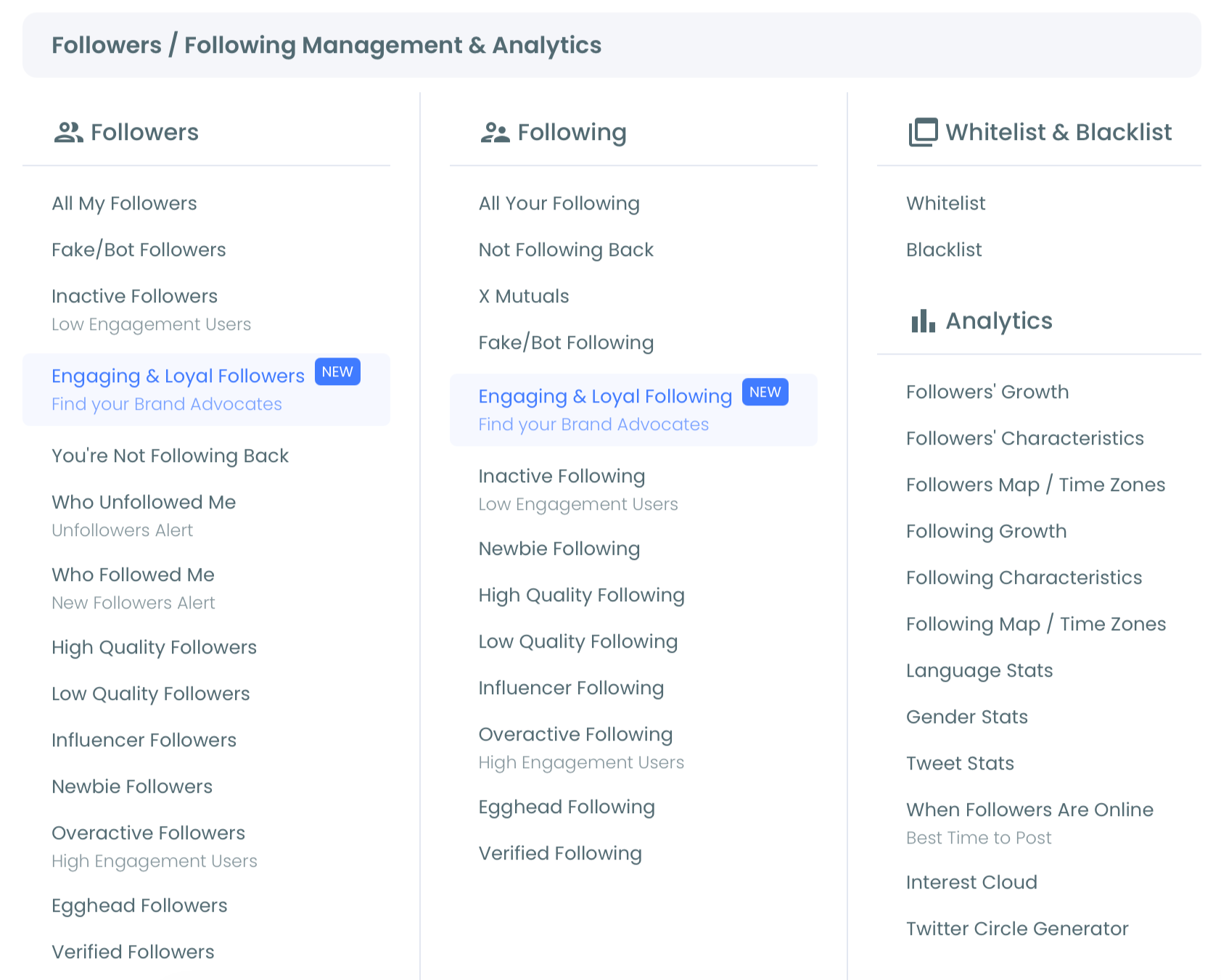
- Open Language Stats in the Follower-Following menu under the Analytics grouping. The dashboard loads the language distribution from the account's follower base.
Read the distribution against the operator's content language
- Read the distribution against the operator's content-language assumption. A gap larger than 15 percentage points between assumed and actual signals meaningful audience drift.
Phase 2: Decompose the Engagement-Language Interaction
Cross-reference the distribution with engagement metrics
- Cross-reference the language distribution with the operator's engagement metrics if the analytics layer supports per-language attribution. The cross-reference surfaces the disproportionate-engagement, underperforming, and engagement-neutral segments.
Identify the content-language strategy for each segment
- Identify the strategy for each segment. Disproportionate-engagement languages warrant occasional or regular content; underperforming languages need diagnosis (content, timing, format); engagement-neutral languages can continue with the existing approach.
Export the audit for downstream content planning
- Export the audit for use in content planning, sponsor decks, or strategy documents. The export produces a structured table that supports both internal review and external pitches.
The six-step sequence is the full workflow. The decomposition is the strategic step; the audit itself runs in minutes.
Video walkthrough: how to find out what languages your Twitter/X followers speak.
What the Audit Produces for the Flat-Engagement Operator
The output is a diagnostic that distinguishes content-quality problems from audience-content fit problems. The two have different fixes, and the language audit is often the cheapest way to distinguish between them. An operator with a flat engagement rate and a meaningful audience-content language gap has a structural fix available; an operator with a flat engagement rate and good language match has a content-quality or publish-window issue to address.
The compounding payoff is operational visibility. The operator who runs the audit quarterly catches linguistic drift before it accumulates into a multi-quarter engagement plateau. The Circleboom piece on 15 Twitter analytics tools to skyrocket your follower stats covers the broader analytics toolkit that complements the language audit; the language audit is one of the highest-signal entries in that toolkit because it cannot be derived from any other metric.
Two adjacent surfaces extend the language audit. The Twitter User Analytics landing covers the parent analytics suite that includes language stats alongside follower growth, demographics, and engagement views. The Track Someone's X Followers and Followings landing covers the competitive audit for operators who want to compare their language distribution against a peer account.
Related Circleboom reading on the audience theme.
- Is it possible to see Twitter followers by country on the country-side audit that pairs with language for the full geographic-linguistic picture.
Action Summary
The audit produces the language distribution, the engagement-language decomposition, and the segment-by-segment content strategy. The flat-engagement problem becomes diagnosable in under fifteen minutes; the corrective action becomes scopable in the same session.
Read your follower language distribution and the engagement-rate plateau that the content director called "something's off and I can't tell what" becomes the measured fact that the audience has outgrown the content language, with a clear path to the corrective.
Still Wondering?
How granular is the language attribution, and does it distinguish between dialects?
The attribution is at the language level, not the dialect level. A Spanish-speaking follower from Mexico, Argentina, and Spain all attribute to "Spanish" in the distribution; the dialect distinction is not exposed through the platform's audience metadata. For most strategic decisions, the language-level granularity is sufficient; for hyper-targeted regional campaigns, the operator usually pairs the language audit with a location audit to identify country-level segments within each language.
What if my account is intentionally multi-lingual already?
Multi-lingual accounts benefit from the audit as much as English-only accounts, because the distribution surfaces whether the multi-lingual mix matches the audience. An account that publishes 50/50 English and Spanish but has a 30/55 English/Spanish audience is misaligned; the audit surfaces the gap and supports re-balancing the content mix.
Will the language audit help with my non-X content (LinkedIn, Instagram)?
The audit is X-specific because the language attribution depends on the platform's audience metadata. Cross-platform language analysis requires running audits on each platform; the Circleboom product surface includes language analytics for some other platforms, with the workflow varying by platform's API support.
How does the audit handle followers whose language preference is "undetermined"?
The platform's metadata assigns "undetermined" or similar attribution to a small percentage of followers whose language signals are unclear. These accounts typically appear as a separate row in the distribution at 1 to 5% of the audience; most operators treat them as a residual unknown rather than a strategic segment.
Can I export the language distribution per follower, or only the aggregate?
The dashboard supports both the aggregate distribution and the per-follower attribution export. The per-follower export is useful for outreach lists that want to target specific language segments; the aggregate export is the right input for strategic content-planning documents.