
Following overactive Twitter accounts is bad for your feed when their volume outweighs their value, because a few high-frequency accounts can crowd out everyone else you follow.
Short answer: following overactive Twitter accounts hurts your feed only when the posting volume is not matched by value. A live-tweeting journalist earns 50 posts a day; a reposting bot does not. Circleboom ranks every account you follow by posting frequency through official X access, so you can tell which is which.
→ check your overactive follows
Below: how overactive follows reshape what you see, and when to keep, list, or cut them.
The honest answer is "it depends," and the thing it depends on is measurable. X never shows you which follows post the most, so a feed can degrade for months before you work out the cause. Circleboom's overactive follows view makes that cause visible in seconds.
How overactive accounts reshape your feed
A timeline has finite attention. Every post from a high-frequency account is a post you see instead of something from a quieter follow. When five accounts each post 80 times a day, they generate 400 posts competing for the same scroll, and the people you follow most deliberately get buried.
This is the mechanical cost of following overactive Twitter accounts: not that any single account is bad, but that their combined volume drowns the signal. The quieter analyst, the friend who posts once a week, the niche account you joined for, all of them lose to sheer frequency.
Circleboom measures frequency as total tweets divided by account age in days, then ranks your follows so the loudest sit at the top. That ranking is the difference between feeling your feed is noisy and knowing exactly which accounts cause it.
There is a compounding effect worth naming. The more an account posts, the more chances X's ranking has to place it in front of you, which means a high-frequency follow does not just take a fixed slice of your feed, it takes a growing one. Two or three accounts on that trajectory can quietly become the majority of everything you scroll, even though you only ever followed them once.
When overactive following is fine, and when it is not
Volume is not automatically a problem. Plenty of high-frequency accounts are worth every post.
- Fine: news desks during breaking events, market-data accounts in trading hours, prolific creators whose work you actively want.
- Not fine: reposting bots, engagement-bait accounts, automation that floods your feed with low-value repetition.
- Depends: a friend or brand that posts heavily but only sometimes relevant, where a List is often the right home.
The test is the volume-to-value ratio, not the raw number of posts. An account posting 60 times a day with content you read is an asset; the same volume of filler is a liability. X's own For you timeline already deprioritizes some repetitive content, but it will not tell you which of your deliberate follows are the culprits.
How to audit the overactive accounts you are following
To judge whether your loud follows are hurting your feed, rank them by frequency, then weigh each against its engagement. The phases below run that check end to end.
See it live: seven reasons your engagement quietly drops, and how a noisy feed full of overactive follows is one of them.
Open your follows ranked by volume
- Log in to Circleboom Twitter and connect your X account with official OAuth.

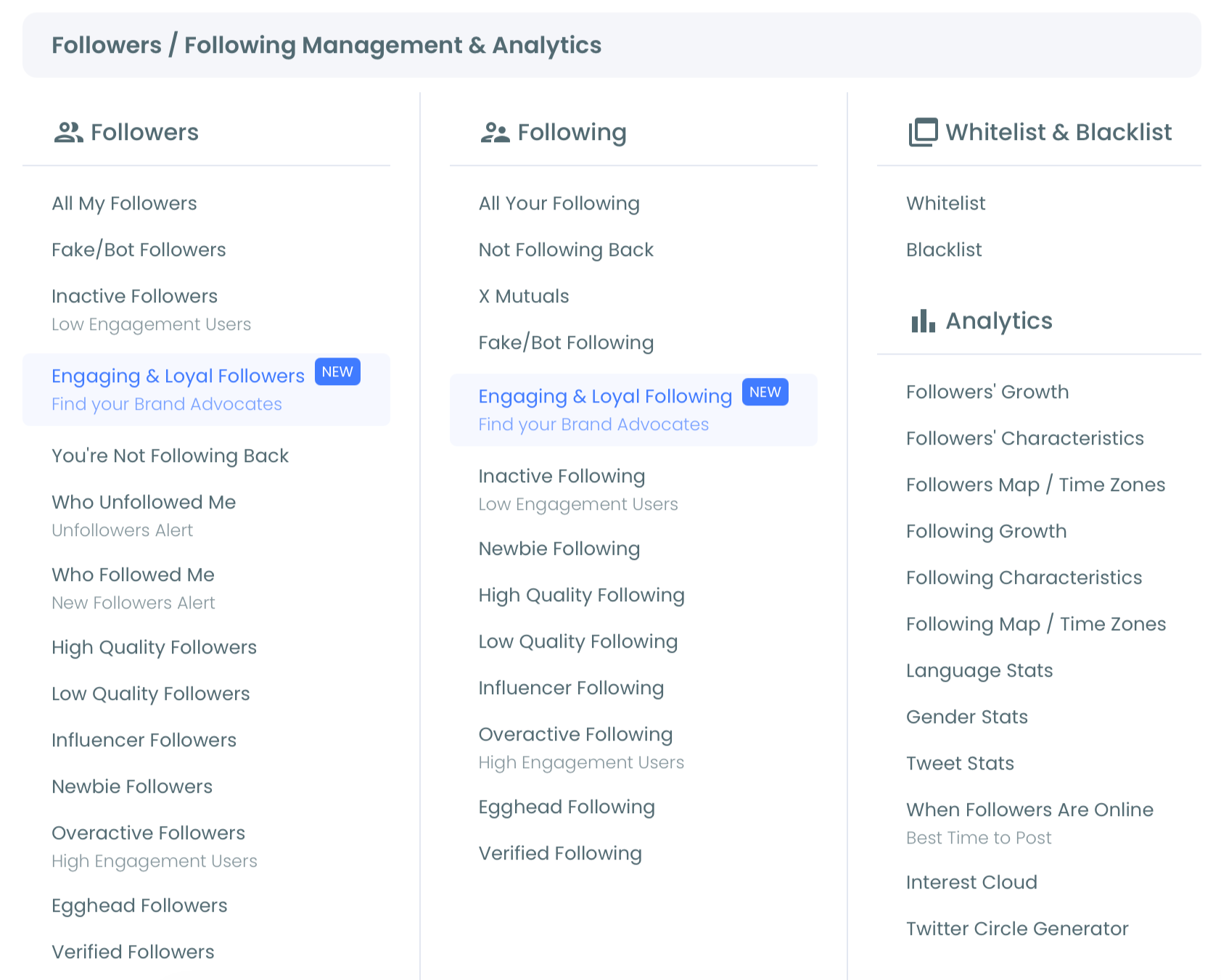
- Open the Follower & Following menu and choose Overactive Following.
Weigh volume against value, then decide
- Sort by Tweet Count descending to see your most prolific follows first.
- Check engagement and the Fake or Spam flag on the top accounts to separate credible sources from automation.
- Keep, list, or unfollow each account based on whether its volume buys you anything.
That order works because it puts evidence before judgment. The login earns official access, the ranking shows volume, and the engagement check stops you from cutting a heavy poster who is genuinely worth it. Decide on data, not on the vague sense that the feed feels off.
What the numbers tell you about each account
Frequency alone cannot answer the "bad or not" question, so Circleboom shows it next to context. Each overactive follow carries an engagement classification, a follow ratio, and a Fake or Spam flag.
A credible high-volume account shows real engagement on its posts. An automated one usually pairs huge volume with almost no engagement and a follow ratio that makes no sense. When those weak signals cluster, you are following something closer to a bot than a person, and that is when the volume is genuinely hurting you.
Circleboom is an official X Enterprise developer, listed on X's own customer directory, so the frequency and engagement numbers come from complete, sanctioned data rather than a partial scrape.
Fix it without unfollowing everyone
If the audit shows your feed is suffering, you have gentler options than a mass unfollow.
- Whitelist the loud accounts you value, protecting them from future cleanups.
- Move to a List the heavy-but-useful accounts so their content waits for you.
- Unfollow only the accounts that are pure repetition or automation.
This is also the moment to look at the other end of the scale. The same dashboard lets you weigh whether more followers or more engaged ones serve you better, figure out why your followers stopped retweeting or liking, and check whether organic reach has dropped for accounts your size. A noisy feed is often one symptom of a wider engagement question.
For keepers, group them with the Twitter List Manager so high-volume sources stay readable, and use Twitter follower and following quality scoring to confirm your loudest follows are not also your lowest quality. You can even view who you are following in full to catch accounts you forgot you added.
Common Questions About Overactive Follows
Does following overactive accounts hurt my own reach?
Not directly. Following changes what you see, not who sees you. The indirect cost is that a flooded feed makes it harder to spot and reply to the accounts that drive your engagement, which can slow your growth over time.
Should I unfollow every high-frequency account?
No. Many high-frequency accounts are credible and worth following. Judge each on the volume-to-value ratio, keep the ones that earn their posts, and move or cut only the noise.
Is muting better than unfollowing for loud accounts?
For valuable-but-loud accounts, yes, because muting and Lists are both reversible while unfollowing is not. Use the ranked overactive view to decide which accounts deserve that softer treatment.
How many overactive accounts is too many?
There is no fixed number. If a handful of accounts generate most of what you see, that is too many regardless of count. The ranking shows you their share at a glance.
What if I want to keep a loud account but see less of it?
That is exactly what a List is for. Move the account into a dedicated List and it leaves your main feed without leaving your network, so you read it on your own schedule. It is the middle path between tolerating the volume and unfollowing a source you value.
The Bottom Line
Following overactive Twitter accounts is bad for your feed only when volume outpaces value, and that is a question you can answer with data instead of frustration. Rank your follows by frequency, weigh each against its engagement, and route the noise to a List or out of your follows entirely.
Keep the accounts that earn their volume, and your feed gets quieter and better at the same time.