
A few accounts can swallow your whole timeline. They post 60, 80, sometimes 100 times a day, and everyone else you follow disappears behind the flood.
To find the overactive accounts I follow on Twitter, connect your account to Circleboom and open the Overactive Following view, which ranks every account you follow by posting frequency (total tweets divided by account age). Circleboom retrieves your full following list through official X APIs, so the data is complete and your account stays safe.
→ overactive accounts I follow on Twitter
Below: how the frequency math works, and how to tell a useful power-user from automated noise.
X gives you no built-in way to sort your follows by how loud they are. You can feel the timeline is noisy without knowing which accounts cause it. That gap is exactly what Circleboom's overactive follows tool closes.
What "overactive" actually means
Overactive is a frequency signal, not a quality verdict. Circleboom computes posting frequency for each account you follow as total tweet count divided by account age in days. An account that has posted 200,000 times since 2009 sits in a different band than one posting twice a week.
The accounts that cross the overactive threshold are the ones most likely to dominate your feed. A follow that posts 50 times a day occupies far more timeline real estate than one posting once. That is fine when the content is worth it, a live-tweeting journalist during a breaking story, a creator whose dense schedule matches your interests. It is a problem when the volume is reposted filler, engagement bait, or scripted activity.
Circleboom surfaces the high-volume edge of your following list and shows it as a sortable table on X using official API access, so you decide per account whether the volume earns its place.
This matters because the noise compounds quietly. When five accounts each post 80 times a day, they generate 400 posts competing for the same scroll, and the quieter account you actually wanted to read gets buried three screens down. You never unfollowed that quieter voice; the volume simply hid it.
How to find overactive accounts you follow on Twitter, step by step
To find your loudest follows, log in, open the follower and following menu, isolate the overactive segment, and sort by tweet count. The four phases below run that loop start to finish.
Short demo: the one-click cleanup that clears fake and low-quality accounts out of your following list before you sort by volume.
Connect your account and open the dashboard
- Log in to Circleboom Twitter and connect your X account with official OAuth.

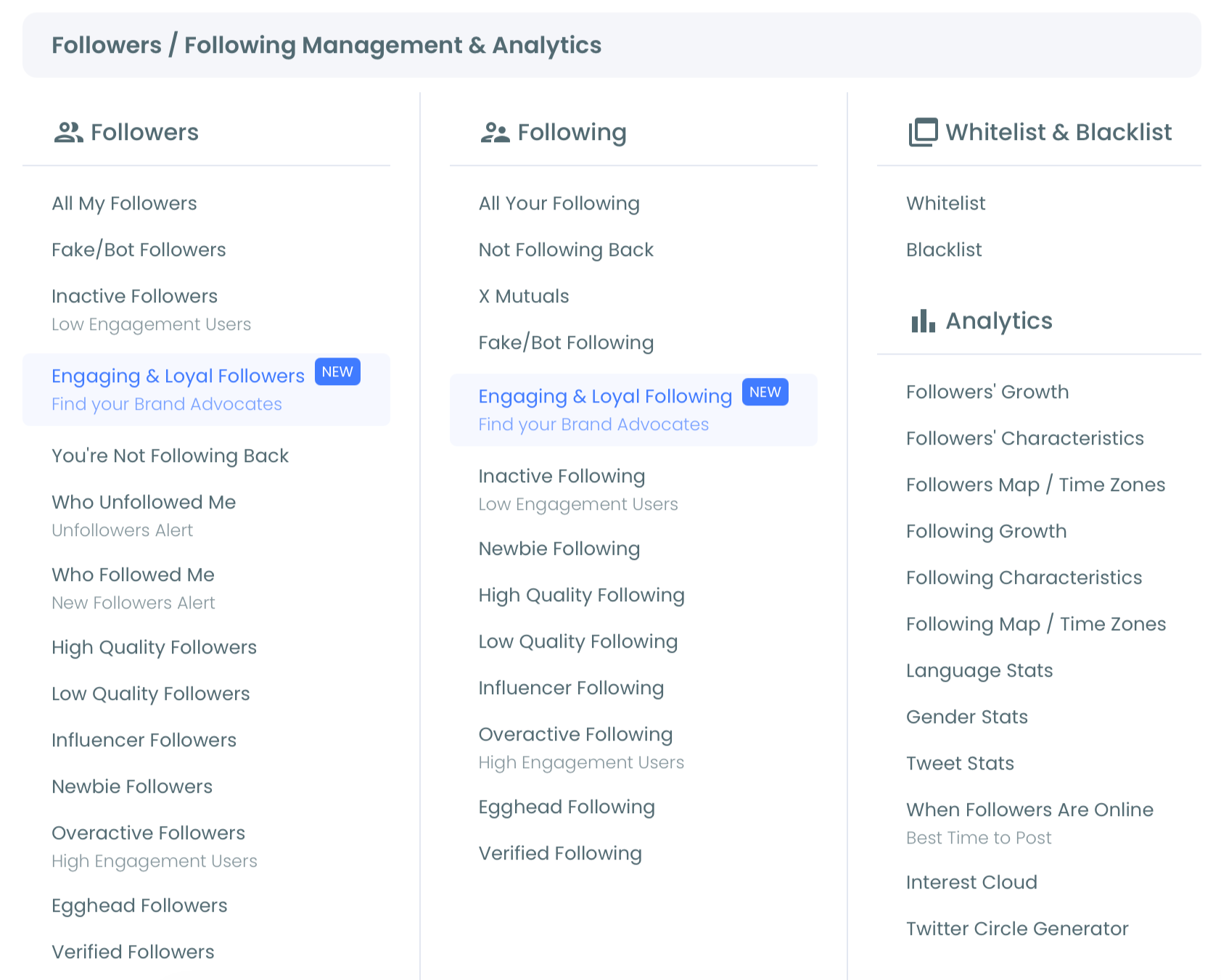
- Open the Follower & Following menu, where every audience segment for the accounts you follow lives.
Isolate the overactive segment and judge it
- Select Overactive Following to load only the accounts posting at unusually high frequency.
- Sort by Tweet Count descending so the most prolific follows sit at the top of the table.
- Open the top profiles before acting, because extreme volume can be a credible news desk or a scripted bot, and the two deserve opposite decisions.
That ordering works because it separates the volume signal from the value judgment. The login earns official-API access, the Overactive filter narrows scope to the loud accounts only, and opening profiles keeps you from unfollowing a high-frequency source you actually rely on. Skip the profile check and you will cut good accounts along with noise.
Tell a power-user apart from automation
Volume alone cannot tell you whether a loud account is worth keeping. Circleboom layers extra context onto each overactive follow: engagement classification, follow ratio, Fake or Spam flagging, and bio keywords. A journalist posting 60 times a day reads very differently from an account posting 120 times a day with near-zero engagement and a suspicious follow ratio.
A compound signal is the tell. When the overactive flag stacks with an Inactive or Low Engagement classification and a lopsided follow ratio, you are usually looking at scripted activity rather than a human.
That stays true even when the profile looks complete, because these accounts are built to pass a glance: photo, bio, history. The same disguise lets them slip past the checks that stop bots from following you on X.
Circleboom is an official X Enterprise developer, listed on X's own customer directory. Every profile you review is pulled through sanctioned access rather than scraped, so the frequency and engagement numbers you act on reflect real platform data, not a guess.
What to do with the accounts you find
Finding the loud accounts is step one. The decision is what matters, and you have three clean options instead of a blunt unfollow.
- Keep and whitelist the high-volume accounts you follow on purpose, so later cleanups never catch them.
- Move to a List the accounts whose content is valuable but too loud for the main feed, so you can read them on your schedule.
- Unfollow or block the accounts confirmed as repetitive, automated, or irrelevant noise.
Lists are usually the smartest middle path. An account you genuinely want to read but cannot tolerate at 80 posts a day belongs in a dedicated List, not in your unfollow queue. X's own advanced mute options cover words and phrases, but they do not rank your follows by volume the way this view does.
The same dashboard lets you keep tuning after this pass. You can view your full following list in one place and unfollow inactive Twitter accounts that never post.
You can also identify and remove low-quality follows that drag your feed quality down. Each is a different lens on the same goal: a timeline that shows the accounts you care about.
Pair the overactive view with Twitter follower and following quality scoring to see whether your loudest follows are also your lowest quality. Then group the survivors with the Twitter List Manager so high-volume sources stay readable without crowding everyone else out of the feed.
Common Questions About Overactive Follows
Does overactive always mean spam?
No. Overactive measures posting frequency, not intent. News desks, analysts, and prolific creators all post heavily because their role demands it. Treat the flag as a prompt to review, not a verdict, and cross-check it with engagement and Fake or Spam signals before you act.
How many posts a day counts as overactive?
There is no single magic number. Circleboom classifies relative to typical user behavior using tweet count over account age, so an account posting many multiples above normal surfaces in the view. Sorting by tweet count descending shows you the most extreme cases first.
Is it safe to unfollow overactive accounts in bulk?
Yes. Every action runs through official X APIs and is rate-limited for account safety, around 50 unfollows per 15 minutes and up to 800 per day, processed gradually. Whitelist the accounts you want to keep before any bulk action so they are never caught.
What is the difference between overactive and inactive follows?
They sit at opposite ends of the same frequency scale. Overactive accounts post far more than typical users and crowd your feed, while inactive accounts barely post and quietly pad your following count. Both distort your network, so many people review the two segments back to back in the same cleanup session.
Can I just mute them instead?
You can, and for valuable-but-loud accounts muting on X or moving them to a List is reversible, while unfollowing is not. Circleboom's view simply tells you which accounts are worth that decision in the first place, so muting becomes a deliberate choice instead of a reflex.
The Bottom Line
Finding the overactive accounts I follow on Twitter is a frequency problem with a precise fix: rank your follows by posting volume, then judge each loud account on engagement and relevance, not on volume alone. Keep the power-users, list the noisy-but-useful, and clear the automated filler.
Circleboom turns that from a guess into a sorted table backed by official X Enterprise data, so a noisy feed becomes a decision you make in minutes.