To unlike a tweet you liked by accident on Twitter, open the post and tap the heart a second time. When you can no longer find the post, load your recent likes in Circleboom and filter them by account, keyword, or date instead.
What this answer covers.Who can still see an accidental like now that likes are private on X.Why the notification and the like itself have two different lifespans.The filter path that finds one buried like without touching the rest of your history.
Circleboom loads up to your last 3,200 liked posts through official X API access and removes only the ones you select. Start here to unlike tweets by accident on Twitter.
The panic is always the same shape. Your thumb brushed the heart on someone's post from four years ago, the heart went red, and you have no idea whether that person is now looking at a notification with your name on it.
What actually happens the moment you like a tweet by accident on X
A like fires a notification to the post's author immediately, and unliking removes it.
The like is an event and the notification is a record of that event, and the two do not behave the same way once you undo the action.
When you unlike, the entry disappears from the author's notifications tab and the like count on the post drops back down.
What you cannot undo is the moment in between. If the author happened to be looking at their notifications while your thumb was still moving, they saw it.
That is the honest answer to the question everyone actually asks. Circleboom's earlier look at whether an accidental like still sends a notification walks through the timing in more detail.
Speed helps. Speed is not a guarantee.
Which is why the calmer move, once the seconds have already passed, is to stop chasing the notification and just undo the accidental like on Twitter properly. The notification is out of your hands within about a second. The like is not.
The second half of the answer is the one almost nobody gets right, and it changed in 2024.
Who can still see the tweets you liked by accident on Twitter
Since June 2024, your Likes tab is no longer public, so a stranger cannot open your profile and scroll your accidental like. X's engineering account announced the switch to private likes and spelled out what survived it.
Three parties still have visibility, and they are worth separating because each one calls for a different reaction:
- You. Your own Likes tab still shows everything you have ever liked, in the order you liked it.
- The post's author. They can still see who liked their own post, which is exactly the person you were worried about.
- X's recommendation engine. Your like stays a live input into what the algorithm shows you next.
Notice what dropped off that list. The random follower, the recruiter, the ex-colleague, the journalist writing about you: none of them can browse your likes anymore.
If your worry was the profile-level audit, the platform already solved it for you. That change is also why so many people now ask why they cannot see their Twitter likes the way they used to.
Circleboom reads that same private Likes tab on X through authorized API access, which is why it can list back the likes nobody else is allowed to browse.
The accidental like is no longer a profile problem. It is a one-person problem plus an algorithm problem.
That reframe matters because most advice on this topic is still written for the old world, where the fix was scrubbing a public tab so it looked clean to visitors. The reason readers still search for how you see someone's Twitter likes is that the change was quiet and the old assumption stuck around.
Why unliking still matters when likes are private
Removing an accidental like still does three concrete things, even with the Likes tab hidden from the public.
It clears the author's view. Anyone can open their own post and see the list of accounts that liked it, and that list persists as long as the like does. Unliking is the only way off it.
It removes the algorithmic signal. X treats likes as interest data, so a stray like on a topic you have no interest in quietly shapes the feed you get served. Cleaning it is closer to correcting a preference than to tidying a shelf.
And it protects the exports. Likes still travel into your own data archive and into any analytics that read your account with your permission.
That is a different kind of exposure from the profile tab people used to worry about when they searched for how to hide likes on Twitter. Hiding was never the same as removing, and now that the platform hides by default, removing is the only lever left.
Circleboom sits on the removal side of that. As an official X Enterprise developer, it works from an authorization token you grant on X's own screen and can withdraw there whenever you like. Your password is never typed into Circleboom, never stored, and never part of the exchange at all.
That distinction is worth a sentence because it decides how a bulk cleanup looks from X's side.
A tool that drives your logged-in browser to click hearts at machine speed produces exactly the pattern abuse systems are tuned to flag. A tool holding an approved API key produces authorized requests that X can attribute and rate-limit normally.
Once you know the accidental like is worth removing, the only remaining problem is finding it. That is where most people give up and reach for something built to unlike tweets you liked by accident on Twitter instead of scrolling.
How to unlike tweets by accident on Twitter with Circleboom
One stray like, pulled out of thousands of deliberate ones, without a single scroll.
https://www.youtube.com/watch?v=lJ0B2oDYV2M
Circleboom's Delete My Last Likes pulls your most recent liked posts into a table you can filter, so you locate the accidental like by who posted it or what it said rather than by scrolling to it.
The flow below runs in three phases: load, narrow, remove. No archive upload is needed at any point.
Load your recent likes into a table you can actually search
- Log in to Circleboom Twitter and authorize the X account whose likes you need to reach. Read access to your likes is what that authorization grants, and nothing is fetched before you approve it.

- Open the Essential Toolbox menu. The likes tools sit in its Delete Tools group rather than under any of the analytics menus, which is where most people look first and lose five minutes.
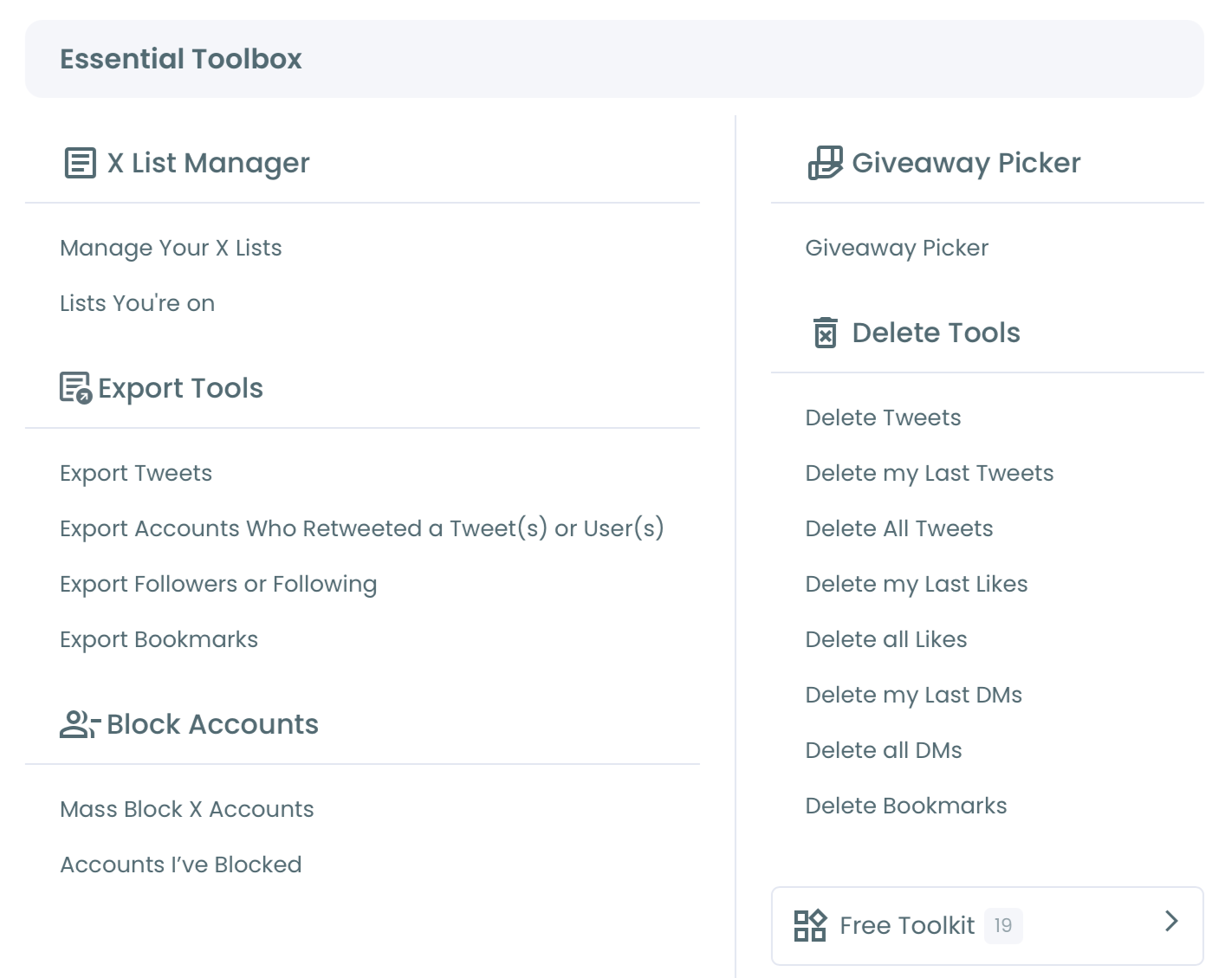
- Select Delete My Last Likes. Circleboom retrieves up to your 3,200 most recent liked posts and lays them out in a paginated table with columns for impressions, likes, retweets, quotes, bookmarks, replies, and the date each post was created.
Narrow the table down to the like you regret
- Open Filter Options and use the keyword, username, or hashtag field, which searches the liked post's text, its @mentions, and its hashtags. If you remember the account you brushed past, their handle is the fastest way in.
- Set the date range using the Earliest and Latest fields. The range works against the post's Created At column shown in the table, which is what makes the classic accident recoverable: an accidental like on someone's old post is the only row in your recent likes carrying a years-old Created At value.
- Review the filtered rows and click the external link icon on any row to open that post on X in a new tab. Confirming before you delete costs seconds and there is no undo afterward.
Remove the like and leave the rest of your history intact
- Export the filtered list as CSV if you use likes as informal bookmarks. The Export button shows your remaining token count, and the file is your only record once the likes are gone.
- Clear the default selection. Every loaded like arrives pre-ticked, so untick the batch and tick only the rows you want removed, or use the trash icon on a single row.
- Click Delete Selected and keep the browser tab open while the batch runs, since Circleboom paces requests against X's API limits rather than firing them all at once.
That order is what keeps the operation surgical.
The filter runs before the selection so you are never choosing from 3,200 rows by eye. The review step catches the near-miss where two accounts share a similar handle. And the export runs before deletion, because unliking through the X API cannot be reversed.
Is it safe to unlike a batch of tweets on X at once?
Yes, when the removal runs through official API endpoints with paced requests, which is how Circleboom handles it.
The risk people associate with bulk actions comes from tools that never had authorized access in the first place and have to improvise around its absence.
There are two real constraints, and neither is about account safety. Unliking is permanent, with no restore path once a like is processed. And the tool reaches your 3,200 most recent likes, so anything older than that window needs the archive-based Delete All Likes route instead.
Worth knowing before you start: if you have liked, say, 6,000 posts over eight years, the accidental like you are hunting is only reachable here if fewer than 3,200 likes have happened since. That is rarely a problem for a like from this morning. It is often a problem for one from three years ago.
Two adjacent cleanups tend to come up in the same session, because the same thumb makes the same mistake in two other places.
Bookmarks are the first. People routinely mix up a bookmark and a like, and the Twitter Bookmarks Manager is where the saved-post version of the problem gets sorted out.
Retweets are the second, and they are the one that genuinely still stings. A retweet lands on your own timeline where everyone can see it, so an accidental one is far more exposed than an accidental like ever was. That is a job for delete retweets, not for the likes tool.
Wrapping up
An accidental like on Twitter is a smaller problem than it feels like and a more specific one than most advice admits.
The public Likes tab is gone, so the exposure narrowed down to the post's author and the algorithm, and both of those are fixed by the same action: removing the like.
The part that stayed hard is retrieval. Finding one stray like among thousands by scrolling does not work, which is why filtering by the account, the keyword, or the Created At date shown in the table is the difference between a two-minute fix and giving up.
Circleboom does that filtering against your last 3,200 likes on X without an archive upload, and removes only the rows you confirm.
→ Unlike the tweets you liked by accident
Lingering questions about one stray heart
If I unlike a tweet right away, will they still know?
The notification vanishes from their tab when you unlike, and the like disappears from the post. The only exposure is real-time: if the author was watching notifications during the seconds your like was live, they saw it, and nothing you do afterward changes that.
Can I undo an unlike if I remove the wrong one?
No. Unliking through the X API is permanent and Circleboom has no restore function for it, which is why the export step exists. Pull the CSV before a batch run if the likes double as saved references you want to keep.
Why can't I find the tweet I accidentally liked just by scrolling?
Your likes are ordered by when you liked something, not by when the post was published. A stray like on a 2019 post sits at today's position in the list, so scrolling backward through years of content will never reach it. Filtering by the author's handle or by the Created At date shown in the table finds it directly.
Does an accidental like affect what X shows me in my feed?
Yes. Likes feed X's recommendation engine, so a stray like on an unrelated topic can shift your For You feed for a while. Removing the like removes the signal, which is a practical reason to clean up even now that the Likes tab is private.