
A follower count tells you how many accounts pressed Follow. It does not tell you how many of them are people, how many still use X, or whether anyone paid for them. To tell if someone bought Twitter followers, you need the composition behind the count, and the right check depends on whose account it is.
A bought audience tends to show a large count sitting on a high suspected fake or bot share, a large inactive share and few responses per post. Circleboom measures those shares for your own followers on Twitter using official Enterprise APIs and lists the accounts behind each one. Someone else's account needs a different route.
→ Bought Twitter followers: run the check on your own account
The table further down matches each kind of account to the check that fits it, and the steps follow.
Why a follower count alone cannot show bought followers on Twitter
The follower count is a running total, and a running total hides what it is made of. X's native view gives you the count and post-level numbers. Nothing on a profile shows how many followers are automated, abandoned or silent.
That is why the usual advice falls back on visible symptoms. The four signs worth checking are these:
- A high share of suspected fake or bot followers.
- A large share of inactive followers.
- A thin top quality tier.
- Few responses for the size of the count.
The last sign is the one people argue about most, because "few" needs a yardstick. That yardstick is a topic of its own, covered under a good like-to-followers ratio on Twitter (X).
A sudden rise in the total is often added as a fifth sign. Treat it as a reason to look at who arrived, which is what the page to check new followers on Twitter is for.
Why the question matters beyond curiosity
Bought followers are a rules matter and a money matter. X's rules on platform manipulation address the buying and selling of followers and engagement, so a purchased audience puts the account itself at risk.
There is also a reach cost, and it falls on the owner. The report's own explainer describes how X shows a new post to a small test group of followers first and expands reach only if they respond. Followers who never respond weaken that first test, however they arrived.
The mistake I see most often is treating the visible symptoms as a verdict. They are a reason to measure. Start by running a check for bought or fake followers on the one account you are allowed to measure in full: your own.
What Circleboom measures on your own X followers
Circleboom's X Account Analysis report breaks your own follower count on X into measured shares. It reads the followers, the following list and the recent tweets of the X account you connect, then returns a dated report in 9 sections.
Three panels in the Audience Quality section carry most of the answer:
- Human vs Fake/Bot: followers classified as real against suspected fake or bot accounts.
- Active vs Inactive: followers who tweet regularly against those who barely tweet.
- Quality tiers: followers sorted into High, Medium and Low by activity, follower-to-following ratio and account age.
With Circleboom's X Account Analysis tool, you can also open the Twitter accounts behind each percentage, which is what separates a measurement from a hunch. Circleboom is an official X Enterprise Developer, so every figure is calculated from official X records and your account is never exposed to scraping.
Where each of the four signs sits in the report
Each visible symptom has a measured counterpart, and each counterpart comes with a reading note:
- The fake share sits in Human vs Fake/Bot, worded as suspected fake or bot accounts.
- The inactive share sits in Active vs Inactive, which measures posting frequency and not whether someone reads.
- The thin top tier sits in Quality tiers, where a low tier is a prompt for review.
- The few responses sit in the Engagement summary, as per-tweet averages over the last 90 days.
The fourth one needs care. The report lists the Top 5 Tweets by Engagements, and an account that posts rarely can have only a handful of posts in the window. Check how many posts an average rests on before you call it low.
Read each share as a percentage and as a count
Each share in the report comes as a percentage and as a number of accounts, and the two answer different questions. The percentage tells you how far the follower count overstates the audience. The count tells you how many profiles stand behind that percentage, which is the size of the review ahead of you.
A small percentage on a large account can still be a long list of profiles.
Cross-check the two before you quote either. You can read the same bought-follower signs on your own account in one sitting, with the profiles to back each share.
Why you cannot see when fake followers arrived on a Twitter account
Nobody can show when fake followers arrived on an account unless someone took a reading at the time. Audience composition cannot be reconstructed for a month that nobody read.
This is the limit most checklists skip. A follower count has a visible history. The mix of real, inactive and suspected fake accounts inside it does not, so a claim that an account bought Twitter followers last spring has nothing to stand on without a dated record.
What you can control is the record from today forward:
- The first analysis becomes the baseline.
- The option Keep it up to date every month adds 12 automatic monthly analyses, 13 in total.
- Compare Reports places up to 4 past analyses beside the current one.
With a baseline in place, a later change in the fake or inactive share has a date range attached. For the count itself, there are separate ways to track Twitter follower growth over time.
Which check fits: your own X account or someone else's?
The full audience check runs only on your own connected account, and someone else's account takes a different route. X Account Analysis has no field for a handle. It reads the X account that is connected and active in Circleboom, and no other.
Use this table to pick the check before you start:
| Whose account | What to run | Reading order | What it shows | What it cannot show |
|---|---|---|---|---|
| Your own connected account | X Account Analysis | Audience Quality, then the drill-down lists, then the essentials row | Fake or bot share, inactive share and quality tiers, with the accounts behind each | Whether anyone paid, or the mix before your first analysis |
| Someone else's account, as a rival | X Competitor Analysis | The same sections, compared across accounts | The same metrics for your account and up to 5 rival accounts, side by side | A cleanup list for the other account |
| Someone else's account, quick look | Twitter X Metrics Calculator | Reach and engagement together | A public read of recent post performance | Who the followers are |
The rule behind the table: the deepest check belongs to the account owner, so run the wrong one and you will read the wrong evidence.
The route for an account that is not yours
For another account, X Competitor Analysis is the route that keeps the same report logic. It needs your own account in the comparison, which is useful: your numbers become the reference point for theirs.
If you only want the outline of the task, there is a separate post on how to Twitter audit someone else.
How to tell if your own Twitter followers look bought, step by step
Your own followers get the full check through X Account Analysis, read from composition to count.
Before the steps, a short clip: checking your Twitter followers inside Circleboom from the follower side.
The process has six steps, grouped by what each stage settles.
Connect the account you want to check
- Log in to Circleboom and connect the X account you want to check. The report runs on the account that is connected and active, so there is no handle to type.
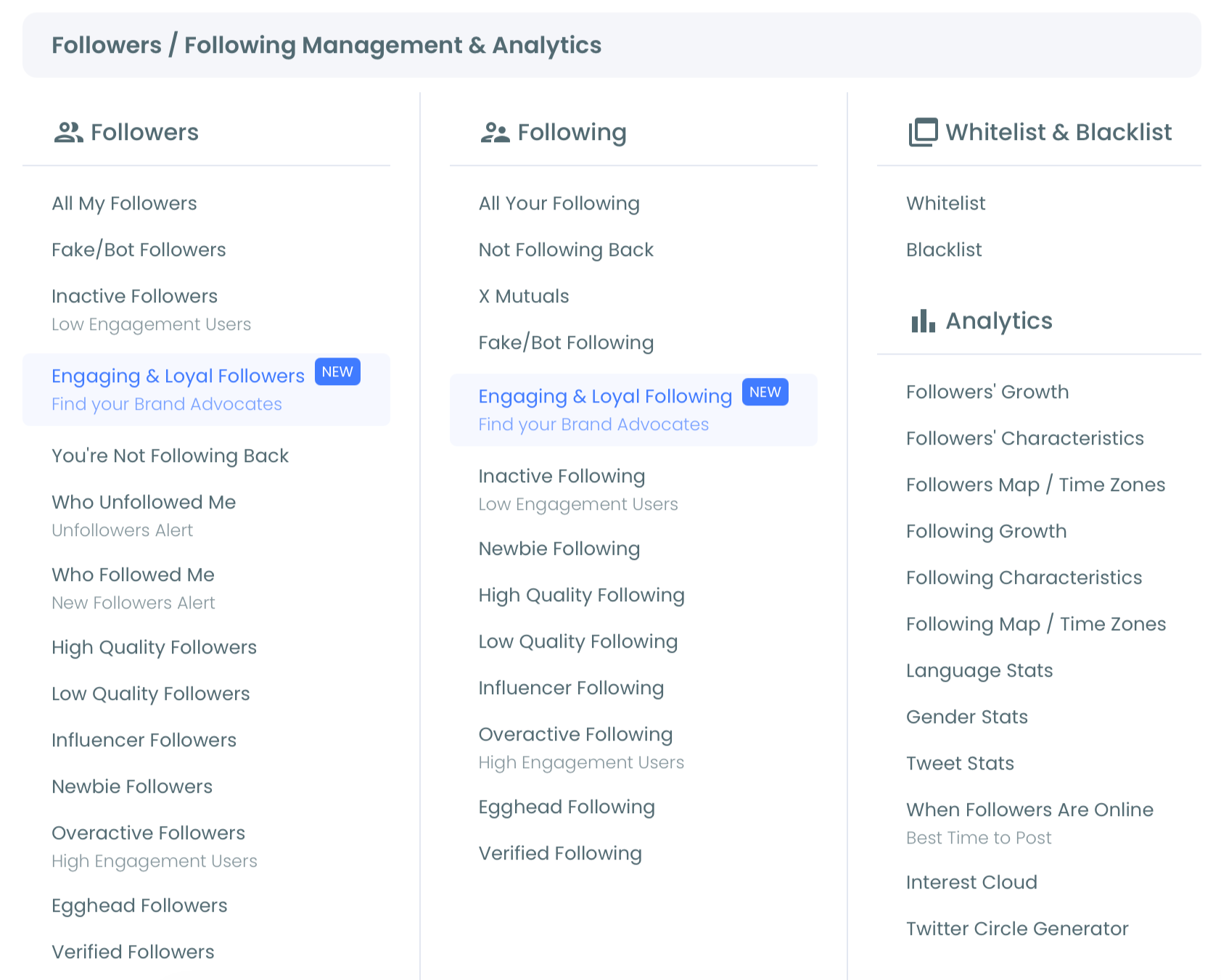
- Go to the Followers / Following Management and Analytics menu and select X Account Analysis, the first item under Analytics.
Run the analysis and read audience quality before the count
- Confirm the account shown on the page and select Start Account Analyses. Use Switch accounts if you have more than one connected, then choose Just this once or Keep it up to date every month.
Both options produce a dated analysis that is stored in your history. An earlier analysis is never overwritten, so each one stays a correct record of the day it was read.
- Open the Audience Quality section with the Followers view selected. Read Human vs Fake/Bot, Active vs Inactive and Quality tiers together, as percentages and as counts.
I read these three panels as a set. A high suspected fake share with a healthy High tier tells a different story from the same share next to a large inactive block.
Check the accounts behind each share
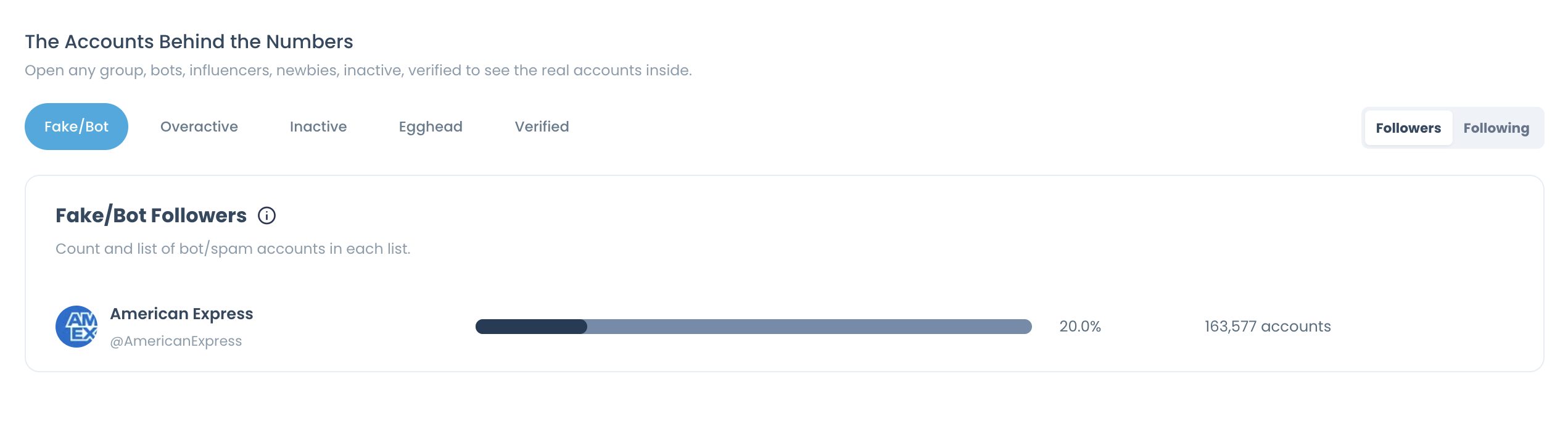
- Select the Fake/Bot tab in The Accounts Behind the Numbers. The panel prints the share of bot or spam accounts among your followers and the number of accounts, and the list lets you inspect the profiles.
- Read the essentials row last. Set the follower count beside the active followers share, the engagement rate and the average impressions.
A note on that engagement rate, since it is the figure people misread most. The report calculates it as total engagement divided by total impressions.
It is not normalized by follower count, so it cannot be turned into a likes-per-follower figure, and the rate in the essentials row can differ from the 90-day figure in the Engagement section.
Composition comes before the headline count in this order because the count anchors judgment once you have seen it. The drill-down lists then turn each percentage into profiles you can verify, so the result rests on accounts and not on an impression.
What the result lets you say about bought followers on X
The result lets you state what your audience is made of, with a date and a source. It does not let you state how any follower got there.
That distinction is practical, because bought followers and collected ones look the same in a count. Suppose a partner asks whether your followers are real. A dated report with the fake share, the inactive share and the quality tiers answers the question they are asking.
Two details keep that answer clean. Check that the Followers view is selected before you quote a share, because the same panels can be switched to the accounts you follow.
And when the report goes to someone else, Create Your Presentation builds a branded export of it, which you should send with the analysis date visible.
Brands have a reason to ask. The FTC's questions and answers on its Endorsement Guides call fake likes from non-existent people clearly deceptive. Both the buyer and the seller of those likes could face enforcement action. A partner who pays for reach has the same reason to ask about followers.
If the flagged accounts turn out to be on your own list, review them before acting, then use the page to remove followers on X. The removal runs through the Circleboom Chrome extension at a gradual pace.
What scrolling an X follower list can and cannot show
Scrolling a follower list shows you individual profiles, and it cannot show you a share. You see whichever accounts load first, you judge them by eye, and you stop when your patience runs out.
The by-eye tells are real but weaker than they look. The usual ones are collected under ways to identify fake Twitter accounts. Two of them need a caveat from the report's own reading notes:
- A missing profile photo is one characteristic. It does not establish that an account is fake.
- Heavy posting can come from news accounts, enthusiasts or automation, so volume alone does not identify spam.
Scrolling works as a spot check on a short list. On a long one, it produces confidence without a number, which is the worst combination when the conclusion is that someone bought followers on X.
Which route to take from here on X
The right move depends on whose account raised the doubt.
If the account is yours, run the analysis, read Audience Quality first and open the lists behind the shares. That is the only place where the question of bought Twitter followers meets measured evidence.
If the account belongs to someone else, run the comparison route from the table and treat the result as a reason to ask questions. I would ask the owner for a dated report before I drew any conclusion.
If the only evidence that someone bought followers is a feeling from scrolling, stop there and measure something first.
→ Find out whether your Twitter followers look bought
Bought followers FAQ: limits, proof and next steps
Is a high fake or bot share proof that followers were bought?
No. The fake or bot classification is an analytical signal for review, not a verified identity judgment, and it says nothing about payment. Accounts that have existed for years collect dormant, abandoned and automated followers without buying any.
Is there a faster check for one suspicious account?
Yes. Circleboom's free Fake X Account Checker takes a single username and returns a plain-language result on whether the profile shows fake account characteristics. It is built for one account at a time, so it does not replace a full read of a follower list.
Can a removed fake follower follow me again?
Yes. Removing a follower ends the current follower relationship, and that account can follow again by its own choice. Stopping an account from returning is a blocking decision, which is a separate action.