
A big follower count is easy to buy and hard to verify. Before you sponsor an influencer, partner with a brand, or trust a competitor's growth story, it helps to know whether their audience is real. An account that buys fake followers looks impressive on the surface and hollow underneath, and the difference matters when money or credibility is on the line.
The challenge is that X shows you the follower count but never the quality behind it. You can see that an account has 80,000 followers; you cannot see that 30,000 of them are bots with no photo, no tweets, and a wildly skewed follow ratio. To check whether an account buys fake followers, you need to look inside its follower list, and the platform gives you no tools to do it.
How do you check if a Twitter account buys fake followers? Use Circleboom Twitter's Followers / Following Search. Enter the account's username, show its followers, and apply the Fake/Spam quality filter. Circleboom loads the follower list through the official X API, classifies each account, and shows what share looks fake or bot-like. A high proportion of low-quality followers is a strong signal the account inflated its numbers. → Start with Followers / Following Search

This guide explains the traces that bought followers leave behind, and how to read them on any public account.
Why bought followers leave a trail
Fake followers are cheap because they are low effort. The accounts sold in bulk tend to share the same tells: no profile photo, no bio, few or zero tweets, a creation date clustered in a narrow window, and a follow ratio that makes no sense, following thousands while being followed by almost no one. Individually, any of these can describe a real but unusual account. In bulk, concentrated in one follower list, they paint a clear picture.
That is the key idea: you are not judging one account, you are reading a pattern across thousands. A real audience is messy and varied. A bought audience is suspiciously uniform, full of empty profiles with the same skewed signals. When a large share of an account's followers share those low-quality traits, the most likely explanation is that the followers were purchased rather than earned.
Circleboom's Followers / Following Search is what lets you see that pattern, because it turns a follower list into a filterable, classified dataset instead of an endless scroll.
What you need before you start
The check runs on public data, so the requirements are minimal:
- A Circleboom Twitter account
- The public username of the account you want to check
- A few minutes to read the filtered results
Circleboom is an official X Enterprise Developer, so the follower list is read through X's approved API using only public profile signals. The account you check is never notified, and nothing about the process relies on scraping.
How to check if a Twitter account buys fake followers
Step 1: Open Followers / Following Search
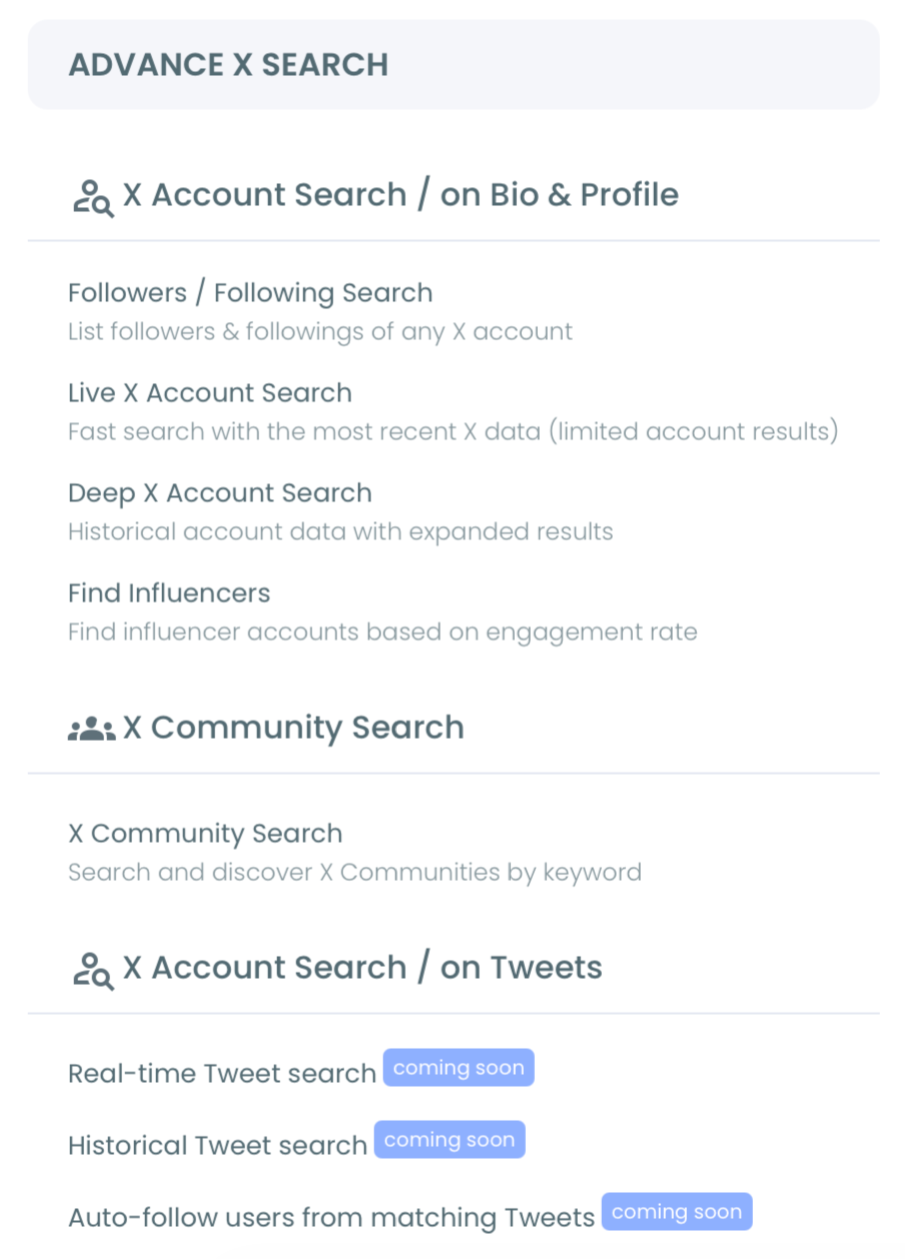
In Circleboom Twitter, open Followers / Following Search. Enter the username of the account you want to check, and choose to show its Followers. Circleboom retrieves the follower list and displays each account with its tweet count, join date, follower and following counts, follow ratio, and engagement classification.
Step 2: Apply the Fake/Spam quality filter
Open Filter Options and set the Follower Quality filter to show Fake/Spam accounts. The table narrows to the followers that carry suspicious signals. The proportion of the list that survives this filter is your headline number: a small slice is normal, while a large one points toward a bought audience.
Step 3: Sort by follow ratio and tweet count
Sort the filtered list by follow ratio, then by tweet count. Bought accounts cluster at the extremes: near-zero followers against thousands followed, and zero or single-digit tweet counts. Seeing the same skewed profile repeat down the list is the pattern that confirms the filter is catching real fakes, not unusual real accounts.
Step 4: Read the engagement classification
Check the Active and Inactive column. A bought audience skews heavily toward the Inactive / Low Engagement tier, because purchased accounts do not post or interact. An account whose followers are mostly inactive, on top of the fake signals, is showing two independent indicators of an inflated count.
Step 5: Form a cautious conclusion
Weigh the signals together rather than trusting any single one. A meaningful share of fake-classified followers, skewed ratios repeating across the list, and a heavy inactive tilt together make a strong case that the account buys fake followers. Treat the result as a well-supported judgment, not a courtroom verdict. You can run the whole check in Followers / Following Search.
How to read the result fairly
The point of this check is an informed decision, not an accusation, so a few habits keep it honest:
- Judge proportion, not raw numbers: every large account has some fake followers, so the share is what matters
- Look for clustering: many near-identical low-quality accounts is a stronger signal than scattered ones
- Treat the classification as likelihood, not proof, since a few real but unusual accounts always slip in
- Combine signals: fake traits plus inactivity plus skewed ratios together are far more convincing than one alone
For more background, these guides help. Start with how to audit someone else on Twitter and how to run a Twitter bot follower check. For the measurement side, see how to tell how many of your followers are bots and how a fake followers audit works.
What the check can and cannot tell you
It is worth being clear about the limits, because honesty about them makes the check more useful, not less. Circleboom reads public signals: profile completeness, tweet count, account age, follow ratio, and engagement classification. From those it estimates how many of an account's followers look fake or bot-like. What it does not do is read the account owner's intent or prove a purchase happened. A follower list heavy with low-quality accounts is consistent with buying followers, but it can also reflect a viral moment that attracted bot attention, a giveaway that drew spam, or a follow-bot campaign run by someone else against the account.
That is why proportion and pattern matter more than any single flag. One inactive follower means nothing. A third of an audience sharing the same empty-profile, skewed-ratio signature is hard to explain any other way than deliberate inflation. The check gives you the evidence to make that judgment; it leaves the judgment to you. Used this way, it is a reliable filter for separating accounts worth your trust from accounts whose numbers do not hold up, without pretending to a certainty the data cannot support.
Using the check before you commit
The real value of this check is in the decisions it informs. Before paying an influencer, weigh their fake-follower share against their engagement: a creator with a clean audience and modest reach is often worth more than one with a huge but hollow following. Before trusting a competitor's growth, check whether the spike is real accounts or purchased ones. Before a partnership, confirm the audience you are buying access to actually exists.
Circleboom makes that check repeatable across any public account, so you can compare candidates on a level field. Pair it with a follower checker for a quick single-account read and a deeper follower audit when the stakes are high. Knowing whether an account buys fake followers turns a guess into evidence, and you can get that evidence in minutes from Followers / Following Search.
Frequently asked questions
Can I really tell if an account buys fake followers?
You can read strong signals. Circleboom classifies an account's followers and shows the share that look fake or bot-like, which, combined with skewed ratios and inactivity, makes a well-supported judgment, though not absolute proof.
Does the account I check get notified?
No. The process uses only public data through the official X API, and the account you analyze receives no notification.
What share of fake followers is suspicious?
There is no fixed line, since every large account has some. A large proportion of fake-classified followers, especially clustered with similar traits, is what points toward a bought audience.
Can I check any account or only my own?
Any public account. Followers / Following Search works on any public username, which is what makes it useful for vetting influencers, partners, and competitors.
Is this allowed under X's rules?
Yes. Circleboom is an official X Enterprise partner and reads public follower data through the approved API.