
Every scroll spent on the same few loud accounts is attention taken from the people you followed for a reason. Leave it alone and the quieter accounts you value fade from your timeline, while you start to believe X has nothing worth reading. A Twitter feed less noisy than yours is usually one ranked list and a short round of decisions away.
Circleboom ranks every account you follow on Twitter by posting frequency through official Enterprise APIs from X, so you can see which few follows flood your timeline. You then keep, List, mute or unfollow each one, with unfollows paced to protect your account.
→ Twitter feed less noisy
Below: a decision table for each type of loud account, the exact steps, and how long a cleanup takes.
Why a noisy Twitter feed costs more than scrolling time
A noisy feed is usually not a big-following problem. It is a concentration problem. A small number of accounts that post constantly take up most of the visible space, and everyone else gets squeezed into the gaps between them.
The cost is easy to miss. You stop seeing replies from peers, threads from people who post once a week, and announcements from smaller accounts in your niche. Your sense of what is happening on X narrows to what the loudest accounts happen to repeat.
The arithmetic explains why. Take an illustrative case: if 15 of the accounts you follow average 40 posts a day, they add 600 posts a day to your timeline. A colleague who posts one careful thread a week has to surface somewhere inside those 600.
No amount of scrolling makes that a fair fight.
The common fixes miss the cause. Unfollowing at random removes quiet accounts as often as loud ones, and muting only the names you happen to remember skips the heavy posters you never noticed.
The fix that works starts with measurement. Your first move is to cut the noise in your Twitter feed by ranking your follows on how often they post.
In my own following, the accounts I would have guessed were rarely the ones at the top once I had numbers to look at.
How Circleboom finds the accounts flooding your X timeline
Circleboom divides each followed account's total tweet count by its age in days, then isolates the accounts whose posting frequency crosses an overactive threshold. You reach that view, Overactive Following, from the following-side options of the Followers / Following menu, and it answers the one question X never does: which of the accounts I follow post the most?
Each row pairs the volume with the context to judge it:
- The sortable Tweets count.
- Joined, which gives the account's age in days.
- The Following and Followers counts with the Follow Ratio.
- An Active & Inactive engagement label at the end of the row.
On X, you would open each profile and guess at a daily rate. In Circleboom, the whole high-volume edge of your following list sits in one table, and the actions you need are on the same screen. That is the fastest route to a less noisy X feed that I know of.
Circleboom is an official X Enterprise Developer company, which matters here because the feature acts on your own account. The follow data comes from X directly, and every unfollow is processed by X under its rules.
Which loud accounts to keep, list, mute or unfollow on Twitter
High posting volume is a feed-impact signal. The right action depends on what kind of account is producing the volume, and five types cover almost every row you will see.
| Account type | How to recognize it | Action |
|---|---|---|
| News desk | High tweet count, active audience, relevant to you | Keep, or move to a List if it crowds your home feed |
| Live-event account | Heavy bursts around events, quiet between them | Mute between events, or keep it in a List |
| Aggregator | High volume of reposted headlines you see elsewhere | Unfollow |
| Reposting bot | Extreme volume, Inactive or Low Engagement label, very low follow ratio | Unfollow, or block if it is harmful |
| Inactive follow | No recent posts, low engagement | Unfollow through Inactive Following |
The table holds up because each action matches what the account costs you. A news desk costs space but returns value, so it moves rather than leaves. A live-event account is only loud part of the time, which makes a reversible mute the best fit. An aggregator and a reposting bot cost space and return little, so they go.
Move value, mute bursts, remove repetition.
Reading the news desk and live-event rows
A news desk is the account type people most often unfollow by mistake. Its tweet count is huge because publishing is its job, and its audience is usually active and engaged. If it covers your field, keep it.
If it covers your field but drowns your friends, a List gives you both: the coverage when you want it and a home feed that is not theirs.
Live-event accounts are harder to read from the table, because Tweets and Joined only give a lifetime average. A few heavy weeks a year can lift that average high enough to put them near the top, so open the profile and check whether the posts cluster around events.
That pattern is the case for a mute rather than an unfollow, since the account is worth having back when its event returns.
Reading the aggregator and reposting-bot rows
Aggregators are real accounts that repeat what other accounts said first. If you already follow the sources, the aggregator doubles your noise for no new information. That makes it the easiest unfollow on the list and a quick way to get your Twitter feed less noisy without touching anyone you read.
Reposting bots are the rows where three signals line up at once: extreme volume, an Inactive or Low Engagement label and a very low follow ratio. Volume alone is not enough to call it, which is why the table asks for all three before an unfollow.
The mute itself happens on X, while Circleboom points you to the accounts worth muting. X's help page on muting accounts on X covers the details. A muted account's posts leave your timeline without an unfollow, the account is not told, and you can undo it at any time.
Clearing low-value follows on camera: unfollowing fake and low-quality accounts from an X following list, the same review this guide applies to loud accounts.
How to make your Twitter feed less noisy, step by step
The process runs in four short phases.
Open the list of accounts that post the most
- Log in to Circleboom using the X account whose home timeline you want to clean.

- Go to the Followers / Following Management and Analytics menu.
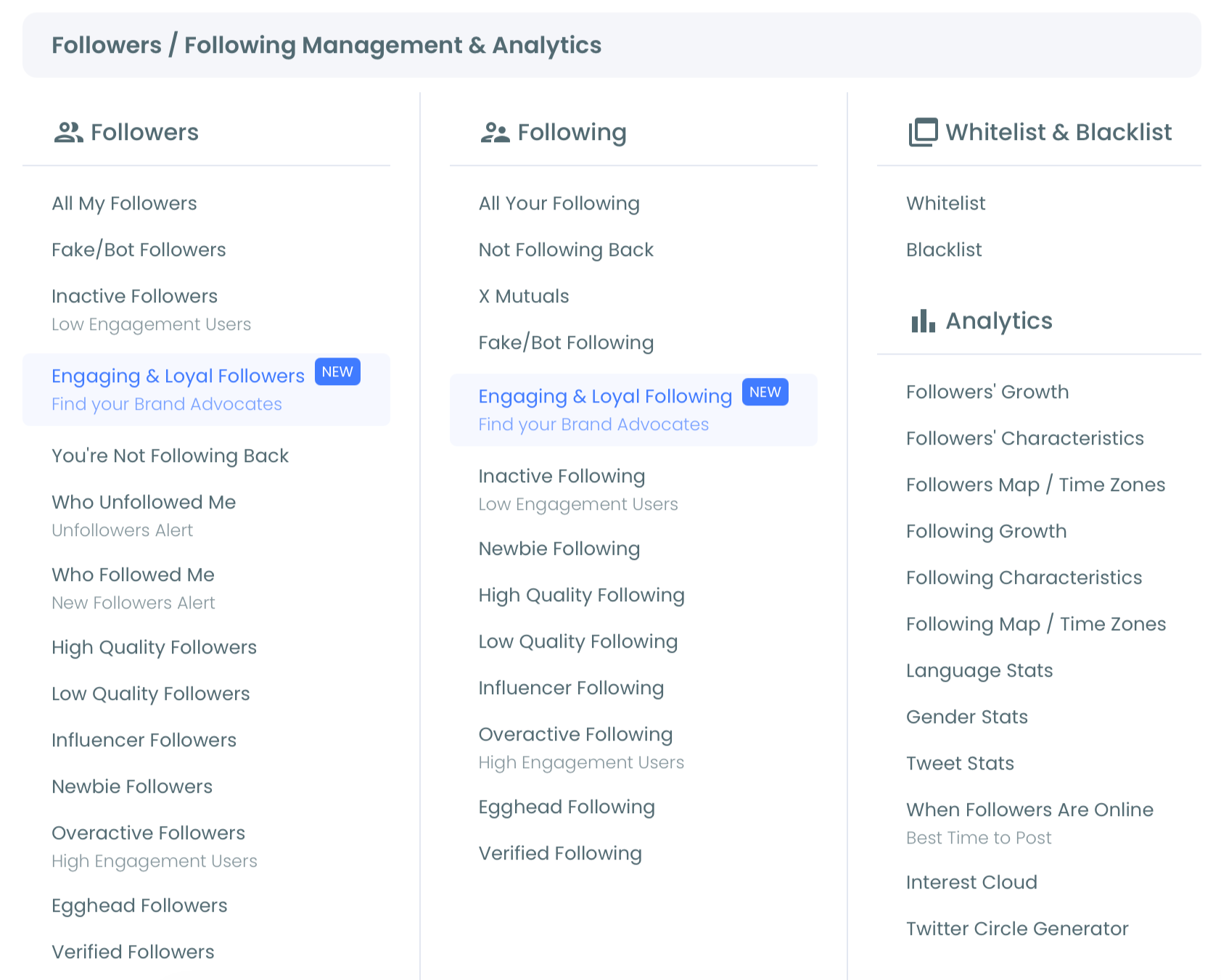
- Select Overactive Following in the Following column to load only the high-frequency accounts you follow.

Rank the accounts and read the top of the list
- Click the Tweets column header until it sorts high to low, so the heaviest posters sit at the top.
- Open each top profile from the link icon on its row and check whether its posts match the account type you suspect.
Protect, list or mute the accounts worth keeping
- Whitelist the news desks and other keepers with the shield icon. Whitelisted accounts are protected from bulk actions and are hidden from the list by default.
- Select loud but useful accounts and choose Add to List, then Twitter List, to place them in an existing List or a new one.
- Mute live-event accounts on X from their profile when you want a break from their bursts without losing them.
Unfollow the rest at a safe pace
- Select the aggregators and reposting bots, click Unfollow (N selected), and confirm the count in the pop-up.
Before you confirm step 9, the Filter Options panel can tighten the selection. Combine the Engagement, Fake/Bot and Follow Ratio filters, or search bios and names for a keyword, and the Active Filters bar above the table shows exactly which filters are applied.
Check that bar and the count in the Unfollow button before you click, because every bulk action applies to whatever is currently selected.
Protection comes before removal at every point in this sequence. Sorting puts the biggest feed-impact first, the whitelist takes keepers out of reach before any bulk action, and the paced queue keeps the unfollow side within safe limits.
The sequence in brief:
- Open Overactive Following from the Followers / Following menu.
- Sort by Tweets and read the top profiles.
- Whitelist keepers, List the useful loud ones, mute bursty ones on X.
- Unfollow what is left and let Circleboom pace it.
The same Unfollow button works across every following view, so the mechanics carry over to any larger cleanup. For a wider sweep beyond loud accounts, this guide on how to mass unfollow Twitter accounts covers the bulk side in more depth.
Is it safe to unfollow a lot of Twitter accounts at once?
Yes, when the unfollows are paced. Circleboom processes them at 50 every 15 minutes, with a daily safety limit of 800, and any remainder resumes automatically the next day. Unfollowing aggressively in a short burst is what can get an account temporarily locked, and X's own limits can vary from account to account.
How long a feed cleanup takes on X
The pacing makes cleanup time easy to estimate:
- A 400-account cleanup finishes in one day, with about two hours of processing at 50 every 15 minutes.
- An 800-account cleanup also fits in one day, at about four hours of processing.
- A 1,200-account cleanup runs 800 on day one and the remaining 400 on day two, with no restart needed.
A feed cleanup is rarely more than a one-day job, and the queue handles the waiting.
After you confirm, Circleboom shows a request-in-progress notice that restates the processing speed: 50 unfollows every 15 minutes, 800 per day, with continuation the next day. That notice is your confirmation that the queue has started, and the rest needs no restart from you. Pacing is part of what keeps a Twitter feed less noisy without new problems on your account.
Two checks before you confirm an unfollow
Two habits keep it safe. Review the selection count in the Unfollow button and the confirmation pop-up before approving, and remember that an unfollow is not a block: the account can still follow you and see your posts. For more on staying within X's rules, read how to unfollow Twitter accounts without getting suspended.
Need the bulk action without the overactive filter? The mass unfollow page explains the same paced queue for any following segment.
Should you unfollow inactive accounts while cleaning your X feed?
Yes, it is the natural second pass. Inactive follows do not add noise, but they pad your following list, distort your follow ratio and make the active accounts harder to review. Removing them right after the loud accounts leaves a list that reflects who you read.
Inactive Following sits in the same Following column, with the same whitelist protection and the same paced unfollow. The case for doing it is laid out in the need to unfollow inactive Twitter accounts and how to do it.
Running the two passes one after the other keeps each one small. Loud accounts first, because they change what your timeline shows today. Silent accounts second, because they only change how clean the list underneath looks. Circleboom also has a dedicated page to unfollow inactive Twitter accounts when that is the only job you have.
Summary: a quieter Twitter feed in one sitting
A noisy timeline usually comes from a few high-volume follows. Getting your Twitter feed less noisy is therefore a short, targeted job rather than a purge. Rank your follows by posting frequency, sort the loud ones by type, then keep, List, mute or unfollow each one, and let the paced queue finish the removals.
The method is the part I would keep even without a tool. Measure first, protect what you value, then remove repetition. Circleboom makes the measuring and the bulk actions fast, and as an approved X Enterprise API partner it does both through X's own channel.
Feed cleanup FAQ
Is every account that posts nonstop on Twitter a bot?
No. High volume marks an account worth checking. A busy support account answering customers all day can post as often as a script, so look for extreme volume together with low engagement and a very low follow ratio before you call an account automated. The distinction is covered in what's the difference between bots and automated accounts on Twitter X.
Where do loud accounts go when I move them to a Twitter list?
They leave your home timeline and appear in the List's own timeline, which you open whenever you want them, as described in X's help page on using Lists on X. Circleboom adds every selected account to a List in one action, and the Twitter List Manager lets you rename Lists or move members between them later.