
Your timeline is not broken: it is showing you what your account has taught it to show, and the fastest way to change the output is to change the input.
What a clean Twitter feed actually takes.Auditing every account you follow, because that list is the only input you own outright.Splitting the keepers into Lists so each topic gets a timeline of its own.Clearing or muting the handful of accounts producing most of the volume.
Circleboom turns everyone you follow on X into a sortable, filterable dataset and moves them into Lists in bulk, all through official X Enterprise APIs. Start here: clean your Twitter feed with X Lists.
Why your Twitter feed keeps filling back up
Most feed cleanups fail because they treat symptoms one post at a time. You tap "Not Interested," you mute a word, you hide a reply, and two weeks later the timeline looks the same as it did before.
The reason is arithmetic. If you follow 900 accounts and a quarter of them post three times a day, your feed has roughly 675 eligible posts competing for your attention every single day.
Suppressing them individually is a race you cannot finish.
Worse, the accounts you never think about are the ones doing the damage. Nobody sets out to follow 200 accounts they will never read again.
Those follows arrive in ones and twos over several years:
- a conference hashtag
- a follow-back campaign
- a research phase that ended
- a topic you cared about in a previous job
Each one felt free at the time. Collectively they now decide what your morning looks like.
Per-post triage never converges, because the supply keeps regenerating.
The durable version of this job starts one level up, at the Twitter List Manager. There, the accounts themselves are the unit of work instead of the posts they publish.
Circleboom pulls your whole following list off X into one table and lets you route every account somewhere deliberate, which is the step X's own interface has never offered.
Muting still has a role, and X's own documentation is clear about its boundaries. Muted words apply to your notifications and Home timeline, and the posts stay visible in search.
For the mechanics of the softer options, our walkthrough on how to remove people from your Twitter timeline covers where mute stops and unfollow begins.
The two layers of a Twitter feed, and which one you control
A Twitter feed has a supply layer and a ranking layer, and only one of them belongs to you.
The supply layer is the pool of accounts eligible to appear: everyone you follow, plus whatever X adds through recommendations. The ranking layer is the model that decides which of those posts you see first, described in X's help pages on how the For You timeline works.
Almost every popular tip targets the ranking layer. Switching to the Following tab, tapping "Not Interested," pruning your interest settings: all of it nudges a model you do not own, on a schedule you do not set.
Editing who you follow works on the supply layer instead. Remove an account and its posts stop being eligible at all, permanently, with no retraining period.
That is the difference between adjusting a filter and changing what goes into the pipe.
There is a second move on the supply layer that most advice skips entirely. A List is a separate feed built from a set of accounts you choose, and it sidesteps the For You ranking model. Build two or three and you have several small, quiet timelines sitting next to the loud one.
Our breakdown of how to block words and people on Twitter pairs well here. Words and accounts are two separate levers, and most people only ever pull the first one.
Why the account-level fix outlasts the post-level fix on X
Ranking-layer adjustments decay because the model keeps learning from new behaviour. Every reply you leave, every profile you open, every video you watch to the end feeds back in, and last month's careful tuning gets diluted by this month's browsing.
Supply-layer edits do not decay. An account you stopped following in March is still not in your feed in December, with no upkeep in between.
That asymmetry is the whole argument for spending an hour on the following list instead of a year on "Not Interested."
Circleboom reads your following list on X through Enterprise-tier API access and returns it as a full table. Tweet count, account age, follow ratio, and engagement tier sit on every row, which is what makes an hour enough.
Is bulk unfollowing safe on X?
Yes, when the pacing respects X's platform limits, and the pacing is not something you have to manage yourself.
Circleboom releases unfollows in waves of 50 per quarter hour and stops once 800 have gone out in a day, holding whatever is left in the queue until the next day opens.
That queue is the safety mechanism. It is what stops a 600-account cleanup from arriving at X as one suspicious burst.
The product recommendation sits well under that ceiling. Keep each run to 100 to 150 accounts rather than reaching for 800, because X reads speed as intent regardless of what you meant by it.
X also sets its own unfollow allowance per account rather than publishing one number for everybody, so the lower figure is the one to plan around.
Circleboom is an official X Enterprise Developer company, which is why every action in this workflow runs on approved API access instead of a browser script pretending to be you. That distinction is what keeps a large cleanup from reading as automation on X's side.
Two constraints are worth knowing before the first batch rather than after it.
Circleboom has no undo for an unfollow, so the account can be followed again by hand but nothing restores the relationship in bulk.
And removing a follower from your own audience, or blocking accounts at scale, runs through a separate Circleboom Chrome extension rather than the API, which is one more reason neither belongs in a feed cleanup.
Every account in a batch stays visible and reviewable before you confirm it. The page on how to unfollow Twitter accounts in bulk sets out the pacing rules in full if you want them in front of you first.
For the fully reversible version of the same decision, our walkthrough on how to mute someone on Twitter covers the option that leaves the relationship untouched.
How to clean your Twitter feed with Circleboom
Cleaning a Twitter feed with Circleboom runs in three phases: pull your full following list into one filtered view, move the accounts worth keeping into topic Lists, then clear the accounts driving the noise. The Lists are built before anything is removed, which means nothing valuable disappears while you work.
Video walkthrough: how a single following list gets split into separate topic feeds you can pin and read independently.
https://www.youtube.com/watch?v=F3t2FxrbIPc
Get your entire X following list into one filtered view
- Log in to Circleboom Twitter and connect your X account.

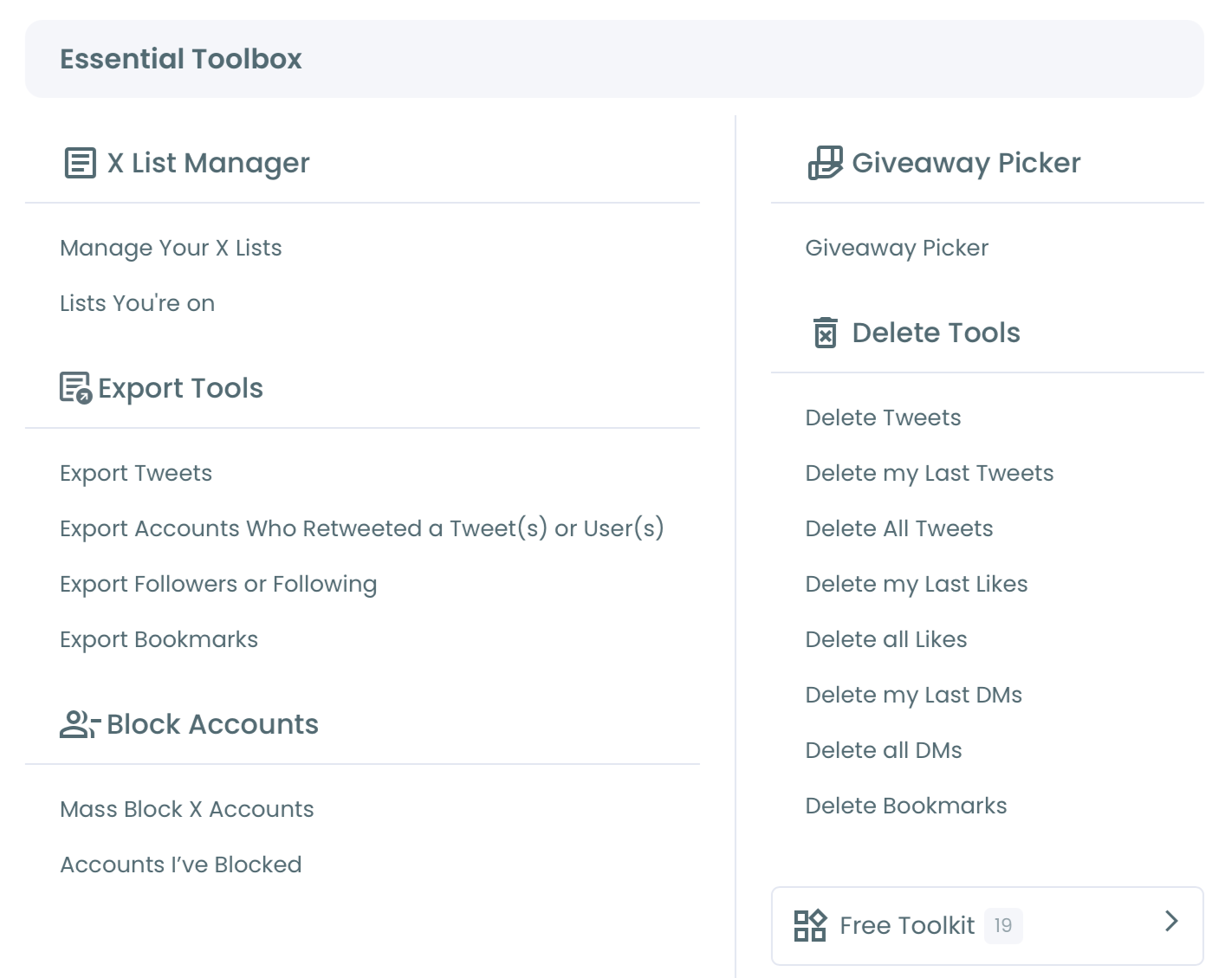
- Open the Essential Toolbox menu and select X List Manager, which opens on every List you already own with its member count and its public or private status.
Group the keepers before you remove anything
- Create one List per reason you follow people. Name each one after a recurring task rather than a vague category, because a List named "Competitors" gets opened and a List named "Interesting" does not.
- Add accounts in bulk from any Circleboom result screen. Select the rows you want, open Add to List, and choose either an existing List or a brand new one. Keep research and monitoring Lists private; X can send a notification when an account is added to a public List.
Clear the accounts driving the volume
- Apply filters to the following list itself. The panel covers account quality flags, verification, follow ratio, tweet count, join date, engagement tier, language, and location, and each active filter appears as a removable chip above the table, which keeps the segment you are currently viewing visible at a glance.
- Whitelist anything you cannot afford to lose, then unfollow the rest in batches. Whitelisted accounts sit outside every bulk operation Circleboom runs, and the tag stays on them, so the same protection applies to every future cleanup as well.
That order matters more than any single filter.
Building the Lists first means the accounts worth reading survive the cleanup as a pinned feed, and whitelisting before you unfollow means one careless click cannot cost you a customer or a partner.
At a glance: connect, open the List Manager, build Lists, filter the following list, whitelist, unfollow.
Which filters to run first on your X following list
One filter is worth running before all the others.
The language filter is usually the single biggest cut available on a following list that spans several languages, because a language you no longer read is unambiguous evidence and takes no judgement call to act on.
Export the segment before you act on it, too. Circleboom writes the selected rows to CSV, so if a filter caught somebody it should not have, the record of who was in that batch still exists after the batch has run.
Sorting by tweet count finds a different kind of candidate. The accounts at the top of that column are not necessarily low quality, they are simply prolific, and a prolific account occupies far more of your feed than its follower count would suggest.
Circleboom's roundup of overactive accounts to mute on Twitter isolates that group without touching the relationship at all.
Reversible options deserve their own pass before the irreversible ones. Our notes on curating your feed with Twitter mute set out what a mute changes and what it quietly leaves alone. That is the right test for any account you are unsure about.
None of this replaces judgement, and it is not supposed to; what it replaces is the scrolling. Every one of those decisions was already available to you on X, one profile visit at a time.
What changes is that you can build a clean Twitter feed from X Lists in an afternoon instead of a fortnight.
Where to start on your Twitter feed cleanup
A clean Twitter feed is a maintained state, not a one-time project, and the maintenance is short once the structure exists.
- Build three Lists this week, one per recurring reason you open X.
- Filter your following list by language and posting volume before anything else.
- Whitelist partners, customers, and key contacts before the first batch.
- Unfollow in batches of 100 to 150 and let the queue pace itself.
- Re-run the filter regularly rather than waiting for the feed to degrade again.
Work through those five and the timeline stops being something that happens to you.
The change shows up the same evening, because an account you removed stops being eligible straight away rather than fading out over a retraining period.
There is a second return that takes longer to notice. Your following list is public, so it doubles as a statement about which communities you associate with, and trimming it changes what a stranger reads off your profile at the same time as it changes what you read every morning.
The scale of that first pass is usually larger than people expect. Say 200 of 900 follows were campaign follow-backs from years ago.
That group was supplying close to a fifth of everything eligible to appear and none of the value, which makes the first hour the cheapest hour you will spend on the platform.
→ clean up your Twitter feed with the X List Manager
Questions worth settling before your first pass
How many accounts can I add to one list on X?
X allows up to 5,000 members per list and up to 1,000 lists per account. Both ceilings are set by X at the platform level, so they apply no matter which Circleboom plan you are on.
Will people know I added them to a list?
Only if it is public. X can notify an account that it has been added to a public list, while private lists are not visible or discoverable by anyone else, which makes private the right default for competitor and research work.
Does unfollowing someone block them?
No. An unfollowed account can still see your posts, reply to them, follow you, and message you. Unfollow only changes what reaches your timeline, which is why it is the correct tool for a feed problem and the wrong tool for a harassment problem.
How often should I redo this?
Regularly, and less often than you would expect once the Lists exist. Most of the drift comes from new follows, so a short pass through the accounts you added since the last audit is usually enough to keep a clean Twitter feed clean.