
Your superfans on Twitter are the followers who have retweeted you more than once, and you find them by ranking your follower list on retweet count instead of on follower count. X does not offer that ranking anywhere in its interface.
Circleboom finds your superfans on Twitter by reading up to your last 3,200 posts through official X data access, collecting the retweeters of each one, and matching that pool against your current follower list. Every account then carries a Times Retweeted number, and sorting on it puts your most loyal followers at the top.
→ find your superfans on Twitter
What that number means, and what to do with the people it names, fills the rest of this walkthrough.
Why X will not show you who your superfans are
X shows you a follower count and a notification feed, and neither one ranks anybody. The follower list is ordered by recency, so the person who has reposted you fourteen times sits in the same undifferentiated scroll as the account that followed you last Tuesday and has never read a word.
Native search does not close the gap either. X's own documentation on how to find people on X describes lookup by name, handle, and contact import. That is discovery of strangers, not ranking of the people already in your audience.
So the loyalty data exists, but it exists scattered across individual post pages. You would have to open every post, read its retweeter list, and tally names by hand to build the ranking yourself.
That manual tally is what Circleboom's Engaging & Loyal Followers report replaces. Circleboom counts the reposts for you and attaches a repost total to every follower on your Twitter account, which is the ranking X never exposes.
It is also why so many creators quietly over-index on follower count. The count is the only number the platform hands them, so it becomes the number they optimize.
The case for the opposite priority sits in this look at whether it is better to have lots of Twitter followers or fewer followers who are more engaged.
There is a vocabulary problem underneath all of this too. "Superfan" is a word borrowed from newsletters and Patreon, where it describes someone who pays.
On X nobody pays, so the word has to be redefined around behavior, and the redefinition is what this breakdown of what engaging and loyal followers are on Twitter works through.
What actually counts as a superfan on X
A superfan is defined by what X will attribute, not by what you feel. This is the part most articles on this topic skip, and it changes the whole exercise.
Three engagement signals exist on X: likes, replies, and reposts. Only one of them is what the loyalty report ranks on.
- Likes are not what this report counts, so a prolific liker carries no rank inside it.
- Replies do not feed it either, and they would reward volume anyway, since one argumentative reply guy would outrank ten quiet supporters.
- Reposts are what Circleboom totals per account across every post the pipeline reads.
A repeat repost is the signal this ranking is built on, which is why the Times Retweeted column is the column that matters here.
The second constraint is the window. X's API exposes a maximum of your last 3,200 posts, so the superfan ranking describes a rolling recent era of your content rather than your lifetime on the platform.
If you post ten times a day, that window is roughly a year. If you post twice a week, it reaches back years.
Neither reading is wrong. But knowing which one you are looking at stops you from mistaking "quiet lately" for "never cared," and it explains why a follower who carried you through 2019 may not appear at all.
There is a content-side mirror to this that is worth running in parallel. The superfan ranking tells you who repeats; your own post history tells you what they repeated.
Reading both together is how you learn which format your advocates are willing to put their name on, and the shortest path into that half is finding out how to see your most retweeted tweet.
The two readings rarely agree, which is the useful part. A post can carry huge impressions and produce almost no repeat reposters, while a smaller, sharper post pulls the same fifteen names every time.
The second kind is the one your superfan list is quietly made of.
How to find your superfans on Twitter step by step
On screen: the finished table with the Times Retweeted column sorted descending.
https://www.youtube.com/watch?v=UlxE2GnvGrQ
To find your superfans on Twitter, connect the account, open the follower analytics menu, let Circleboom process your post history, then sort the finished table by Times Retweeted. The three phases below take you from an authorised account to a segment you can act on.
Connect the account
- Log in to Circleboom Twitter and connect the X account whose superfans you want to rank.

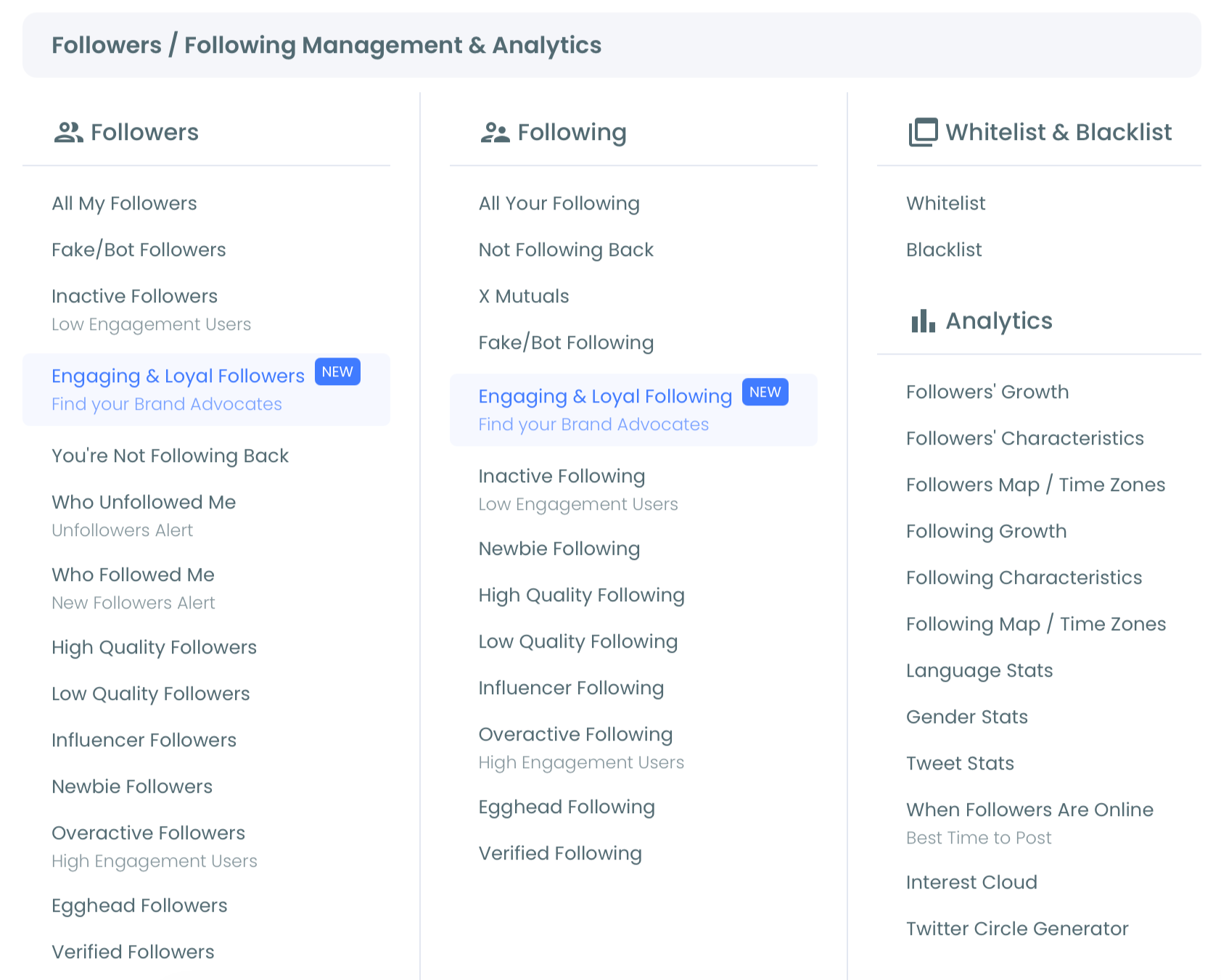
- Open the Follower & Following menu, which holds every audience segment Circleboom builds from your account.
Start the scan and let it finish
- Select Engaging & Loyal Followers and leave the preparation screen to run. It reports each stage as it goes: fetching your posts, fetching the retweeters of each post, removing duplicates and inauthentic accounts, then finalizing the list. Processing takes one to three hours and you get a notification when the results are ready.
Read the ranking and act on it
- Sort the results by Times Retweeted, descending. The column is unique to this report and it is the whole point of the exercise. Top rows are the accounts that have carried your posts most often.
- Filter before you act. The panel opens as a side drawer with the controls you need to narrow the segment: engagement tier, verification status, follower and following counts, follow ratio, join date, language, location, and a bio and name keyword search.
- Select the accounts and pick an action. The bulk bar covers Follow, Add to List with Twitter List, Whitelist and Blacklist options, and Export to CSV against your remaining export tokens.
Nothing in that sequence survives being moved.
Authorising the account is what lets Circleboom read your post history at all, the menu scopes you to audience data rather than post data, and the processing run does counting no manual method can match. The sort is what turns a raw pool into a ranking you can filter and act on.
What to do with your superfan list once you have it
The list is worth building only if it changes something you do.
Three actions cover almost every case, and each is available from the same bulk bar.
Whitelist them first. The label means the next cleanup you run cannot reach them, however many filters you stack or how many passes you make.
This matters more than it sounds: superfans are frequently small accounts with low follower counts and modest post totals, exactly the profile that quality filters flag. Whitelisting is what stops a routine cleanup from removing the people who spread your work.
Add them to a Twitter List. A dedicated advocates list turns a one-off report into a feed you can check and reply to on purpose.
The Twitter List Manager handles creation, membership, and export from one screen, and the bulk bar can either drop the selection into an existing list or spin up a new one with those accounts as its founding members.
Lists work here because they solve a sequencing problem rather than a storage problem. Your advocates are scattered across a timeline you cannot control; a list is a timeline you can. The habit side of that is covered in this walkthrough on how to use Twitter lists effectively.
Export the segment. The CSV carries username, follower and following counts, post count, account age, verification type, location, and bio.
Circleboom's own in-app recommendation on this screen is to run low-budget X Ads against the exported accounts, on the logic that people who have already reposted you are the least speculative audience you can buy.
The math is worth sitting with for a second. Suppose a 12,000-follower account finishes its run and 60 accounts show a Times Retweeted value above one.
That is half a percent of the audience doing the repeat sharing. It reframes "grow the follower count" into "keep and activate those sixty," which is a smaller and far more tractable job. You can watch the same pattern from the content side in X engagement analytics.
None of this makes the wider audience worthless. It just puts the numbers in proportion, and this look at how many followers actually see your tweets explains why the gap between a follower count and real reach runs as wide as it does.
Ready to run it on your own account? Start with your Twitter superfans.
Is it safe to run this on your X account?
Yes, and the reason is architectural rather than reassuring. Circleboom is an official X Enterprise Developer company, which is what lets a pipeline this long run against your account while you do something else entirely.
No private interaction data is touched, no direct messages are read, and nothing outside public engagement enters the report.
The report itself is read-only. Building the ranking changes nothing about your account.
Only the actions you choose afterward touch your relationships, and the pacing has a practical consequence worth planning around: at 50 follows every 15 minutes and 400 in a day, a long follow-back list is a two-day job rather than an afternoon, with the queue pausing and resuming on its own at the ceiling.
One honest limitation. Results reflect the moment the run finished, not live state. A follower who started reposting you yesterday will not appear until you generate a fresh list, which is why the date selector keeping every past run is useful rather than decorative.
A second limitation is worth naming because it is a judgment call, not a technical one. Repeat reposting proves relationship, not fit.
Someone can push every post you write and still sit outside the niche you sell into. Treat the ranking as a shortlist to read, not a verdict to act on blindly. The wider habits that move the number for everyone are collected in this look at how to improve your Twitter engagement rates.
The one column that reorders your audience
Finding your superfans on Twitter comes down to one substitution: rank your followers by how many of your posts they have reposted rather than by how many followers they have.
Circleboom builds that ranking from up to 3,200 of your posts, cross-checks it against your live follower list, and hands you a sortable Times Retweeted column plus the filters and bulk actions to do something with it.
The list pays off in three places. It protects your advocates from cleanup, it gives you a named group worth replying to, and it produces the most qualified export you can hand to an ads campaign.
The people who carry your posts already exist. This is the report that tells you their names.
Reader questions about the loyalty ranking
How long does the superfan report take to run?
One to three hours. Circleboom has to request the retweeter list for every post in your history separately, so the wait scales with how much you have published. The preparation screen names the current stage while it works, and you are notified when the results are ready.
Does the report include people who are not following me?
No. The retweeter pool is cross-checked against your current follower list, so only followers appear. If you want the wider group of everyone who has ever reposted a specific post, that is a different job and a different report.
Why do some of my most loyal followers not show up?
Two usual reasons. They engaged with posts older than the 3,200-post window, or they engage by liking and replying rather than reposting. The ranking counts reposts because a repost is the action Circleboom can attribute and total per account across your whole post history.
What happens to someone's ranking if they unfollow me?
They drop out. The retweeter pool is matched against your live follower list every time the report is generated, so an account that leaves stops appearing in the next run even though the reposts it made are still on X. The ranking describes current followers, not everyone who ever amplified you.