
Your Twitter home feed keeps returning the same four or five names, and everything else you follow has gone quiet by comparison. The symptom is real and it is measurable.
The cause sits where most searches never look. A timeline is assembled from the accounts you follow, so the volume problem lives on your following list, not inside your audience.
Which accounts are flooding my Twitter timeline, and how do I find them?
They are accounts you follow, not accounts that follow you. Circleboom groups every high-frequency account on your following list into an Overactive Following view, reads posting frequency from X's own official API data, and lets you unfollow, list, or protect each one from a single table.
→ accounts flooding your Twitter timeline
Can a follower actually flood your Twitter timeline?
No. A follower reads your posts. You never read theirs unless you follow them back.
That one-way rule is why the phrase most people type into search does not match the thing they are trying to fix. The wording feels right because both relationships sit under the same everyday word. Mechanically they are opposites: one controls who receives you, the other controls what reaches you.
So when you go hunting for the followers flooding my timeline on Twitter, the accounts you actually want are on the following side. Nothing you do to a follower, including removing them, changes a single post in your feed.
The wrong fix is easy to reach for. Removing a follower is a visible, satisfying action that produces zero feed improvement.
Plenty of people run that cleanup, watch nothing change, and conclude the problem is the algorithm. It usually is not. It is a routing mistake baked into the search phrase itself.
Circleboom happens to be one of the few places where the difference is checkable rather than arguable, because it ships both views side by side under the same menu.
The two overactive views, and what each one answers
Circleboom carries an Overactive Following view and an Overactive Followers view. They read the same underlying signal and answer two different questions.
Overactive Following lists accounts you follow that post at unusually high frequency. These are the accounts occupying your feed. Circleboom computes posting frequency by dividing an account's total post count by its account age in days, then isolates everything above the overactive threshold.
Available actions there are Unfollow, Add to List, Whitelist, Blacklist, and Export.
Overactive Followers lists accounts in your audience running at the same extreme volume. That view answers an audience-quality question rather than a feed question: which of the people receiving your posts are posting at machine cadence.
Its actions differ, because the relationship differs: Remove Follower, Follow, Add to List, and Export.
Where the two lists overlap is the part worth reading
An account appearing in both views is a mutual, and mutuals are the only accounts that can be a volume problem in your feed and a composition question in your audience at the same time.
An account that shows up only in Overactive Followers has never once touched your timeline. Whatever you decide about it, you are making an audience decision, not a feed decision.
Running both views back to back takes a minute and settles the question permanently. Most people never do it because the search phrase told them there was only one list to look at.
Circleboom pulls both through an official X Enterprise Developer company relationship with the platform. That is what keeps a bulk unfollow inside X's own rate windows rather than tripping the platform's aggressive-behavior detection.
The Twitter follower quality and following quality scores sitting beside each row are worth reading before you act. Volume alone is not a verdict, and Circleboom's own guidance is explicit about that.
Once both lists are visible, the fix is a short sequence. Start with the high-volume accounts flooding your feed and work down.
How to find the followers flooding my timeline on Twitter with Circleboom
Two minutes on screen: the Overactive Following view sorted by tweet count, before a single unfollow is confirmed.
https://www.youtube.com/watch?v=-YWvGUWQg3A
The process, in order.
Open the view that actually controls your feed
- Log in to Circleboom Twitter and connect the X account whose timeline you want to repair.

- Open the Follower & Following Management and Analytics menu, which is where both overactive views live.
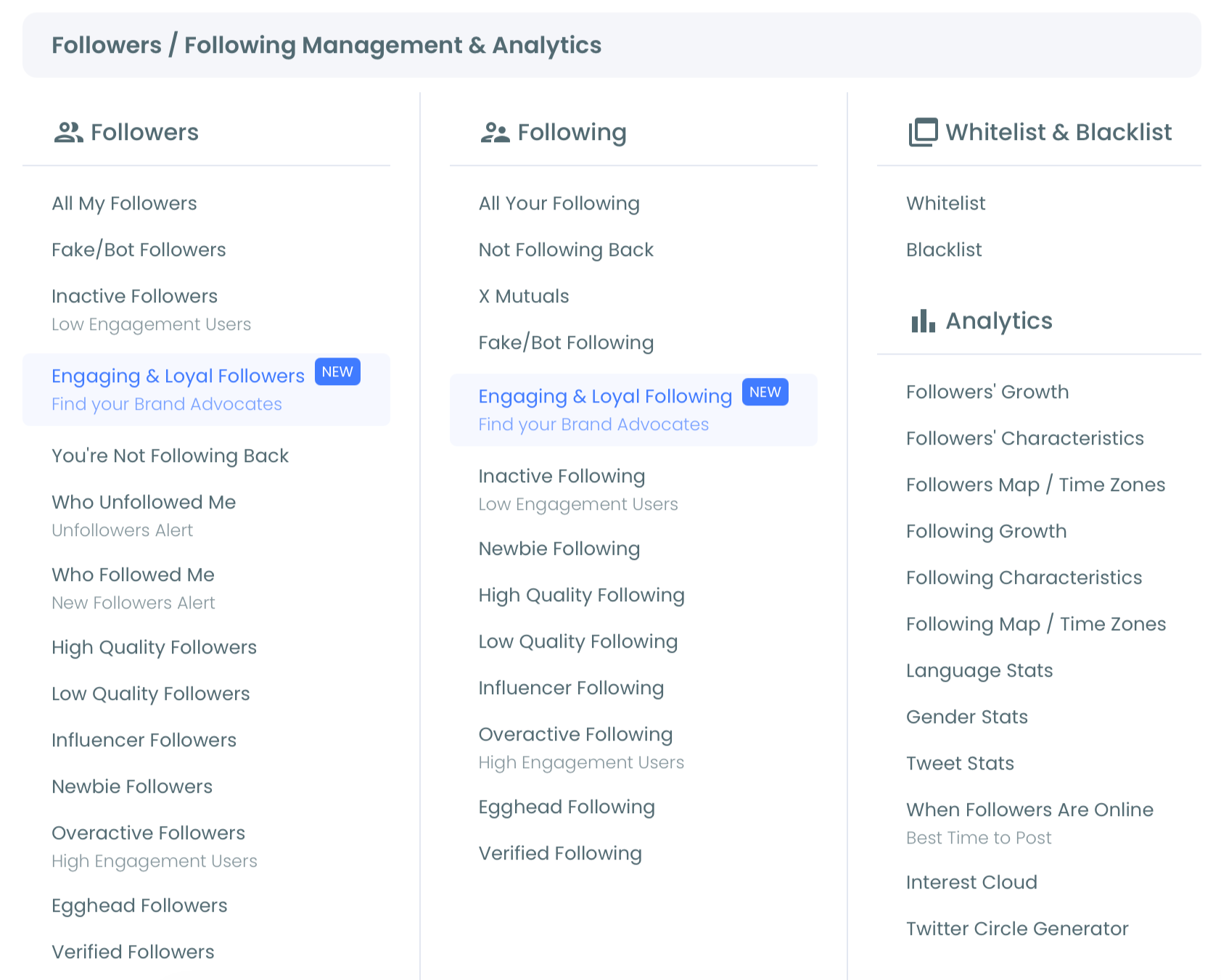
- Select Overactive Following rather than Overactive Followers. This single choice decides whether the session changes your feed or only tells you something about your audience.
Separate the loud accounts you want from the ones you do not
- Sort the Tweets column descending, then read it against the Joined column. Total post count is lifetime volume; the join date turns it into a rate.
- Whitelist the high-volume accounts you follow on purpose. News desks, live-event reporters, market data accounts, and prolific creators post heavily by design, and a whitelist protects them from every bulk action across the platform.
- Unfollow the rest, or move them into an X List first. Circleboom processes 50 unfollows every 15 minutes, up to 800 a day, and resumes automatically the next day once the quota resets.
Each step in that sequence protects the one after it. The login authorizes the data pull, the menu choice puts you on the following side, and the whitelist pass runs ahead of the unfollow so nothing valuable is swept into the batch.
The short version of that sequence:
- Connect the account, then open the Follower & Following menu.
- Choose Overactive Following, not Overactive Followers.
- Sort by Tweets and read the join date beside it.
- Whitelist first, unfollow or list second.
To thin the list by a different signal entirely, the same menu also lets you unfollow inactive Twitter accounts. That is the opposite end of the same distribution.
What the Overactive Following table actually shows
Every row carries seven columns: Name, Tweets, Joined, Following, Followers, Follow Ratio, and an activity classification that reads as Active, Moderate Active, or Inactive.
Those last two columns do most of the diagnostic work.
A high-volume account classified as Inactive or Low Engagement is publishing constantly while almost nobody responds, and that pairing is a far stronger automation signal than raw volume on its own.
Follow Ratio adds the second half of the picture. An account following thousands while being followed by very few, posting at extreme frequency, with nothing engaging back, is not a prolific creator.
The filter panel opens as a side drawer and stacks conditions together. Follower Quality carries five dropdowns, each set to show, hide, or show only that type:
- Eggheads, for accounts with no profile photo.
- Protected, for locked accounts.
- Fake/Spam, for the platform's low-trust segment.
- Inactive, for accounts that have gone dormant.
- Overactive, which is the one this workflow turns on.
Beyond those, the panel adds verification status, a bio and name search, whitelist and blacklist state, follower and following count ranges, tweet count ranges, follow ratio ranges, join date ranges, engagement tier, language, and location. Everything combines as an AND condition, and an active-filter bar keeps the current segment visible before you act on it.
Why the join date changes the ranking
Sorting by raw post count alone ranks the wrong accounts first, and it does so consistently.
Here is the arithmetic, using illustrative figures rather than a measured case. An account that joined 400 days ago with 60,000 posts averages roughly 150 posts a day. An account that joined 5,000 days ago with 90,000 posts averages about 18.
The second account has the bigger number in the Tweets column and contributes less than an eighth as much to your feed.
Lifetime volume ranks history. Frequency ranks impact.
Circleboom already applies the frequency calculation when it decides who qualifies as overactive. The ordering inside the view is yours to set, though, and the default reading most people reach for is the misleading one.
For accounts you want to keep watching without the volume, a list is the softer exit. The Twitter List Manager handles that move in bulk.
Lists only earn their keep when they have a job, though. How to use Twitter lists effectively covers the organizing patterns that stop a list from becoming another place you never open.
What changes on your X feed after the pass
The feed gets its variance back. Accounts that were being pushed out by sheer volume start appearing again, and the improvement is structural rather than algorithmic.
There is a second effect worth naming. Your reading habits stop being shaped by whoever posts most, which quietly changes what you reply to and what you amplify.
That matters more than it sounds. Reply behaviour is one of the strongest signals you send about who you are on the platform, and for months it may have been decided by cadence rather than by preference.
A quieter feed is really a feed where your own choices start counting again.
The other change is diagnostic. Once the loudest accounts are handled, any remaining feeling of noise points somewhere else entirely, usually toward the sheer size of the following list or toward the mix of topics inside it. Both are solvable, and neither is the same problem.
Muting stays on X, and that boundary is worth knowing
Muting is the reversible alternative when an account is valuable but loud, and it is an action you take on X rather than inside Circleboom.
Circleboom's job ends at naming the account and handing you the exit routes it controls.
X's own documentation on how muting works on X covers what a mute hides and what it leaves visible.
From the reader's side, how to mute someone on Twitter walks through the same controls in practice.
If an account has crossed from loud into unwanted, how to remove people from your Twitter timeline covers the stronger options.
Your next move, by symptom
If your feed is dominated by a handful of names you recognize and mostly want, keep them and move them into a list, then unfollow from the main timeline so they stop competing with everything else.
If the loud accounts are ones you barely recognize, run Overactive Following, whitelist nothing, and unfollow the segment in batches. Mass unfollow Twitter accounts covers the pacing when the list is long.
If they are loud, unfamiliar, and carry a very low follow ratio alongside an Inactive classification, treat that combination as an automation signal rather than a taste problem, and block instead of unfollow.
And if none of that describes your feed, the volume theory is wrong and the following list is the wrong place to be looking.
→ Start with what is flooding your Twitter timeline
Questions people send me about a flooded Twitter timeline
Does removing a follower quiet my timeline at all?
No. Removing a follower stops that account from receiving your posts, and it has no effect on what appears in your feed. Feed content comes only from accounts you follow, so the fix always runs through the following list.
Can Circleboom mute an account for me?
No. Mute is an X-side action and lives in X's own controls. Circleboom identifies which accounts are worth muting and gives you unfollow, list, whitelist, blacklist, and export as its own actions, but the mute itself happens on X.
How many accounts can I unfollow in one session?
Circleboom processes 50 unfollows every 15 minutes and up to 800 a day. It recommends staying well below that, around 100 to 150 at a time, and when the daily quota is reached processing resumes automatically the next day.
Is a high post count on its own a reason to unfollow?
No, and Circleboom's own guidance says so. Journalists, community managers, and live-event accounts post at high volume because their role requires it. Check the engagement classification and follow ratio beside the post count before acting on anyone.