
Accounts tweeting too much are found by ranking your following list by posting frequency, not by scrolling and reacting.
X publishes no such ranking, so the loudest handles you follow stay anonymous as a group while they take over what you read.
Which accounts I follow are tweeting too much?
Circleboom sorts your full X following list by posting frequency and isolates every account whose tweet-per-day rate sits far above normal user behavior, all through official API access. You then unfollow, whitelist, or move each one into a Twitter List from the same table.
→ accounts tweeting too much
What counts as an account tweeting too much on X
An account is tweeting too much when its posting rate runs far above ordinary user behavior, measured against how long the account has existed.
That second half matters. Raw tweet totals punish age, so a careful account opened in 2011 can show a bigger number than a scripted feed opened last spring.
Circleboom computes the rate directly from the X profile data behind each row: total tweet count divided by account age in days. Accounts whose result crosses the overactive threshold get pulled into their own view, separated from the rest of your following list.
The number is descriptive, not a verdict. A newsroom, a live-sports commentator, a market-data account, and an automated repost farm can all land in the same frequency band.
Volume tells you who is loud. It never tells you who is worth it.
That distinction is the whole reason the feature exists as a review surface rather than a delete button.
Before you touch anything, you want to see the ranked list of accounts that tweet too much with tweet counts, join dates, follow ratios, and engagement classification sitting in the same row.
Why X gives you no way to sort your following by posting frequency
X shows your following list in a single scrolling column with no sort control and no per-account statistics. You can open a profile and read its tweet count, but there is no view that ranks two thousand accounts by how often they post.
That gap is why a noisy timeline feels like a mystery.
The symptom is obvious and the cause is invisible.
A reader with 800 follows would have to open 800 profiles, note two numbers from each, and do the arithmetic by hand to reproduce what a frequency ranking gives in one pass. Nobody does that, so the loud accounts keep their cover.
The same blind spot shows up when people try to audit their follows at all, which is why a Twitter following list viewer is usually the first thing anyone reaches for.
Circleboom closes the gap by pulling your entire X following list with per-account tweet counts and creation dates attached, then computing the rate for every row before you look at it. The heavy lifting happens before the page renders.
What arrives is a table, not a feed.
Every followed account occupies one row carrying its display name, total tweets, join date, following count, follower count, follow ratio, and an activity classification, and every one of those columns sorts.
That structure changes the question you can ask.
A feed only lets you ask what happened recently; a sortable table lets you ask who has been producing the most, for how long, and with what response, which is the question a noisy timeline actually poses.
How to find accounts tweeting too much on X in one filtered pass
Watch the same segment get built and cleared on screen: this walkthrough covers the low-quality end of a following list from sort to unfollow.
https://www.youtube.com/watch?v=TKLnXgdzJCc
Finding the accounts tweeting too much on X takes two moves: rank the following list by posting frequency, then layer quality filters on top of that ranking so genuine power users separate from automation.
The five steps below run that loop start to finish, and the second phase is the one that protects the follows you actually want.
Rank the following list by posting frequency
- Sign in at Circleboom Twitter and hook up the X account whose timeline is the problem.

- Open the Follower and Following management and analytics menu, which holds every audience segment Circleboom builds for the connected account.
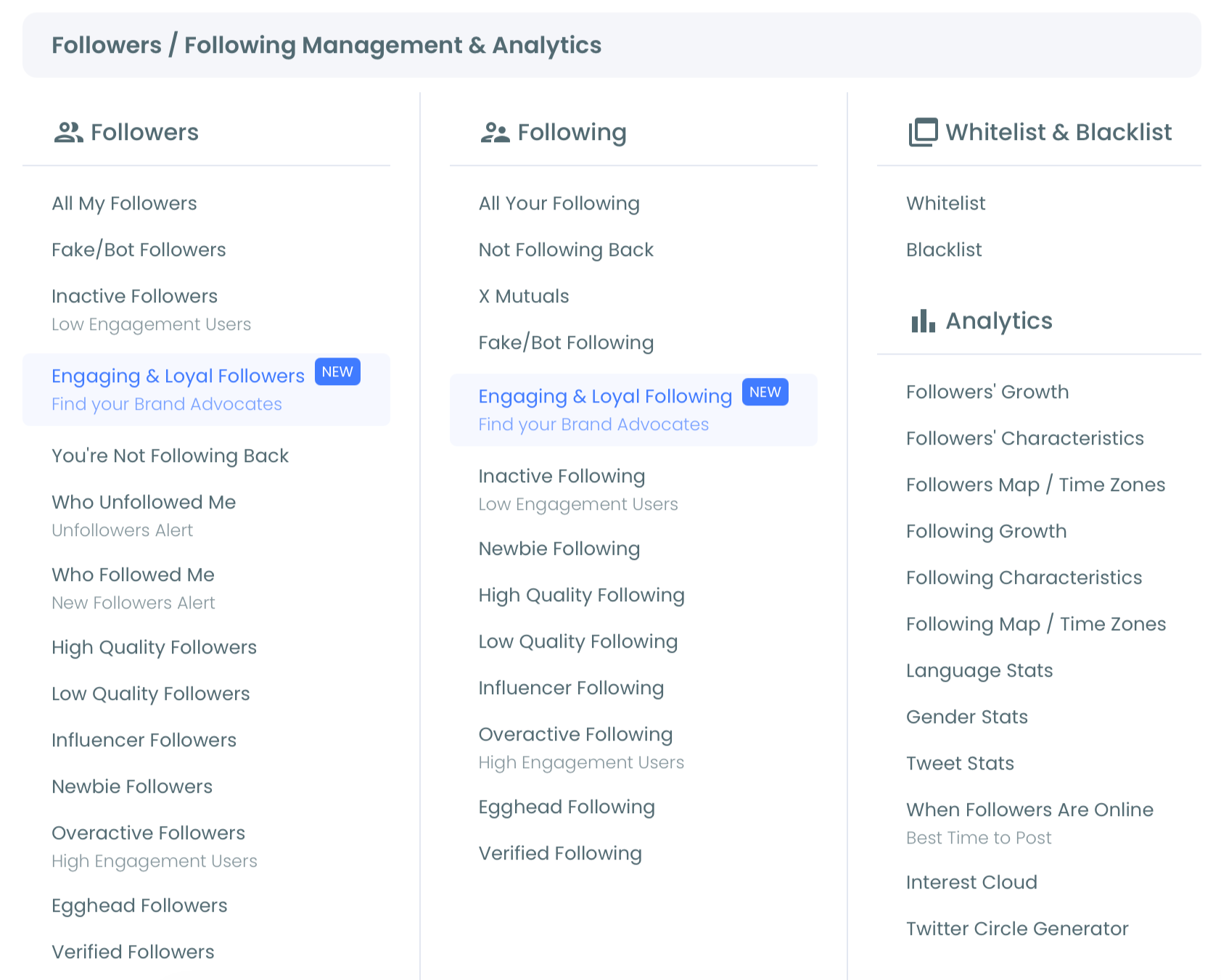
- Choose the Overactive segment inside your following list, then sort the Tweets column descending. The heaviest posters move to the top of the table, and the Joined column beside them shows the account age the rate was computed against.
Separate real broadcasters from automated noise
- The quality filters live in Filter Options: switch on Overactive alongside Fake/Spam and Engagement. A Follow Ratio maximum then isolates handles that publish constantly while almost nobody follows back, and Find in Bio and Name strips out subjects you stopped caring about.
- Click Open Profile on the top rows and read the last dozen posts before you decide anything. A verified news desk at ninety posts a day and an empty-bio account at ninety posts a day look identical in the table and nothing alike on the page.
That order works because ranking establishes the true size of the problem before any judgment enters, and filtering narrows the segment before any action does.
Reversing the two produces a list you cannot trust and a cleanup you will regret.
At a glance: connect, open the menu, sort by tweets, stack the quality filters, then read profiles before acting.
The three signals that separate a power user from a spam feed
Posting frequency by itself is one signal, and one signal is never enough to act on.
Circleboom attaches three more to every row in the segment, and reading them together is what turns a volume list into a decision list.
The pairing that matters most is high frequency with an Inactive or Low Engagement classification. An account publishing at automation-like volume while collecting almost no replies, likes, or reposts is broadcasting into a void, which is exactly what a scripted feed does. Genuine power users generate conversation in proportion to their output.
Follow ratio is the second check. An account with 40,000 posts, 300 followers, and 4,000 follows is not a publication, whatever its bio says. Real broadcasters accumulate an audience because people choose to receive them.
Profile completeness closes the set. A bio, a photo, a coherent posting history, and a join date that predates the account's output pattern all point toward a human.
Their absence does not prove automation on its own. The difference is worth understanding before you judge anyone, because bots and automated accounts on X are not the same category under X's own rules.
Read together, those signals give you a working rule:
- High frequency plus strong engagement means keep, or move to a Twitter List.
- High frequency plus a Fake/Spam flag means unfollow.
- High frequency plus low engagement plus a lopsided follow ratio means unfollow.
- High frequency on a topic you no longer care about means unfollow regardless of quality.
- High frequency you signed up for on purpose means whitelist, immediately.
Whitelisting is the step people skip and then regret.
The shield icon marks an account as protected so no later cleanup sweeps it up by its tweet count, and running it first is what makes every future audit of your account safe to run at speed.
What to do with the accounts you find
Three exits exist, and only one of them cannot be undone.
Muting is the gentlest. The account stays followed, its posts stop reaching your timeline, and you can lift the mute whenever you want. X keeps that setting entirely on its own side, and its documentation on muting accounts explains what the muted account can and cannot see.
Circleboom's contribution is telling you which handles deserve the mute in the first place, since X will never rank them for you. If you have muted people before and lost track of who, you can still see muted accounts on Twitter from your settings.
A Twitter List is the middle exit and usually the smartest one. Select the valuable-but-loud accounts, choose Add to List, and their output becomes a place you visit rather than a stream you get flooded by. The relationship survives and the timeline recovers.
Unfollowing is the last exit, and it belongs to accounts whose volume returns nothing at all.
Circleboom runs the action through the X API as an official X Enterprise developer, so a bulk cleanup on your following list stays inside platform rules instead of gambling with your account standing.
Work down the segment of overactive accounts you follow one filtered batch at a time and the timeline changes shape fast.
Export sits alongside all three. The Export button downloads the current selection as a CSV and consumes export tokens, which gives you a record of the segment exactly as it looked before anything changed.
Is it safe to unfollow accounts tweeting too much in bulk?
Yes, provided the batch is paced.
Fifty unfollows per 15-minute window and roughly 800 per day are X's numbers, and Circleboom releases a selection into them in stages instead of all at once.
Staying at 100 to 150 accounts per sitting keeps you comfortably under the ceiling.
The account locks people report almost always follow rapid, unpaced unfollowing, which is the behavior the pacing is designed to prevent. The mechanics are laid out in more depth in how to unfollow Twitter accounts without getting suspended.
Two habits carry most of the safety.
Read the whole selection before you confirm it, and protect anything you would miss with the shield icon, because dropping a follow is the one move the segment cannot walk back.
Blocking is a heavier instrument than unfollowing and should stay reserved for behavior that is harmful rather than merely frequent. Adding an account to the Mass Block queue is a statement about conduct, not about volume.
Which cleanup path fits what your ranking shows
Your move depends on what sits at the top of the segment.
If the top of your segment is three or four accounts you follow on purpose, whitelist them and stop. Your feed problem is smaller than it felt, and the fix took one pass.
If the top is a mix of real sources and empty-bio broadcasters, split it: lists for the sources, unfollow for the rest. That is the common case, and it is what a proper Twitter follower and following manager workflow is built to handle.
If the top is dominated by accounts you no longer recognize, treat the volume audit as the entry point to a broader cleanup. Pair it with the engaging followers and following view so you can see which follows are earning the space they take.
Running the same segment through a Twitter bot checker pass usually explains how the noise arrived in the first place. Volume and automation cluster together at the top of most following lists, and clearing one tends to clear part of the other.
Whichever fork you take, it starts from the same ranked table, and none of the three forks requires you to decide anything about accounts you did not open.
The reason this holds up over time is that nothing in it is permanent by default. Whitelists persist, lists persist, and only the unfollow closes a door, so the audit stays cheap to repeat next quarter.
→ Pull the list of accounts tweeting too much
Common questions about accounts tweeting too much
Does a huge tweet count always mean the account is automated?
No. The overactive classification measures tweet count against account age, so a long-running news desk will post an enormous number for entirely honest reasons. Pair the frequency with the Fake/Spam filter, the engagement classification, and the follow ratio before you read volume as evidence of automation.
Can I keep an account and still stop seeing its posts?
Yes, and that is what muting and Twitter Lists are for. Muting removes the account's posts from your timeline on X's side while the follow stays intact, and a list moves the content somewhere you choose to visit. Unfollowing is the only one of the three you cannot walk back from inside the segment.
How many accounts can I unfollow in one sitting?
X permits 50 unfollows per 15-minute window and about 800 per day, and Circleboom paces batches to stay inside that. Sittings of 100 to 150 accounts keep you well clear of the automated checks X runs against rapid follow activity, and Circleboom resumes on its own the next day when a daily limit is reached.
Will the overactive segment change if I re-run it later?
Yes. Posting rates move, accounts go quiet, new follows arrive, and the segment reflects whatever your following list looks like on the day you open it. Treating it as a recurring audit rather than a one-time cleanup is what keeps a timeline readable over months.