
Your follower count moved this month, and X gave you no breakdown of the movement.
A month where ninety accounts arrived and sixty left looks identical on your profile to a quiet month where nine arrived and six left, because the profile shows one net figure and nothing underneath it.
To find out how many unfollowed you this month on Twitter, open a dedicated unfollower list and set its time window to the last four weeks. Circleboom compares your live X follower list against its own stored snapshots and prints the total at the top of the results, so the month arrives as a number plus the named accounts behind it. Divide that total by your follower base and you have a churn rate that stays comparable next month.
→ Run the count: how many unfollowed you this month on Twitter
What follows is mostly about what that number looks like when nothing is actually wrong.
How to find out how many unfollowed me this month on Twitter, step by step
On screen: the unfollower tracking flow, from connecting the profile to reading the list of accounts that left.
Six actions, split across two phases.
Open the four-week window on your departures
- Log in to Circleboom Twitter, then authorize the X profile whose figure you need.

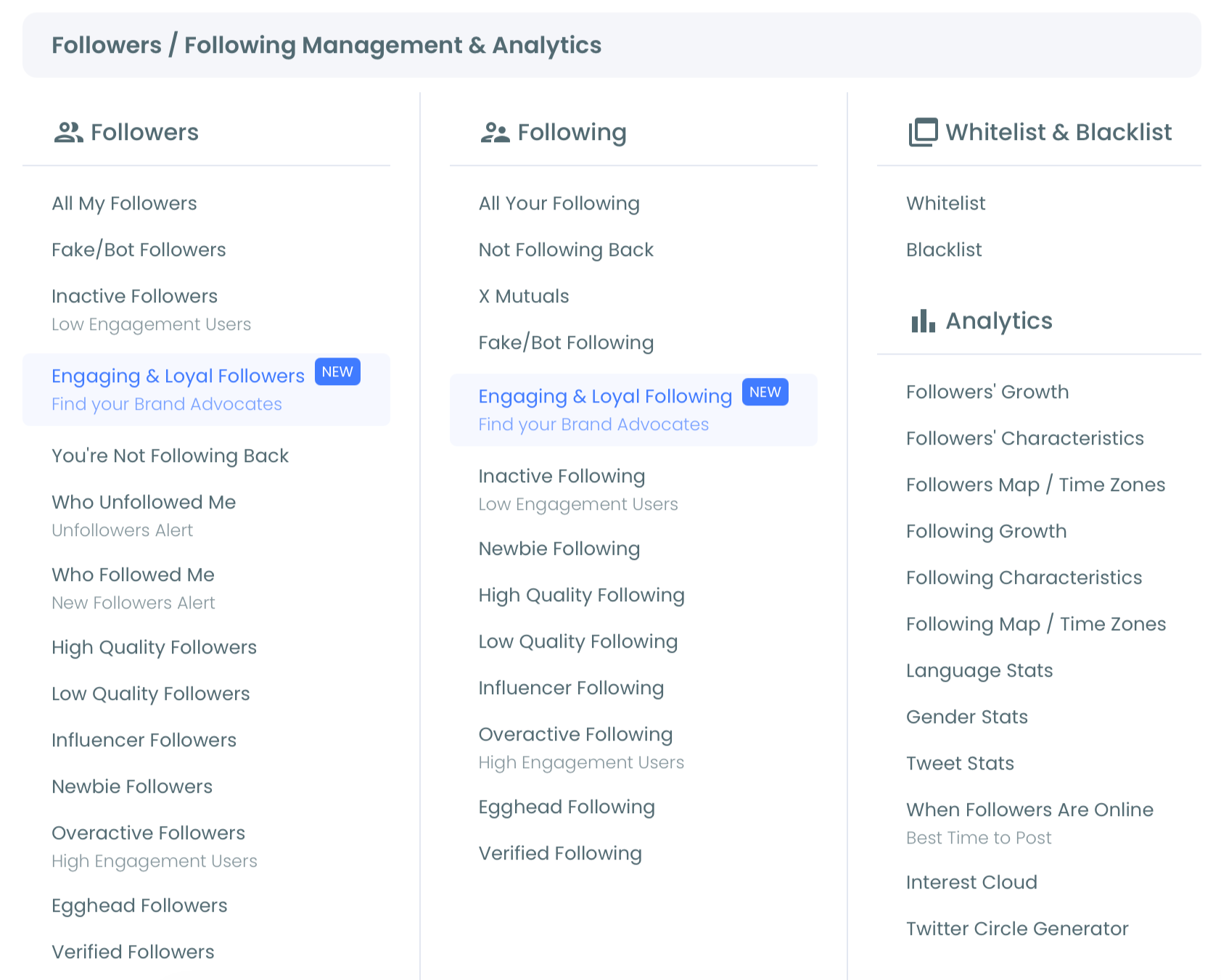
- Open Follower / Following Management and Analytics, whose section list contains Who Unfollowed Me.
- Switch the time period control to last 4 weeks. It sits directly above the account list, outside the filter panel, and starts on last 1 day. That default is why so many people check, see four names, and conclude nothing happened.
Turn the total into a rate you can carry forward
- Read the count in the page header. The line above the table states how many accounts unfollowed you inside the window you just selected. That figure is the answer to the question you came with.
- Divide the total by your current follower count. A raw count means nothing on its own, because it grows with your audience. A percentage stays honest as the base moves.
- Save the list as a CSV before you move on. Your remaining export tokens are displayed beside the button, and the file is what lets this month be compared with the next.
This order matters because every step removes one way of being wrong.
Widening the window before reading the number stops you answering a one-day question with a monthly mindset. Converting to a rate stops you panicking at a total that is only large because your account is.
At a glance:
- Authorize the profile.
- Find Who Unfollowed Me under the follower section.
- Widen the window to four weeks.
- Take the header total.
- Turn it into a rate and keep the CSV.
Why X shows you a number and never the names
X does not tell you who left, and it never has. Its own help page on following on X says the platform emails you when someone new follows you. In the other direction it says only that no notification goes out when an account unfollows.
The asymmetry is deliberate on X's side and expensive on yours. Arrivals get a notification, a name, and a profile you can look at. Departures get a silent decrement.
So the only way to answer the question is to hold your own history. That is what a follower snapshot does: it stores the list as it stood, then compares it against the list as it stands now, and the difference is your month.
Open the answer to how many unfollowed me this month on Twitter and it works from a cold start. The history only builds forward from the day you connect.
That is the one cost of waiting. Readers who have been asking who unfollowed them on Twitter for months discover that the answer was available all along, just not retroactively.
What is a normal number of unfollowers per month on Twitter?
Normal is a percentage of your own base, not a number anyone else can hand you.
An account with 800 followers and an account with 80,000 followers do not share a threshold, and treating twenty departures as identical for both is how people talk themselves into panic or complacency.
Run the arithmetic on your own figures.
If 12,000 accounts follow you and 180 left over the last four weeks, that is 1.5% monthly churn. If 900 follow you and the same 180 left, that is 20%, and the two situations have nothing in common except the raw total.
The rate is the reading. The count is just the input.
The base you divide by should be the live one, not the number you remember from your last screenshot. Twitter follower stats give you the current figure.
Using a stale base is the most common way a churn calculation quietly drifts by a few tenths of a percent every month, which is exactly the size of the change you are trying to detect.
Two forces that move your rate on their own
Two things move that percentage without any content change on your part.
Larger accounts shed more in absolute terms, because a bigger audience holds more loosely attached followers who joined for one post and never engaged again.
Accounts that grew fast recently churn harder for a related reason: a share of every growth spike is people who followed on impulse and drift away within weeks.
That second effect catches people out constantly. A campaign that adds 2,000 followers in two weeks will show up as an elevated churn month roughly four to eight weeks later.
It reads as a content problem when it is really the tail of the win.
That is also why people keep losing followers on Twitter while doing nothing differently. A stable rate under a growing base still produces a rising count.
Your first three months of readings are worth treating as calibration rather than diagnosis. You are learning where your own line sits, and no external benchmark can tell you that, because your niche, your posting cadence, and your acquisition sources all move it.
Reading this month against last month without a calendar view
No calendar-month option exists in the time period control, and that is worth understanding before you compare two readings. The choices run from a single day at the narrow end up to a full year at the wide end, with four weeks and three months among the steps in between.
Every one is a trailing window measured backward from today. A four-week window reaches back 28 days from the moment you open it, so it begins partway through the previous month rather than on its first day.
Two consequences follow, and both are easy to work with once you know:
- A four-week figure is a 28-day rate rather than a calendar-month rate, so it will not reconcile against anything measured on calendar boundaries.
- Compare a four-week reading against another four-week reading, never against a three-month one divided by three.
The nested windows are also useful in their own right. If last 4 weeks reports 180 and last week reports 140, the month was not a month at all; it was one week with a tail, and the cause sits in those seven days rather than across the whole period.
Anyone tracking followers daily, weekly, and monthly is really building the same nested picture from the other direction.
What the monthly figure is worth once you have three of them
One reading tells you almost nothing.
Three consecutive readings tell you whether your audience is stable, thinning, or reacting to something you changed, and that is the point at which the number starts paying for the minute it costs.
The list underneath the total is where the judgment happens. Each row carries:
- A creation date.
- A lifetime post count.
- The two follow numbers.
- The ratio they produce.
- A label for how active the account is.
That is enough to tell a 1.5% month of dormant accounts falling away from a 1.5% month of people who used to reply to you. Same percentage, entirely different news.
Circleboom reads this data as an official X Enterprise Developer company, which is the reason the monthly figure works as a measurement rather than an estimate. A tool working around the API instead of through it gets partial follower lists, and a partial list produces a churn rate that is wrong in an unknowable direction.
Start the Twitter unfollowers alert if you would rather not remember to check. You give the control in that page's top right corner an email address, and Circleboom then mails you a recurring digest naming each account that has gone since the previous message.
When a high month deserves a reaction
React to the composition of a month, not to its size. A month that runs double your usual rate is a question, and the filter panel answers it faster than staring at the total does.
Open Filter Options on the same screen and narrow the month's departures three ways:
- By engagement classification, to see whether the accounts that left were ever active.
- By follower count or follow ratio, to separate real readers from ratio-balancing accounts.
- By join date, to spot a band of profiles created around the same time.
An active filter bar appears above the list showing exactly which criteria are applied, and each one can be cleared individually, so you can hold the window fixed and swap filters until the shape of the month is obvious.
Deciding what the filtered month means
The reaction follows from what survives the filters.
If the engaged and long-standing accounts are still in your audience and the departures were dormant profiles, your content is fine and your denominator just got healthier.
If the people who left were the ones who used to reply, the month is telling you something and the total was never the interesting part.
The mistake I see most often is a doubled month being treated as a verdict before anyone has opened the list at all.
There is a third outcome that catches people out, and it is the most common of the three.
Most months come back mixed, with no dominant group, and mixed is a result rather than a failure to find one. A month with no pattern in it is the definition of ordinary churn, and the correct response is to write the rate down and close the tab.
For the incoming half of the equation, Twitter follower growth stats show the net line that your churn figure sits underneath.
Marketers who only watch that net line are the ones who get surprised. A flat month can hide 300 departures replaced by 300 arrivals, and those are two completely different audiences wearing the same number.
Where this leaves you
A follower count is a scoreboard. A monthly churn rate is a measurement, and only one of the two survives contact with a question like "is this bad?"
Once you know your own rate, the reaction to a drop stops being emotional and starts being arithmetic.
Twenty departures against a base of 900 is a signal worth reading. The same twenty against 12,000 is a Tuesday.
Readers still searching for who unfollowed them are usually asking a rate question in count language, and the count never answers it.
→ Pull this month's number: how many people unfollowed you this month on X
Questions about your monthly Twitter unfollower count
How far back can I see unfollowers if I only connected today?
Your history starts on the day the account is connected, because the comparison needs a stored snapshot to measure against. I tell people to switch it on before they think they need it. The wider windows fill in as the weeks pass, so a last 4 weeks reading is complete once you have been connected for four weeks.
Does unfollowing people back affect my own monthly numbers?
It changes your following count, not your follower count, so your churn rate is untouched. Circleboom paces the action at 50 unfollows per 15-minute block, with a ceiling of 800 in a day, and picks up again by itself once X refreshes the quota.
Can I get the monthly figure for someone else's account?
Not from this feature. The unfollower comparison needs authenticated access to the account's own follower history, which only the account owner can grant. For a public account you do not control, Track Someone's X Followers and Followings records follower and unfollow movement from the day you start watching it. The record builds forward rather than reaching back.