
How far back does your X profile actually go, and can you still reach the posts from your first year on the platform? Most people who set out to clear their Twitter history find out the hard way that the app will not show them those posts, and that the tools they try quietly stop at the same invisible ceiling.
Manual: X deletes one post at a time, and your oldest years are not even loadable in the app. Circleboom: upload your X archive file once, and Circleboom deletes tweets, retweets, and replies across your entire account history on X through official API access.
→ clear your Twitter history
The archive file is what carries you past the 3,200-post wall that stops everything else.
How to clear your Twitter history from your full archive
Clearing a full post history on X takes two inputs: the archive file X generates for you, and a filter pass that decides what actually goes. The sequence below runs both through Circleboom, from login to the final confirmation screen.
Seven steps, three phases.
Open the archive workspace inside Circleboom
- Log in to Circleboom Twitter and connect the X account whose history you want cleared.

- Open the Essential Toolbox menu, where all of Circleboom's delete surfaces live.
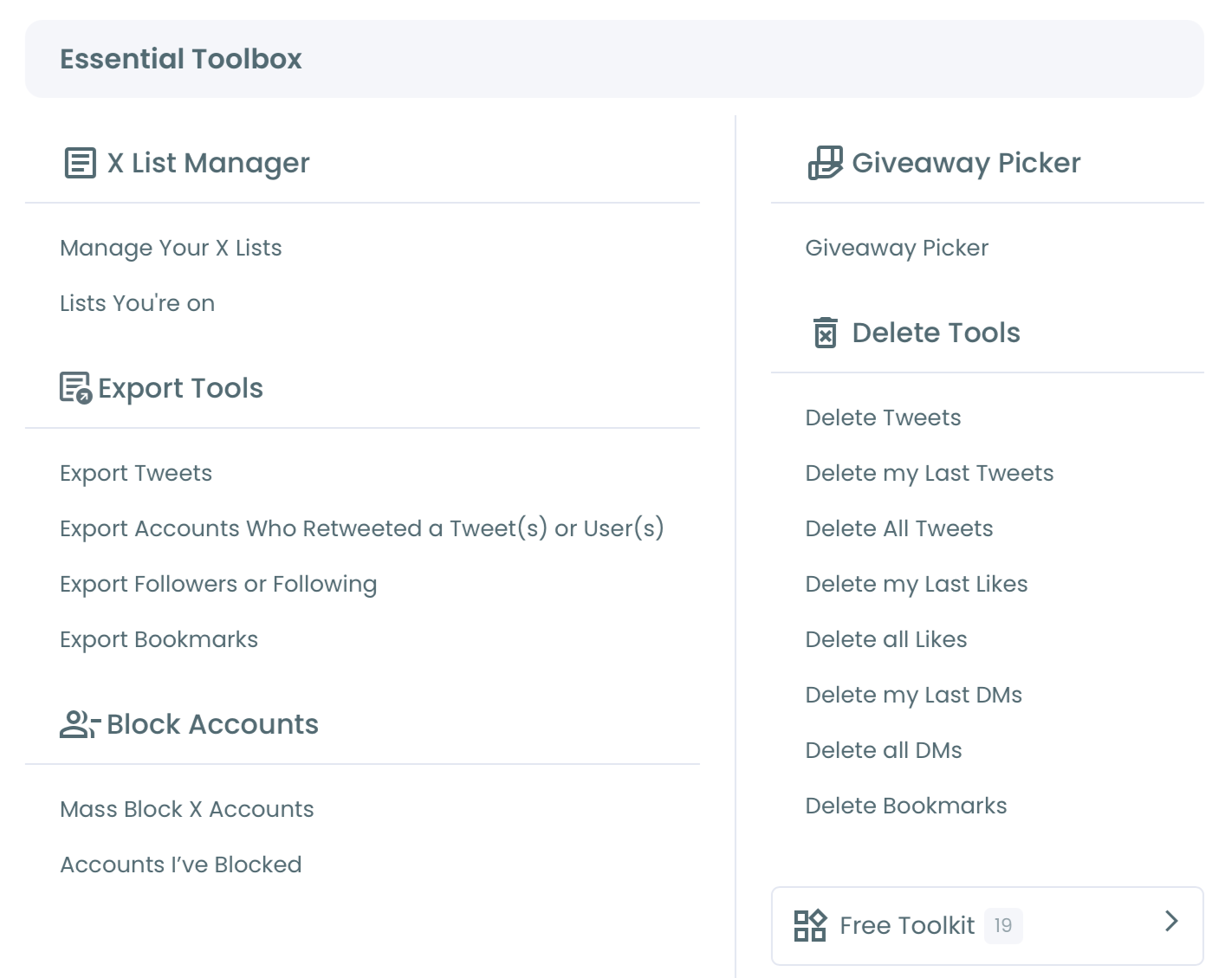
- Select Delete All Tweets and read the START screen of the three-step wizard. Its four-line guide names tweet.js as the only file you will need.
Bring in the file that holds your whole history
- Request your data archive from X's own settings. X walks you through it in how to download your X archive, and delivery usually lands within 24 to 48 hours. Plan around that window if the cleanup has a deadline.
- Upload the tweet.js file from the unzipped archive folder, not the archive ZIP. Circleboom reads only that file, and it has to come from the X account tied to your Circleboom subscription. Files from a different account will not process.
Filter, confirm, then delete
- Apply the filters that match your intent. Post type, date range, keyword or hashtag, like count, retweet count, language, and media presence are all available, and the Protect List lets you exempt specific posts from an otherwise full wipe.
- Review the Approve & Delete panel on the right, which shows the exact count of tweets, retweets, and replies queued, then click "Delete my Tweets" to run it.
That order is what keeps the operation honest.
The archive comes first so you still hold a record of everything. The filter pass narrows the scope before anything becomes irreversible, and the count on the Approve & Delete panel is your last chance to catch a filter you set wrong.
At a glance: log in, open Essential Toolbox, request the archive, upload tweet.js, filter, confirm the count, delete.
Watch the archive workflow end to end: the upload screen, the filter panel, and the count that appears before anything is deleted.
https://www.youtube.com/watch?v=RkHcy9B3cbA
Why most "delete all tweets" tools stop at 3,200 posts
X's API returns at most the 3,200 most recent posts from any account.
That number is not a Circleboom setting or a plan tier. It is a platform ceiling documented in X's own timelines introduction, and every tool that reads your live timeline through the API inherits it.
The consequence is uncomfortable if you have been posting for years.
An account with 40,000 lifetime posts that runs an API-only cleaner watches the counter finish, sees a clean recent timeline, and still has roughly 36,800 posts sitting public and indexed.
Nothing failed. The tool simply never had access to them.
That gap is not cosmetic either. The posts stranded on the far side of the ceiling are your oldest ones, written in a voice and a context that no longer match the account.
They are also the ones most likely to be screenshotted out of context, because age is exactly what makes a post look like a revelation.
The archive path closes that gap. The file X builds for you contains the full record regardless of age or volume, so uploading it hands Circleboom the posts the API never exposed.
Check what is actually sitting in there first, then wipe your Twitter history in one filtered pass.
If your goal is narrower than a full reset, the same archive supports it. Our walkthrough on how to delete old tweets by year covers the date-range version of this workflow. Only the older material goes, and recent content survives untouched.
How to tell whether your history reaches past the API limit
Open your X profile and read the post count under your handle. That single number decides which method can actually finish the job for you.
Under roughly 3,200 lifetime posts, an API-based cleaner reaches everything you have, and the archive request is optional convenience rather than a requirement.
Above it, the surplus is invisible to any timeline-reading tool, and the gap grows with every year the account has been active.
The profile counter is a rough guide, though. It folds retweets in with original posts, and it does not tell you how the total splits across years.
The upload screen gives you the exact figure. After you drop in tweet.js, Circleboom reads the file and reports the real total in plain language, along the lines of "You have uploaded 786 Tweets."
That number is your history as X recorded it, not as the API is willing to serve it.
Comparing the two shows how much was hiding faster than any other check.
Many accounts discover the difference is larger than they assumed. A profile that reads 12,000 posts often turns out to be carrying several years of replies nobody has thought about since, and replies are the part of a history that ages worst.
What the archive path gives you that a timeline scan cannot
The archive turns a blunt wipe into something you can aim.
Because Circleboom reads the whole file before you commit, the filter panel works against your complete history rather than a recent slice, and the counts it shows you are real counts.
Three capabilities follow from that:
- Date ranges that reach your earliest posting years, not just the last few thousand posts.
- A Protect List that carves specific posts out of an otherwise full deletion run.
- Language and media filters that work across the whole record, so an old photo dump goes without touching your text posts.
The Protect List is what makes a full reset survivable.
Most accounts have five or ten posts worth keeping, a launch announcement, a thread people still link to, a testimonial from a customer. Adding them to the Protect List means the rest of the archive can go while those stay live.
Circleboom is an official X Enterprise Developer company, so every deletion request runs through sanctioned endpoints rather than a browser script working around the platform. Your account is not doing anything X considers unusual while the batch runs.
Open the workspace and clear Twitter history from the archive whenever the record no longer matches the account you want.
Before you run it, save what you are about to lose. You can export tweets to CSV so the good material survives in a form you can search later, which the raw archive folder does not make easy. Our post on how to delete all tweets on X covers the backup-first sequence in more detail.
Clearing your history while keeping the account itself
Deleting the record and deleting the account are two different decisions, and only one of them is reversible in any useful sense.
A new account starts at zero on everything that took you years to build:
- Account age.
- The handle you actually want.
- The follower relationships.
- The verification state.
- The muscle memory people have of finding you at that address.
Clearing the post history keeps all of it and resets only the part that stopped representing you.
That is why full history clearing shows up most often around rebrands and role changes rather than around leaving the platform. A consultant who spent six years posting about one industry and now works in another does not need a new audience.
They need the old positioning to stop being the first thing a visitor scrolls into.
The follower count also stays intact through the operation. Deleting posts does not touch who follows you, so the account emerges with the same reach and a blank slate to publish into.
Plan what fills that slate before you clear it. A profile with a live follower base and no posts reads as abandoned rather than fresh, and the first few posts after a reset carry more weight than usual because they are the only context a visitor has.
Is it safe to clear your whole Twitter history?
Yes, in the sense that matters: the deletion runs through official endpoints and your account is never at risk of a policy strike for it. The risk is editorial, not technical.
Old posts carry things you may not have priced in:
- Support answers customers still find.
- Announcements other sites linked to.
- Proof of when you said something.
- Community context that makes your replies legible.
Once the batch completes, those are gone from the public record, and the local archive folder is the only copy left.
Two things also survive the wipe, and both surprise people. Anything another account wrote about your post, a quote tweet or a reply, is their content and stays exactly where it is.
And "Twitter history" in the everyday sense covers more than posts, so a full clean-out usually means running delete retweets as its own pass alongside the archive job.
Large runs also take real time. API rate limits apply while the batch executes, so a history in the tens of thousands works through in stages rather than instantly. Leave the tab open and let it finish.
If the reason for clearing is reputational rather than a rebrand, a scheduled cleanup often fits better than one big reset. The approach in auto-delete all tweets keeps a rolling window instead, so posts age out on their own and you never face a 40,000-post decision again.
Your next move
Pick the path that matches why you are here.
If you are rebranding and the whole record has to go, download the archive, upload tweet.js with no filters, and confirm the count.
If you only want a specific era gone, use the date range and leave everything after it standing.
If a handful of posts are the real problem, skip the full reset and run a keyword filter instead. Our breakdown of how to delete all tweets instantly walks that version through step by step.
Whichever fork you take, the archive is the prerequisite.
Without it you are working on the most recent 3,200 posts and calling it a history.
→ Kick off the reset: clear your Twitter history
Questions readers ask next
How long does it take to clear a large Twitter history?
Two waits stack up. X takes 24 to 48 hours to build your archive after you request it, and the deletion itself runs against API rate limits, so a very large batch takes time to work through. Keep the browser tab open until the run finishes rather than interrupting it mid-operation.
Can I get my tweets back after deleting them?
No. Deletion through Circleboom is permanent and irreversible, exactly as it is when you delete a post inside X. The archive folder you downloaded before the run is the only record you will have afterward, which is why requesting it first is not an optional step.
Do I need to upload the whole archive ZIP file?
No, and uploading the ZIP will not work. Unzip the archive folder X sends you and upload the single tweet.js file inside it. That file has to belong to the X account connected to your Circleboom subscription, since files from other accounts are rejected at the processing stage.