
A mutual is two follows pointing in opposite directions: you follow them, and they follow you back. X confirms each direction on its own, but it never puts the two together on a single screen.
So "are we actually mutuals?" stays a guess until you read both lists by hand.
That guesswork is the whole problem, and it gets worse the bigger your network is.
Circleboom checks whether you and another account are mutuals by pulling your full follower list and following list through official API access, then isolating every reciprocal connection in one sortable view. No tab-switching, no profile-by-profile scrolling.
→ check if you and another account are mutuals
Keep reading for the mechanism behind a mutual, and how to confirm it across a whole list.
Why X Makes Mutuals So Hard to Confirm
X stores following and followers as two separate lists that never get compared for you. When you open a single profile, X shows a small "Follows you" label if that account follows you, but that label only confirms one direction, and only one profile at a time.
The X Help Center documents the "Follows you" indicator as a per-profile signal, not a network-wide report.
To actually confirm a mutual, you need both directions to be true at the same time. One profile check tells you whether they follow you.
It says nothing about whether you still follow them back, which matters more than people expect after a few years of follows and unfollows.
For a handful of accounts, manual checking is annoying but doable. For a few thousand follows, it is hopeless.
This is exactly where most people give up and assume their "mutuals" are whoever they remember interacting with, which is rarely accurate. If you want a faster path, you can confirm your X mutuals without opening a single profile.
What a Mutual Actually Means (and Why It Takes Two Checks)
A mutual follow is not one relationship. It is two one-directional follows that happen to point at each other. Account A follows account B, and account B follows account A. Both edges have to exist for the connection to count as mutual.
That detail explains why no tool can answer "are we mutuals?" in a single lookup. The only honest way to resolve it is to run two checks and combine them: does A follow B, and does B follow A?
If both come back true, the relationship is mutual.
If either is false, it is one-sided.
Circleboom runs both sides of that comparison at scale. It retrieves your complete following list and your complete follower list, then keeps only the accounts that appear in both.
Because Circleboom is an official X Enterprise Developer company, it reads those lists through sanctioned access rather than scraping, so the data is complete and your account stays compliant while it works.
If you want the broader picture first, our walkthrough on how to check mutual followers on Twitter covers the same comparison from the ground up.
The result is the part X never shows you: a single, deduplicated list of genuine two-way connections.
The Fastest Way to Check Your Mutual Follows on X
Circleboom's X Mutuals view is purpose-built for this one question. Instead of cross-referencing two lists in your head, you get one screen that shows only the accounts where the follow is reciprocal, each enriched with engagement level, follower count, account age, and follow ratio.
That enrichment is what separates a list of names from a usable network map. You can check your mutual follows on X and immediately sort the reciprocal accounts by reach or activity, so the people who actually matter rise to the top.
Unlike scrolling through thousands of follows and clicking into each profile for the "Follows you" badge, Circleboom resolves the entire comparison in one pass.
Video walkthrough: how Circleboom isolates your reciprocal follows in one list instead of two.
How to Check If You and Another Account Are Mutuals on X (Step by Step)
Here is the flow, start to finish.
- Log in to Circleboom Twitter and connect your X account with official OAuth.

- Open the Follower & Following menu and select X Mutuals to load every reciprocal connection.
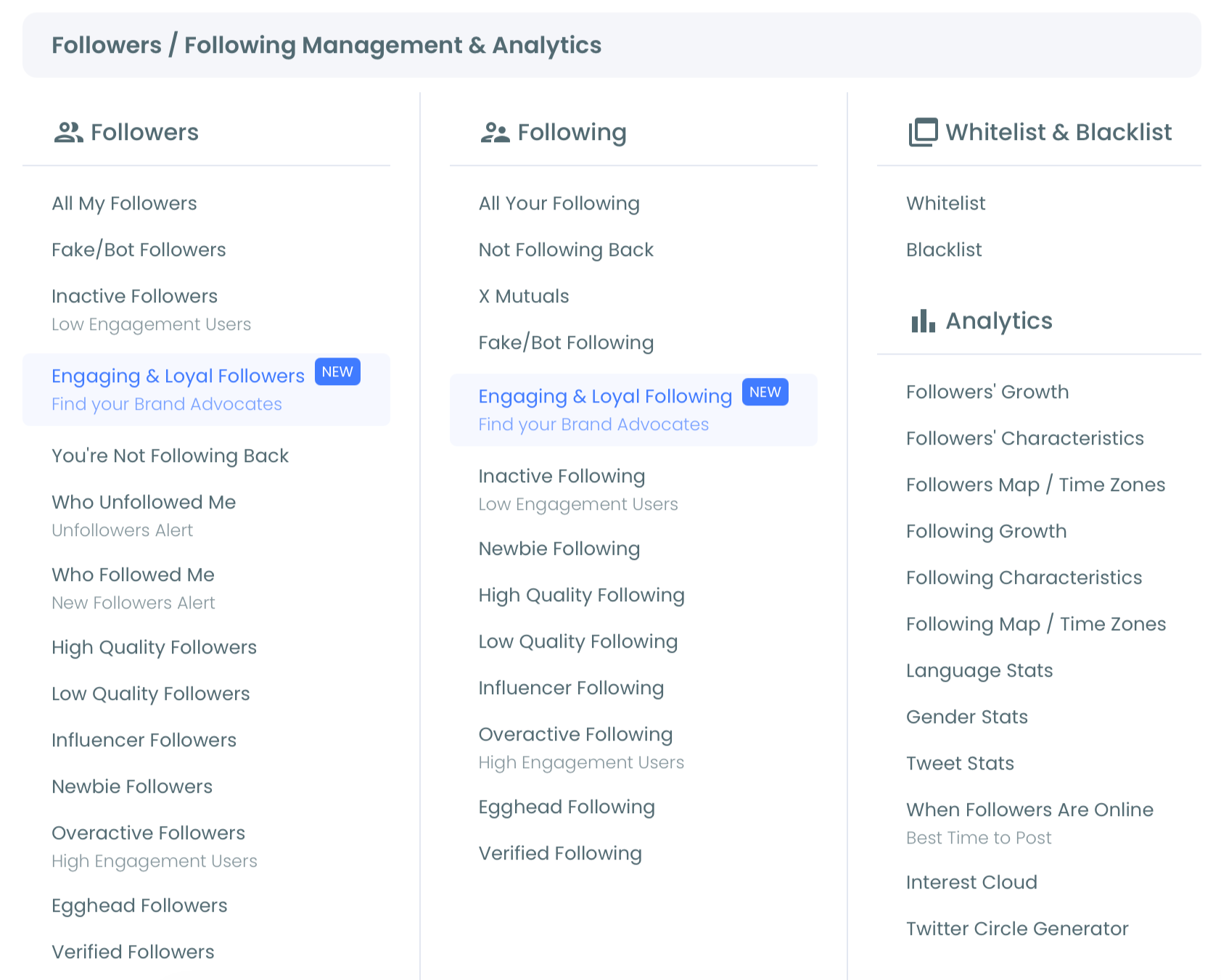
- Search or filter the list by name, engagement, verification, location, or follower count to find the specific account or segment you care about.
- Act on what you find by sorting, whitelisting high-value mutuals, adding them to a Twitter List, or exporting the set as a CSV.
That order works because the login earns official-API access first, the menu pre-builds the reciprocal set for you, and the filters narrow a huge list to the exact accounts you came to confirm.
Not All Mutuals Are Equal: Filter Before You Act
The biggest mistake people make is treating every mutual as equally valuable. A two-way follow proves both parties once chose to connect. It does not prove the account is active, relevant, or worth your attention now.
This is where the question shifts from "are we mutuals?" to "which mutuals matter?" When you check if you and another account are mutuals inside a filterable view, the high-engagement, on-topic relationships separate from the dormant follow-for-follow leftovers in seconds.
A few filters do most of the work:
- Engagement classification surfaces the mutuals who actually post and interact.
- Follower count and follow ratio flag the high-reach accounts worth nurturing.
- Bio and location isolate the mutuals who fit your niche or market.
Once the strongest mutuals are visible, the protective move is to whitelist them before any cleanup so a bulk unfollow never touches an account that follows you back. You can think of it the way you would whitelist your Twitter followers ahead of a big purge.
What You Gain From a Clean Mutuals View
Confirming your mutuals is rarely the end goal. It is the input to better decisions about engagement, outreach, and list-building.
A clear mutual map shows you the warmest part of your network at a glance, which is the right starting point for collaboration or partnership conversations. Your two-way connections are also the strongest candidates for a dedicated feed, so many people build a Twitter List from them to keep their most engaging followers on Twitter in one place.
There is also a clarity dividend. The gap between your following count, your follower count, and your mutual count tells you how reciprocal your network really is.
A large following with few mutuals means most of your follows are one-sided, which reframes how you read your own numbers. Understanding what a mutual on Twitter is in that proportional sense is more useful than any raw count.
The Bottom Line
X will tell you, one profile at a time, whether someone follows you. It will never tell you, in one view, who you and another account both follow each other.
Circleboom closes that gap by cross-referencing both lists through official API access and handing you the reciprocal set, sorted and ready to act on.
Confirm your real two-way network, protect it, and build on it from one screen.
Common Questions About Checking X Mutuals
How can I tell if a specific account is a mutual?
Open Circleboom's X Mutuals view and search for the account by name or username. If it appears in the list, the follow is reciprocal; if it does not, one side of the follow is missing.
Does X have a built-in mutuals checker?
No. X only shows a per-profile "Follows you" label and never compiles a network-wide list of reciprocal follows, which is why a tool that cross-references both lists is needed.
Is it safe to check my mutuals with a third-party tool?
Yes, when the tool uses sanctioned access. Circleboom reads your follow lists through official API access in full compliance with platform rules, so checking your mutuals never risks your account.
Can I export my list of mutuals?
Yes. After the reciprocal list loads, you can export it as a CSV for outreach planning, CRM enrichment, or community management.