
One thousand, in a single upload. That is the row ceiling on a Circleboom CSV, and it is the number most people are reaching for when they type the question into a search box.
Two different ceilings sit behind that answer, though, and they belong to two different companies. One is set by the scheduling tool you connect. The other is set by X, and no tool can lift it.
Circleboom schedules up to 1,000 tweets at once on X from one CSV file, mapping every row to its own posting time through official X API access. X's built-in scheduler takes one post at a time, so any number above one comes from the tool you connect, never from the platform itself.
→ schedule tweets in bulk on X
The number that stops most first uploads is not 1,000. It is 15.
How to schedule 1,000 tweets on X in one upload
The flow, in order, from login to a queued calendar.
Connect the account the batch will publish from
- Log in to Circleboom Twitter, choosing the X account these posts belong to. Every import targets one connected profile, so settle that before you build the file.

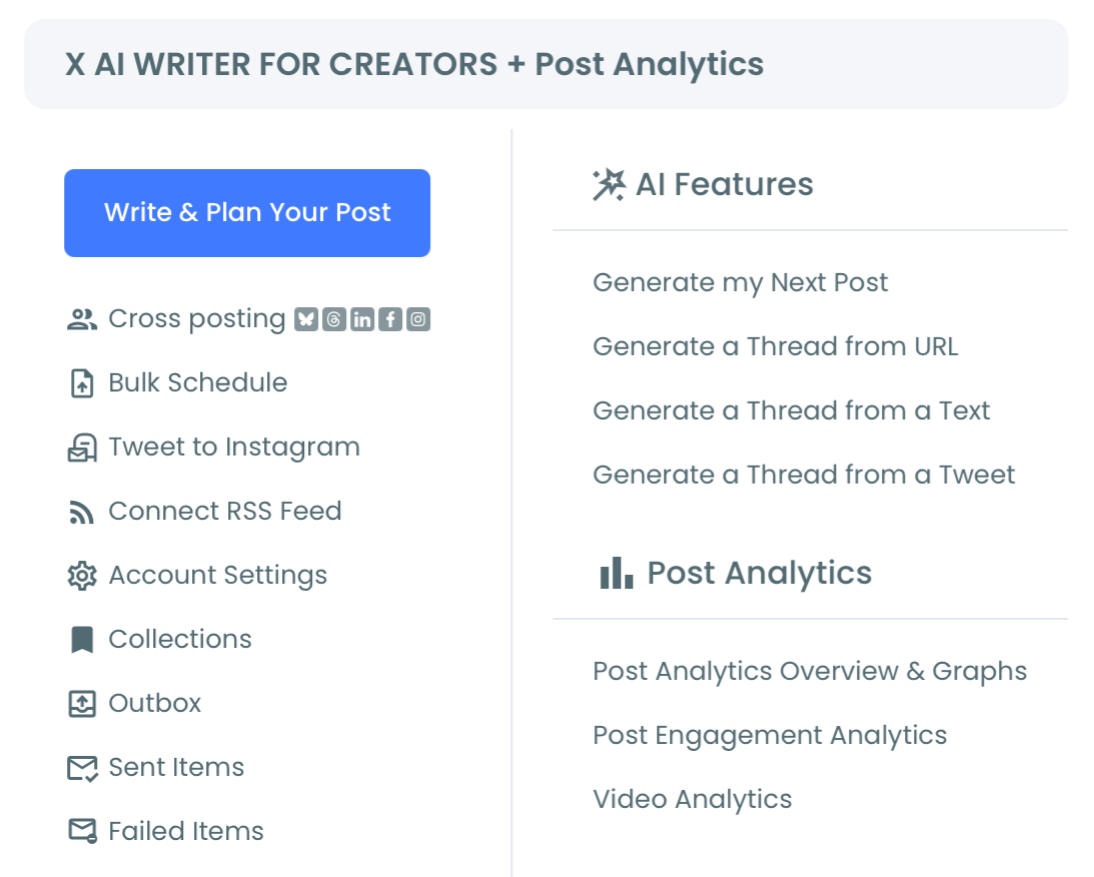
- Select X Post Planner from the left menu, then Bulk Schedule inside it. This is the same planner you use for single posts, so the calendar you are about to fill is one you already recognize.
Build a file every row can clear
- Download the sample CSV template from inside the upload modal. It carries the four column headers the importer expects, spelled exactly:
text,image_url,labels, andposting_time. Renaming a column is the fastest way to fail a whole file. - Format every posting time as
YYYY-MM-DD HH:mmand give each row content intextorimage_url. Both cannot be empty in the same row, and no posting time may land within fifteen minutes of when you upload. A row timed for four minutes from now gets rejected, not queued.
Read the preview before anything is committed
- Upload the file and click Next. Circleboom parses the sheet and returns two counts, valid posts and invalid posts, before a single tweet joins the queue.
- Work the preview table, then click Schedule Posts. The table lists post text, image thumbnail, label chips, posting time, and a per-row status mark, and you can filter it by status or search it by keyword. If the invalid count is anything but zero, go back and fix the file rather than shipping half a calendar.
That order holds up because the validation screen is the only place an error stays cheap. One wrong date format in a spreadsheet is one wrong date format in every row that copied it, and the preview is where you catch that for free instead of watching a month of posts land at the wrong hour.
Quick recap:
- Connect the account that will publish.
- Open Bulk Schedule inside X Post Planner.
- Match the four headers exactly.
- Keep every posting time 15 minutes out or more.
- Read the valid and invalid split, then schedule.
Why the question gets a different answer everywhere you look
Search this question and you get five numbers from five vendors, which is the tell.
I have watched people compare those figures for an hour and come away with less certainty than they started with. Every figure you find is a product decision, not a platform fact, because X itself never built for the case.
Its native composer schedules a post, singular. The how to schedule tweets using the Twitter web app flow is a one-post-at-a-time path by design.
That leaves you comparing caps across tools with no baseline. It also explains the odd feeling of reading four articles and coming away less sure than when you started.
What helps is to stop treating the cap as the headline. What decides whether a batch works is whether the rows survive validation and whether the cadence survives your audience.
A tool that accepts 1,000 rows and rejects 300 of them at import has given you 700, and a tool that accepts all thousand and fires them across ten days has given you an unfollow campaign.
Circleboom answers the first half by validating before it queues. The X Post Planner answers the second, putting the imported batch on a calendar you can look at and rearrange, which is where cadence problems become visible.
If you want the raw capability first, you can bulk schedule tweets and sort the calendar afterward.
The 1,000 you control and the limits X controls
The 1,000-row cap is a Circleboom decision, and it applies per file rather than per account. A 2,400-post library is not blocked by it; it is three uploads. The feature's own rules say so directly: files with more rows are split into multiple imports, which costs you two extra minutes and nothing else.
X's numbers are the ones you cannot negotiate with. Its own Media Studio scheduling FAQs state that you can only schedule one post at a time per account. That is why every answer to this question arrives with a tool's name attached to it.
Understanding X limits documents a ceiling of 2,400 updates per day, broken into semi-hourly intervals. Unverified accounts sit far below that, at 50 original posts and 200 replies a day.
Those two facts settle the question cleanly.
The bulk number belongs to the tool. The daily number belongs to X.
A scheduler that promised to raise the second one would be promising something it has no way to deliver.
Why the split between the two matters when you act
Account safety stops being an abstraction at this point.
Circleboom is an official X Enterprise Developer company, so a 1,000-row import travels through sanctioned publishing endpoints instead of automation software driving a browser session in your name.
Once you know how many tweets you can schedule at once and send them in one action, the delivery path is the part you want to be boring.
If a rolling queue suits you better than one large drop, the how to queue posts on Twitter walkthrough covers that pattern instead.
On screen: the whole CSV-to-calendar path, including what the preview does with a row that fails.
https://www.youtube.com/watch?v=lRq7Bb7YEAg
Is it safe to schedule 1,000 tweets at once on X?
Yes, with one caveat that concerns not the upload but everything after it. Importing a thousand rows is not risky in itself. The posts sit in the Outbox, each carrying its own timestamp, and publish on the schedule you set.
The risk is cadence. A thousand rows spread across a fortnight reads as a bot to your followers long before it comes near anything X enforces.
The feature's own guidance says the same thing in fewer words: leave spacing between posts so the account does not look automated, and keep room for real-time content. An account that cannot react to something happening today has traded responsiveness for coverage, and that trade rarely pays.
Worth being precise about what the importer does not do. Circleboom sets no minimum gap between two scheduled posts.
The only time rule in the file is that each posting time must sit at least 15 minutes ahead of upload. Spacing stays your judgment call, and nothing stops you stacking forty tweets into one afternoon.
Pull the timing from data instead of instinct. The best time to post on Twitter report finds the windows your own followers are awake for.
What the 15-minute rule actually catches
Fifteen minutes is the gap between now and the earliest slot a row is allowed to occupy, and it is the most common reason a first import comes back with invalid rows.
The mechanism is mundane. You build the sheet on Monday morning, time the opening rows for Monday morning, and by the time you have written row 300 and hit upload, those early rows sit in the past.
Validation rejects them. The counts come back split and the file looks broken, when the only thing that went wrong is that writing took longer than you budgeted for.
Start the calendar tomorrow. It costs nothing and removes the entire class of error.
Two more rules quietly decide whether rows survive. Labels only apply when they already exist in the account, so unknown labels are ignored with a warning rather than created on the fly.
Image URLs have to be public direct links to a real file. That single requirement is behind most silent media failures, and bulk schedule tweets with images goes through it properly.
Splitting a plan that runs past 1,000 rows
A file with 1,400 rows in it does not go up as one import. You split it.
The clean way to split is by month rather than by row number. Cut the sheet at a calendar boundary, upload the first file, confirm the valid count matches what you expect, then upload the second. Two imports of 700 behave exactly like one import of 1,400 would, and the calendar ends up identical.
Splitting by month also gives you a natural checkpoint. Between the two uploads you can look at what the first batch did on the calendar, notice that Thursdays are somehow empty, and fix it before the second file locks the same gap into the following month.
One caution about the seam. The 15-minute rule applies to every upload separately, so if the second file sat on your desktop for an hour while you reviewed the first, any rows you had timed tightly against the present are now in the past.
Re-check the earliest few rows of file two before you send it.
What a thousand scheduled posts is actually for
A thousand rows is a planning horizon, not a posting target. At three posts a day, one import covers roughly eleven months. At five a day, a bit over six months. Neither of those is a calendar anyone should fill in one sitting.
The value is that the ceiling stops being something you plan around. Once capacity is a non-issue, the work moves to the questions that actually change results: what belongs in the calendar, in what order, and against which audience windows.
That shift is the real payoff of bulk scheduling, and it is why a content plan built in a spreadsheet tends to be better than one built inside a composer. Structure first, then timing.
The how to create a Twitter content calendar approach pairs naturally with a batch import, because a filled calendar converts into rows almost mechanically.
The number worth keeping
The pushback I get most often: a thousand rows is more content than anyone actually has, so the cap is academic. It is the opposite of academic. Most accounts do not lack capacity, they lack horizon, and horizon is precisely what a batch import buys.
Almost nobody should fill the ceiling. Knowing where it sits is what lets you stop counting and start planning, and the difference between a batch import and 90 separate scheduling sessions is measured in hours you get back.
Build the quarter in a spreadsheet, run it through validation, fix whatever fails, and let the queue take it from there.
→ Open bulk tweet scheduling and start with next month
Questions to settle before your first CSV
Can I edit a tweet after I have bulk scheduled it?
Yes. Imported posts land in the Outbox, and each one stays editable on its own until the minute it is due to publish. A typo in row 412 is a quick fix rather than a reason to redo the whole import.
What happens to the CSV file after I upload it?
Circleboom does not keep it. The rows become scheduled posts and the file itself is discarded after import, so hold on to your source spreadsheet if you want a record or plan to re-import a similar campaign later.
Can one CSV publish to more than one X account?
No. Each import targets the single connected account you selected, and cross-posting destinations are set per post in the Outbox afterward. Running several accounts means several uploads, one per account.