To collect Twitter hashtag data from a specific time period, you need a search that queries by date range instead of by recency, plus a result set that keeps the author attached to every post it collected. X's native search gives you neither once your window is more than a week old.
Circleboom collects Twitter hashtag data from any date window on X and hands it back as two linked views: the matching posts with their metrics, and the deduplicated list of accounts that wrote them. Set the hashtag, pick the range, choose the collection size, then export both as CSV.
→ collect Twitter hashtag data
The number almost nobody quotes: how many unique accounts a given tweet count actually yields.
How to collect Twitter hashtag data on X, step by step
The flow below runs in three phases, from window to filters to account list.
Set the window before you touch the keyword
- Log in to Circleboom Twitter and connect your X account with official OAuth.
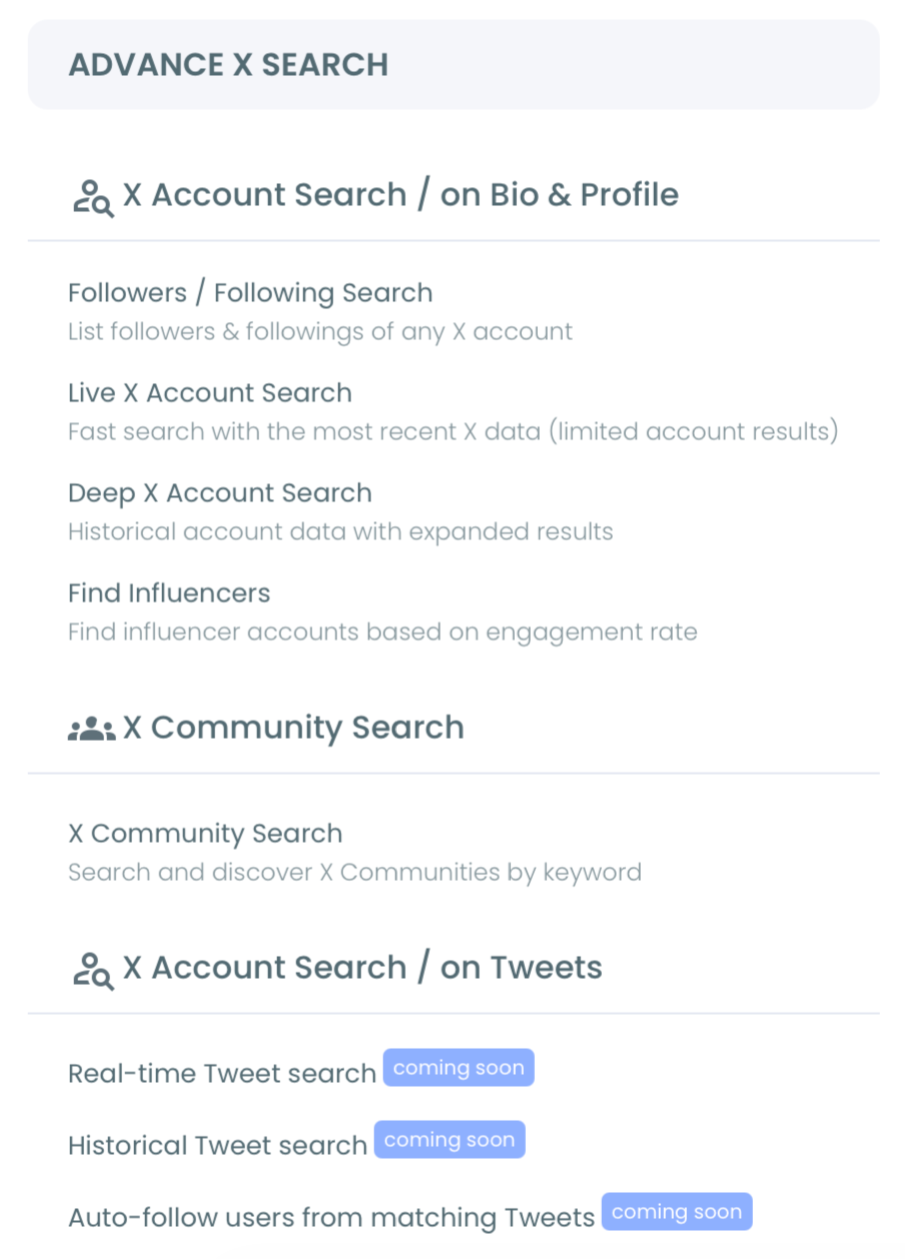
- Open the Advanced X Search menu and pick Historical Tweet Search when the window has already closed, or Real-time Tweet Search when it is still open.
- Write the hashtag as a plain-language search, then set the range. Historical Tweet Search takes the last 30, 60, or 90 days, the last year, or a custom start and end date.
Narrow the pull before you spend the collection
- Open Filters and cut the noise first. One exclude term and a minimum like count remove most of the junk a busy hashtag drags in.
- Choose how many posts to collect. That number sets the collection size, not the number of accounts you walk away with.
Turn the posts into an account list
- Click "Display Profiles of this search" once results load. Circleboom deduplicates the authors of every matched X post, so an account that used the hashtag forty times shows up once.
- Export both views as CSV. The account file carries username, follower and following counts, follow ratio, join date, location, bio, verification type, and the fake, inactive, and overactive flags.
That order holds because every step shrinks the cost of the next one. The window decides which of the two searches you are even in, the filters decide what your collection gets spent on, and the profile view is what makes the pull usable anywhere outside X.
At a glance: connect, choose the search, bound the dates, filter, collect, pivot to profiles, export.
Why X's own search will not give you the window you need
X's search box is built for recency, not retrieval. The recent-search endpoint behind structured post queries reaches back seven days and is open to every developer.
Anything older sits behind full-archive access, which X reserves for its paid and Enterprise tiers per its search endpoint documentation.
Scroll the app instead and you get an unstable ribbon of posts you cannot filter, count, or download.
That is why a hashtag report assembled by scrolling is never reproducible. Two people scrolling the same hashtag on the same afternoon end up with different sets, and neither set survives a follow-up question about who posted what.
The fix is to stop treating the hashtag as a feed and start treating it as a query with a start and an end. That is exactly what you get when you pull Twitter hashtag data by date instead of by scroll depth.
If your interest is narrower than a full dataset, our post on the Twitter keyword and hashtag tracker covers the monitoring side of the same question.
Screen recording: the exact date-scoped hashtag query that ends in an exportable account list, run start to finish.
https://www.youtube.com/watch?v=ZRslhxkc43Y
What a dated hashtag pull actually returns
A finished pull gives you two views of one result set, and they answer different questions.
The tweet view is the evidence layer.
Each row carries the post text with a link back to the original, plus impressions, likes, retweets, quotes, bookmarks, replies, and the creation timestamp.
That is the view you keep when the deliverable is a narrative: what was said, how loudly, and when.
The profile view is the action layer.
Circleboom extracts the author of every matched post and deduplicates them, so you get accounts rather than repetitions, each with follower count, following count, follow ratio, post count, join date, and an activity classification.
Every row in both views arrives through Circleboom's access as an official X Enterprise Developer company, so the dataset holds up when someone asks where the numbers came from. Nothing here is scraped off a rendered page.
Circleboom pairs that with plain-language querying. You can gather hashtag data from X by describing what you are after, rather than assembling operator syntax by hand.
For the manual comparison, Twitter hashtag search and trend search shows what the same job looks like with no date-scoped query behind it.
Tweet count is not account count, and the gap is the whole budget
Here is the part that decides whether your pull was worth running: the number you choose is a count of posts, not a count of people.
Five hundred collected posts from a hashtag with a small, loud core might return fifty unique accounts. The same five hundred posts from a broad campaign hashtag might return four hundred and eighty.
Same collection size, a ten-fold difference in the deliverable.
The ratio between posts and unique authors is a property of the hashtag, not a setting you control.
That has a practical consequence most tool comparisons skip. If you need roughly two hundred accounts from a hashtag where the top voices post repeatedly, a two-hundred-post collection will not get you there, and no filter will fix it after the fact.
The workable move is to run a small probe first. Collect a modest sample, switch to the profile view, and read the account count against the post count.
That single ratio tells you what a full pull will cost before you commit to it.
Reach questions run on the same logic, which is why how many people saw my hashtag is a different measurement from how many accounts used it.
A Twitter hashtag counter answers volume; the profile view answers participation.
Which filters actually change what you collect
Filters are not cosmetic on a hashtag pull. They decide what your collection budget gets spent on. On a busy tag, they are the difference between a usable set and four hundred rows of giveaway spam.
Four of them do most of the work:
- Exclude terms strip the parasitic uses of a hashtag, the giveaway and follow-for-follow variants that ride popular tags.
- Minimum likes or retweets cut the long tail down to posts that registered with somebody.
- Replies off removes the conversation layer when you want originators rather than commenters.
- Language keeps a globally used hashtag inside the market you are studying.
Two more fire less often but are worth knowing. The verified-only toggle narrows a noisy tag to accounts carrying a paid or institutional signal. Media type separates image and video posts from text-only ones.
All active filters combine as AND conditions, so each one you add narrows the set further rather than widening it.
The Active Filters bar above the results shows exactly what is applied. Read it before you commit a collection, because a filter you forgot to clear will quietly shrink the pull.
A tight query on a wide window beats a loose query on a narrow one.
The instinct runs the other way. People shorten the date range first when a pull starts to feel expensive, and that is the one change that costs them the thing they came for.
Narrow the query instead, and keep the window you actually need.
Historical or real-time: which search fits your hashtag window?
Pick by whether your window has closed, not by which tool sounds more capable.
Historical Tweet Search queries backward inside a fixed range. You give it a start and an end, and it retrieves what matched inside those boundaries.
Use it for a conference that finished last spring, a competitor incident from two quarters ago, or a campaign retrospective where the conversation is already over.
Real-time Tweet Search collects forward from a start date you choose. It accumulates matching posts as they appear rather than querying a settled archive.
Use it while a launch is live, while an event is running, or while a buying signal is still fresh enough to act on.
The two produce genuinely different datasets from the same hashtag. One reconstructs; the other accumulates.
There is an honest limitation worth naming.
Historical coverage depends on what has been indexed for that range, and posts that were deleted or made private after the fact leave gaps you cannot fill.
Treat a historical pull as a strong sample of the public record, not a census of it.
Once you know which accounts matter, you can follow a hashtag on Twitter continuously instead of re-running the same query by hand.
For the backward-looking half of that pair, Twitter historical data is where the archive side of the same question lives.
What the account list is actually for
The export is where the data stops being a report and starts being a workflow.
The CSV carries profile fields you would otherwise collect one account at a time: ProfileId, username, display name, location, post count, following count, follower count, verification type, account creation date, and bio.
It also carries Circleboom's own quality flags for protected, egghead, fake, inactive, and overactive accounts.
From inside the same result you have three moves:
- Follow selected accounts.
- Add them to an X List for ongoing monitoring.
- Push them into a mass block list when the hashtag turned out to be spam-heavy.
Every one of those actions is user-initiated and reviewed before it runs.
Lists are usually the better first move. They let you watch a group without changing your follow graph, which matters when the accounts are prospects rather than peers, and they turn a one-time pull into something you can check again next month.
Export is also the safe move before any bulk action, because it preserves the segment exactly as it looked at the moment you pulled it.
On formats and limits, safely download tweet data is the companion read. Export Tweets covers the same job for your own posting history.
One caveat on the metrics: likes, retweets, and impressions are captured at retrieval time. A dataset from March reports March's counts, not today's.
The bottom line
The usual objection to a dated hashtag pull is that it looks like overkill for a question a search box should answer. That objection holds right up until someone asks you to prove the number, reproduce the set, or name the accounts behind it.
The second objection is cost. Collections and exports draw on a token balance, so a careless broad pull on a busy hashtag burns budget on posts you will filter out anyway.
That is an argument for tighter queries, not for scrolling.
Both objections point the same direction: decide the window, narrow the query, run a small probe, then collect for real.
→ collect Twitter hashtag data for your window
Common questions about hashtag windows and limits
How far back can I go when collecting hashtag data on X?
As far back as a custom range will let you set, with the built-in presets reaching a year. The real ceiling is the index rather than the date picker: retrieval depends on what has been indexed for the period you pick, and very old windows or posts deleted before indexing leave gaps. A historical result reflects what the archive still holds rather than everything that was posted at the time.
Does collecting hashtag data include private or protected accounts?
No. Only publicly available posts from public accounts are returned, and protected, private, or deleted posts cannot be retrieved. An account that was public when it posted but has since gone private may still appear in a historical result, so its current state can differ from what the pull shows.
Can I re-open a hashtag search without paying for it twice?
Yes. Searches are stored under a search log and can be revisited without consuming the token balance again. Running a new collection or exporting a result set does consume tokens, so the cheap move is to keep one well-scoped search and return to it rather than re-running the same query with slightly different wording.