
The message is frustrating because it looks final, yet it often is not. When X says an unfollow failed, the useful question is not “how do I force it?” but “what changed between my account, that profile, and X’s current action limits?”
What this guide gives you.A way to tell a temporary action limit from a relationship-state problem.A safe review process before retrying an unfollow.A controlled path for cleaning a larger following list.
Circleboom helps you review and manage followed accounts on X using official Enterprise APIs. Start with failed to unfollow user Twitter.
What the failed-unfollow message usually means
“Failed to unfollow” is an outcome, not a diagnosis.
X may reject an action because it is temporarily limiting activity, because the account relationship has already changed, because the target profile is restricted, or because a session has gone stale.
The same message can therefore appear for very different causes.
The first thing I check is whether the target still appears as followed. If it does not, retrying can create confusion rather than solve anything.
Refresh the profile or following view before doing more work, because an earlier action may have completed even though the screen did not update cleanly.
For people making more than one change, Mass Unfollow is useful only after the segment is clear. The action itself is simple. Getting the target set right is the part that protects your feed and your relationships.
Separate a temporary limit from a real account problem
X does not publish every trigger behind action failures, so no tool can promise a universal cause from one error banner. Still, the timing and scope of the failure provide strong clues.
A limit is likely when several unfollows stop working together
If individual unfollows worked and a cluster of later attempts fails, pause.
Circleboom’s documented guardrail is 50 unfollows per 15-minute window and up to 800 in a day, but those are platform-aware ceilings, not targets to race toward.
A cautious cleanup should stay gradual and leave room for normal account activity.
X’s common following issues guidance explains that following actions can be limited when an account reaches a limit. It also covers activity the platform needs to review.
The practical response is time, not repeated clicks. Repeated retries can make a short interruption feel longer.
A relationship-state problem is likely when only one profile fails
When every other unfollow works but one profile does not, inspect that profile. It may be protected, suspended, deactivated, renamed, or already removed from your following list. A profile that has vanished from search cannot be managed as if it were an ordinary active account.
Use the native profile view as the final relationship check. X’s unfollow instructions describe the normal profile-level action, which is a useful baseline when a dashboard result and the live profile appear to disagree.
A session problem is likely when the interface acts inconsistently
A stale login, a network interruption, or an old page state can produce a misleading failure.
Sign out and back in only if a refresh and a single profile check do not reconcile the status.
Do not open a string of tabs and repeat the same action in each one; that creates more uncertainty about which request actually landed.
The safe rule: verify once, pause when the failure is broad, and retry only after you have a reason to think the condition changed.
Why retrying immediately is usually the wrong move
The native X interface treats unfollowing as an individual relationship change.
It does not give you a clear audit trail, a purpose-based review layer, or a practical way to protect important sources before a cleanup.
That makes error-driven clicking risky: the anxiety created by one failed action can turn into dozens of poorly considered ones.
Circleboom’s Twitter Unfollow starts from a different model. You can inspect a following dataset, sort it, filter it, select a defined segment, and confirm an action.
The service is an official X Enterprise Developer. Account data and supported actions use official Enterprise APIs, rather than asking you to imitate manual clicks at scale.
That distinction does not remove X’s limits. It does make the sequence easier to control: visibility first, decision second, action last.
How to handle a failed unfollow user Twitter error safely
The best retry workflow is deliberately boring. It replaces guessing with a few observable checks, then uses a small, reviewed segment if you still need to clean up several follows.
When you are ready to work from that reviewed set, use Mass Unfollow for failed unfollow user Twitter errors. Do not return to rapid manual retries.
Confirm the relationship on the live profile
- Refresh the profile or your following list.
- Check whether the account is still marked as followed.
- Note whether the profile is active, protected, unavailable, or visibly changed.
If the relationship is already gone, stop there. If it remains and the failure affected many accounts, give the account time before attempting another action.
Open a clean Circleboom session
- Open the Following area and choose the view that matches the reason for cleanup.
- Use search, sorting, and filters to make the candidate set visible.
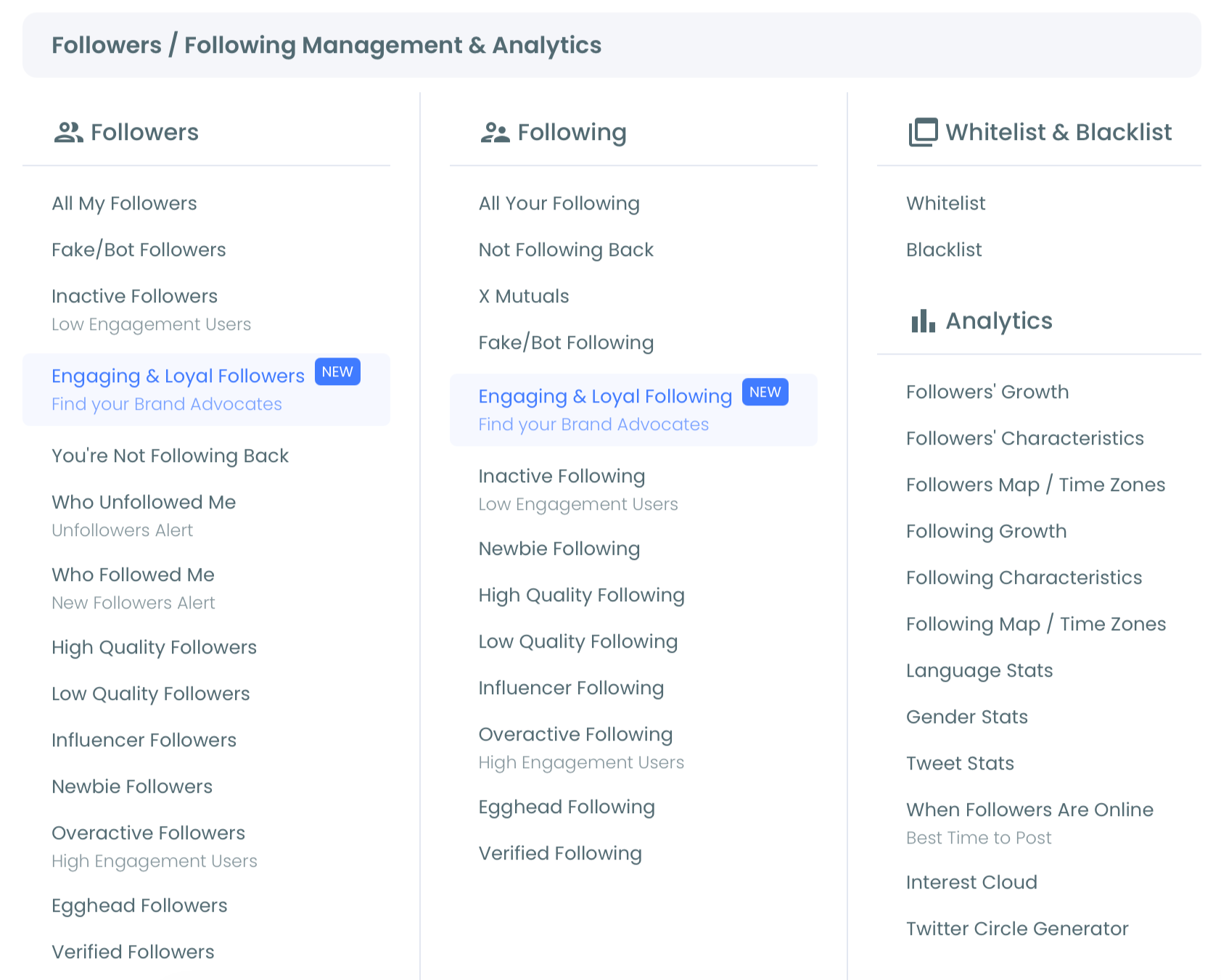
Circleboom’s All My Following view is particularly helpful when the error exposed a bigger issue: you are no longer sure why many of the accounts are followed.
It can sort by tweet count, join date, follower and following counts, follow ratio, and engagement classification.
It also lets you combine filters such as inactivity, language, location, or profile terms.
Protect accounts before selecting a cleanup group
- Review partners, customers, journalists, creators, and monitoring sources.
- Whitelist accounts that should survive a broad cleanup.
- Export the proposed segment if you want a record before an irreversible change.
Whitelisting matters because a low tweet count or weak follow ratio is only a signal. A quiet analyst or customer can still be valuable. I treat filtering as a way to form a review queue, not as an automatic verdict on people.
Retry a small, confirmed selection
- Select a small group that you have reviewed.
- Use the unfollow action and confirm the selection.
- Check the results before building the next group.
Circleboom processes unfollows gradually within X’s limits and can resume a queued operation when a daily limit requires it. That is a safety behavior, not a reason to make the selection larger. An unfollow cannot be reversed automatically; re-following later is a separate choice.
Screen walkthrough: how to review a group before using the Mass Unfollow action.
A better way to decide whom to unfollow
Most pages about an error stop after “wait and try again.” The larger gain is using the error as a prompt to inspect the decision rule behind your cleanup. An account that fails to unfollow today may be one you would not want to remove tomorrow once you see its context.
Use purpose as the selection rule
Build a segment from purpose, not frustration:
- Accounts that are inactive and no longer useful to your feed.
- One-way follows that no longer have professional or informational value.
- Old growth-campaign follows that do not match your current work.
- Profiles you have reviewed and deliberately marked for removal.
- Accounts with multiple weak signals, rather than one cosmetic signal.
If inactivity is the main concern, unfollow inactive Twitter accounts after reviewing the results. If you are unsure what the whole network contains, begin with an all-following audit.
Keep related choices separate
Useful adjacent reading can keep that audit focused. Review how to unfollow Twitter accounts without getting suspended before a larger cleanup.
If reciprocal follows are part of the decision, use unfollow everyone on X who doesn’t follow you without getting a ban.
This article adds that specific lens.
Automation is another area where wording matters. Unfollow people automatically on X should still mean a user-defined, confirmed workflow, not unattended relationship changes.
For a device-specific walkthrough, see mass unfollow on Twitter mobile.
This approach also gives you a useful distinction between unfollowing and blocking.
Unfollowing changes what you see and removes your following relationship. It does not prevent the other account from following or interacting with you.
Those are different goals and should not be mixed during a cleanup.
Common situations and the right response
You can unfollow manually but not in a larger workflow
That pattern points toward timing, selection state, or a temporary limit rather than a permanent account-level block. Wait, reload the dataset, and try a smaller reviewed group later. Avoid running simultaneous workflows from several devices.
The profile says you are not following, but the list still shows it
Treat the live relationship state as the check to investigate first, then refresh the list. Data views update, while an account relationship can change between retrieval and display. Do not make a duplicate action just to make the list look current.
The account is important but looks inactive
Whitelist it. A cleanup system should preserve accounts with strategic value even when their recent post volume is low. This is why a full audit works better than sorting only by one metric.
You need a record before a broad cleanup
Export the following segment first. A CSV gives you a point-in-time reference for what was selected and helps you explain a decision later. It is more reliable than trying to reconstruct a selection from memory after the relationship is gone.
A short diagnostic checklist before the next attempt
Before retrying, use this small checklist to separate a technical interruption from a decision problem:
- Confirm that the account still shows as followed on the live profile.
- Decide whether the failure affected one account or a cluster of actions.
- Stop and wait when the issue is broad rather than trying multiple routes.
- Rebuild the candidate group from a current view, then whitelist exceptions.
- Keep the next selection small enough to review without rushing.
The checklist may sound conservative, but it changes the quality of the outcome.
Your following list is also an editorial input: it influences which conversations reach your timeline, whose work you notice, and which accounts you may amplify later.
A smaller count is not automatically a better network.
A defensible set of follows is better.
There is also a practical reason to keep the review visible. Filters combine as conditions, so an account in a result set may match several signals at once.
Check the active filters before you select anything.
If you cannot state the rule that put an account in the set, that account is not ready for bulk action.
A measured cleanup is better than a perfect retry
A failed action is often a nudge to slow down, not a sign that you need a more aggressive workaround. The account-safe path is to verify the relationship, wait out broad failures, inspect the segment, protect what matters, and process confirmed choices in manageable groups.
If your following list has become hard to reason about, fix a failed unfollow on Twitter only after the review stage. You will end with a cleaner feed and a clearer rationale for every relationship you changed.
Questions about X unfollow failures
Can I get suspended for retrying an unfollow?
X controls its own activity limits, so no one can guarantee an outcome. Avoid rapid repeated retries, work gradually, and follow the platform’s guidance when an action is limited.
Does a failed unfollow mean the other person blocked me?
Not necessarily. A broad failure is more consistent with an action or session issue, while a one-profile failure may relate to that profile’s current state. Check the live profile before assuming a block.
Can Circleboom unfollow everyone instantly?
No. Circleboom handles actions through official Enterprise APIs and observes X limits, with gradual processing and user confirmation. That is safer than presenting an irreversible relationship change as an instant, unreviewed command.
What is the biggest mistake people make after this error?
In my experience, it is treating one error as a reason to remove accounts without reviewing them. A saved segment, whitelist, and small confirmed batch turn the same task into a controlled cleanup.






%3F)
