
X gives you a follower count and a list you can scroll. Neither answers the question people are actually asking, which is who these accounts are.
How do you see who is following you on Twitter?
The Followers tab lists them in reverse order with no sorting, filtering, or export. Circleboom retrieves your full follower list through official X Enterprise APIs and presents each account with its activity level, follow ratio, account age, engagement classification, and location in one sortable table.
→ see who is following you on Twitter
The gap is not access. You can already see every follower. The gap is that a list of ten thousand names in arbitrary order is not information.
What the native Followers tab withholds
The tab shows display name, handle, bio, and a follow button. That is genuinely all of it.
There is no sort. You cannot order followers by when they joined, how active they are, how many people follow them, or whether they have ever engaged with you.
There is no filter. You cannot isolate verified accounts, accounts in a language, accounts that have been dormant for two years, or accounts that follow ten thousand people each.
There is no export. Whatever you learn by scrolling stays in your head, and next month you start over.
And there is no aggregate. The tab cannot tell you what share of your followers are active, where they cluster geographically, or how the composition has shifted since last year.
A follower count is a measurement. A follower list without sorting is not.
The analysis framing here is covered in how to get 1000 followers on Twitter fast, which sets out what the questions are worth asking.
The four things people actually want to know
"Who is following me" is almost always shorthand for something more specific.
Are they real? The most common underlying question, and the one that determines whether your other metrics mean anything. Inauthentic followers inflate the denominator in every engagement calculation without ever contributing to the numerator.
Are they active? A real but dormant follower is functionally identical to no follower. Accounts that have not posted in two years do not see your content, and they quietly drag your effective reach below your nominal reach.
Do any of them matter? Most audiences contain a small number of accounts with disproportionate reach or relevance, and finding those by scrolling is impossible because nothing distinguishes them visually in the list.
Who is new? Recent followers are the ones responding to something specific you did, and that mapping is the most actionable feedback the platform produces.
Each of those is a sort or a filter on a table. None of them is available on a list you can only scroll.
That is the whole reason to pull the list somewhere you can analyze your X followers rather than reading it in the app. Same accounts, different affordances.
The verified segment is one people ask about constantly, and find out blue checks following you on Twitter covers isolating it.
For demographic composition rather than individual accounts, Circleboom's Twitter follower demographics view aggregates the same data.
Finding the high-reach accounts is its own task. How to check and export my most followed followers covers that specific operation.
Composition beats count
The number in your profile describes how many accounts pressed follow at some point. It says nothing about how many are currently capable of seeing anything you post.
Break a follower base into rough groups and the picture changes. Active accounts that post and engage. Passive real accounts that read and rarely act. Dormant accounts that stopped using the platform entirely. Inauthentic accounts that were never people.
The second group is usually the largest on a healthy account, and that is fine. Lurkers are real people who read things and sometimes act on them, and an audience of readers is not a problem to be solved.
The third and fourth groups are where the count becomes misleading:
- Dormant accounts inflate your total while seeing nothing.
- Inauthentic accounts inflate it while contributing nothing.
- Both distort every rate you calculate against your follower number.
An account with 10,000 followers where 4,000 are dormant or fake is operating with an effective audience of 6,000 and grading itself against 10,000. Every post looks worse than it performed.
Circleboom classifies each follower on engagement level, so the composition is visible as a breakdown rather than something you infer. The wider version of this read is in how do you copy Twitter X followers.
How to see who is following you on Twitter
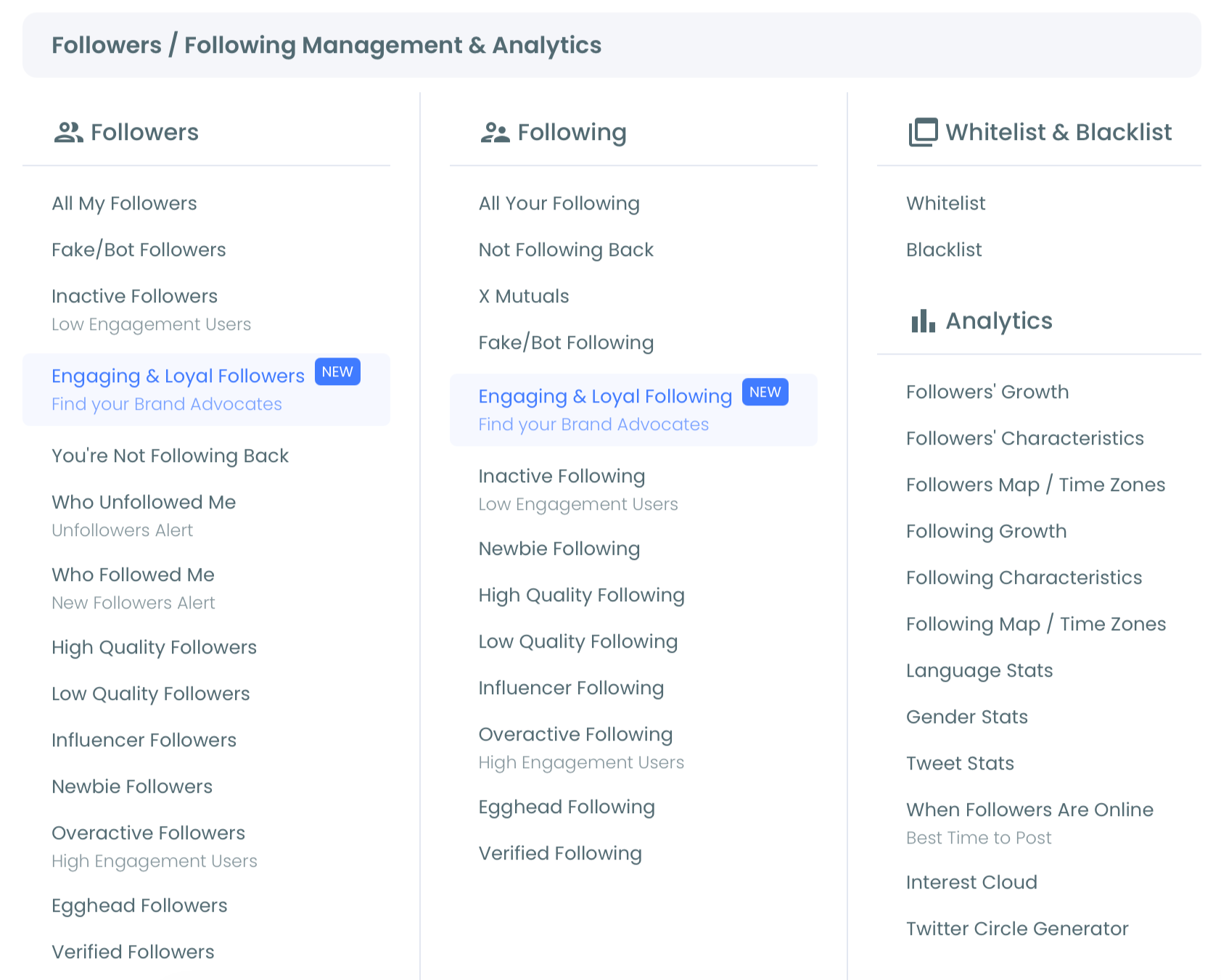
To see who is following you on Twitter with real detail, open the Follower and Following menu in Circleboom and load All My Followers. Each account arrives with its activity classification, follow ratio, post count, account age, and location, and any column can sort the whole list. The sorting is what turns the list into an answer.
Five actions, ending with the segments rather than the list.
Load the full list
- Log in to Circleboom Twitter and connect the X account whose audience you want to see.

- Open the Follower and Following menu and select All My Followers to retrieve the complete list with its data columns.
Sort into the answers
- Sort by follower count, descending, to bring up the accounts in your audience with the widest reach of their own.
- Sort by join date to separate long-standing followers from recent arrivals, and check whether recent additions cluster around a date.
- Filter by engagement classification to see what proportion of the list is active, and treat that proportion as your real audience size.
That order works because each sort answers a different question with the same data. Reach tells you who could carry a post further, join date tells you what attracted people recently, and the activity split tells you how much of your follower number is currently real.
At a glance: sort by reach to find who matters, by date to find what worked, by activity to find what your count actually means.
One boundary to note. Circleboom retrieves your follower list through authorized API access, so the data reflects what is publicly available on each account at retrieval time rather than a live stream.
Video walkthrough: how a raw follower list becomes a sortable table with activity and quality visible per account.
→ view your full X follower list
Reading new followers as feedback
The recent end of your follower list is the most useful and least examined part of it.
People follow accounts for reasons, and those reasons are nearly always traceable to something specific: a post that travelled, a reply someone saw, a mention by a larger account, an appearance in a list. Sorting by join date and looking at when people arrived maps your growth to your actions.
What the pattern tends to show:
- Tight clusters around a date point at one post or one mention doing the work.
- Steady low-level arrival suggests search, profile visits, or ongoing discovery.
- A sudden burst with poor quality signals usually means a bot campaign rather than success.
That third case is worth recognizing early, because a spike in the count reads as a win until you look at who arrived. A growth jump made of inauthentic accounts is a metric problem wearing the costume of a result.
The attribution question is covered more fully in how can I track where my Twitter followers came from.
The segments worth naming
A sorted list is better than a scroll, but the real gain comes from naming a few groups and treating them differently.
The reachable few. Accounts in your audience with substantial followings of their own. Usually a very small number, and worth knowing by name rather than by row, because a single repost from one of them outperforms weeks of ordinary posting.
The engaged core. Followers who reliably reply, quote, and repost. Smaller than most people expect and the group that actually determines whether a post travels in its first hour.
The silent majority. Real accounts that read and rarely act. The largest group on almost every account, invisible in engagement metrics, and frequently the ones who buy things.
The ballast. Dormant and inauthentic accounts, contributing nothing but sitting in the denominator of every rate you calculate.
Why naming them changes decisions
Each group responds to a different action, and treating the audience as one undifferentiated block means doing none of them well.
The reachable few are a relationship question, not a content question. The engaged core rewards consistency and responsiveness. The silent majority needs content that works without requiring interaction, since they are never going to reply and that is not a failure. The ballast is a measurement problem to be corrected periodically.
Proportions matter more than absolute numbers here. An account where the engaged core is two percent of the list behaves very differently from one where it is fifteen, and posting strategy that works for one reads as noise on the other.
Run the split once a quarter rather than continuously. Audience composition drifts slowly, and watching it weekly produces reaction to variance rather than insight.
Four groups, four different jobs. One list treats them as the same person.
The mutual-follower subset is worth checking alongside this, and how to check mutual followers on Twitter covers isolating it.
What the list cannot tell you
Circleboom is an official X Enterprise Developer company, so follower data comes through authorized access rather than scraping, and the classifications run on publicly available signals. Those signals define the ceiling.
Public behavior is visible. Intent is not. A dormant account belonging to a real person who still reads occasionally looks identical to an abandoned one, because nothing observable separates them.
The activity classification is also a description rather than a judgment. An inactive follower is not a bad follower, it is a follower who is not currently reading, and those are different problems with different responses.
Two things worth holding onto:
- A low follower count of engaged readers outperforms a large one of dormant accounts.
- Removing inauthentic followers corrects your metrics rather than improving your reach.
X's own guidance on following and followers covers the platform mechanics underneath all of this.
Sort it, then decide what it means
Seeing who is following you on Twitter is a sorting problem rather than an access problem. The list is already yours; what it lacks is order, and order is what converts ten thousand names into three or four things you can act on.
Sort by reach, by date, and by activity. Those three passes answer nearly every version of the question.
Do it quarterly rather than compulsively. Follower composition shifts slowly enough that a monthly check mostly measures noise, and the value is in comparing one quarter against the last rather than in watching the number move.
→ open your follower list on X
Questions about your Twitter follower list
Can I sort my followers on X natively?
No. The Followers tab lists accounts in reverse order with no sorting, filtering, or export, which is why a separate table is needed for any real analysis.
How do I find my most influential followers?
Sort the list by their own follower count. The accounts with the widest reach appear at the top instead of being hidden among thousands of rows.
Does a high follower count mean a large audience?
Not necessarily. Dormant and inauthentic accounts inflate the total while seeing nothing, so the active proportion is the figure that describes your real reach.
Can I see when someone followed me?
You can sort by account join date and identify recent arrivals as a group, which is what makes follower growth traceable to specific posts.
Is an inactive follower worth removing?
Usually not. Inactive is a description rather than a fault, and removal only matters when the proportion is large enough to distort your engagement rate.