
One X account can own up to 1,000 lists, and every one of those lists can hold up to 5,000 members. Nobody asks your permission before dropping you into one.
I went looking for a name-by-name roster of everyone who had listed me. What came back was complete in one direction and permanently closed in the other.
The public half is readable, countable, and worth reading closely. The private half is not data anyone can request, including the person being listed.
Can you find out who added me to a Twitter list?
Partly. Circleboom reads every public X list that contains your account through X's Enterprise API and lays them out as cards, and opening a card takes you to the list on X where the owner's name sits on the list itself. Lists their creators marked private are never returned, so no tool can name those owners.
→ who added me to a Twitter list
How I check who added me to a Twitter list
The run I do before any profile review, in order.
Get the public roster on screen
- Log in to Circleboom Twitter with whichever handle's placements matter to you.

- Open the Essential Toolbox menu. Our X List Manager section lives inside it.
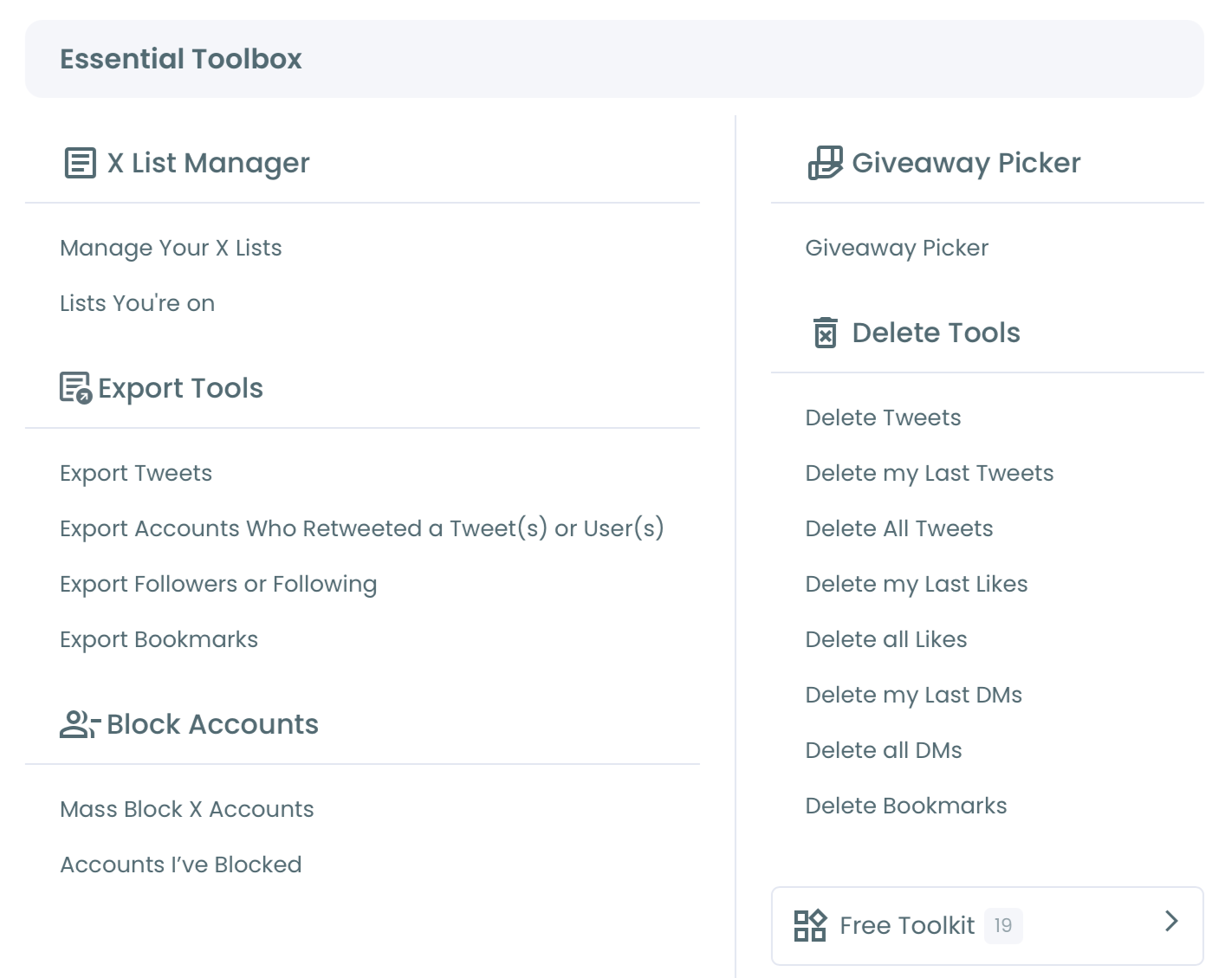
- Switch to the Lists You're On view inside the List Manager. This is the read-only side of the tool, separate from the lists you build yourself.
Turn the cards into names
- Read the card grid. Each card carries the list name, its member count, its follower count, and a color-coded icon, so you can rank the placements by reach before opening any of them.
- Click a card to open that list on X, where you can see the full membership, the list feed, and the profile of the account that built it.
That order matters because the owner's identity never lives inside Circleboom.
The tool gets you the complete public set in one screen, then hands you off to X for the one field it does not carry. Reading the grid first means you only make that hop for the placements worth investigating.
At a glance: connect, open the List Manager, read the grid, click through for the owner.
What the card grid tells you that a single list page cannot
The follower count on each card is the number worth ranking by. A list with 40 followers and a list with 4,000 followers put your handle in front of wildly different audiences, and on X you would have to open each one to learn that.
The grid puts both numbers side by side.
Member count reads differently. A 12-member list is somebody's short list of accounts they take seriously in your field. A 4,800-member list is closer to a topical directory, sitting near X's ceiling of how many accounts you can add to Twitter lists.
Being one of twelve says something. Being one of 4,800 says almost nothing.
Small and well-followed beats large and ignored, every time.
Notice what the card does not carry: a date. There is no timestamp telling you when you were added, so a list built around you three years ago and one built last week look identical in the grid.
Age is not a field you get anywhere in this flow, which is why the count from your last check is the only sense of movement available to you.
Watch it run: how the X List Manager is laid out, which is the screen this entire check happens inside.
https://www.youtube.com/watch?v=VvGU13mvRoo
Can you see who put you on a private X list?
No, and this is worth being blunt about because plenty of pages imply otherwise.
X's own Help with Lists page states that only you can view your private lists, and that private lists owned by other accounts are not visible to you. That applies to lists you are a member of.
Circleboom sits on the same boundary. Because we are an official X Enterprise Developer company pulling from sanctioned endpoints rather than scraping around them, the tool returns exactly what X authorizes and nothing beyond it.
A private list containing your account is not withheld by Circleboom. It is not in the response at all.
That cuts both ways, and the second half is the part people miss.
If a competitor has quietly filed you under a monitoring list, you will never see it. If you file competitors under a private list of your own, they will never see that either.
Whether Twitter lists are public is a choice the list owner makes at creation, and it decides the whole visibility question for everyone downstream.
So when you review the public grid, read it as a sample of how you are categorized, not a census of it.
Who else is reading the X lists you are on
Everyone who wants to. That is the part that changed how seriously I take this screen.
A public list is a public page. It carries a title, a member roster, and a follower count. Any of it can be opened by:
- a recruiter
- a prospective client
- a journalist checking sources
- a partner running diligence on your account before a call
None of them need a tool. They need the same three clicks you would use.
Which means the grid is not private research about yourself. It is a preview of a page other people can already read, and you are usually the last one to look at it.
That reframes the timing. Most people check list membership out of curiosity, once, and never again. The useful moment is the week before somebody else has a reason to check, and that moment is predictable:
- a launch
- a funding round
- a conference
- a job application
- a media request
Run it then. Pull up the record of who put me on a Twitter list and read it the way a stranger would, top to bottom, titles first.
The peer set you did not pick
When the grid keeps grouping you with the same handful of accounts across different owners, those accounts are your public peer set, whether you chose them or not.
You can then compare X accounts to see how much of the audience you actually share with the people you are being filed next to. External categorization becomes a measurable overlap number instead of an impression.
Why the list name tells you more than the list owner on X
I opened the tool wanting owners. I left caring about titles, which is the reverse of what I went in for.
A list name is a stranger's one-line summary of what your account is for. Nobody writes a list title for an audience. They write it for themselves, as a filing label, which makes it a more honest read on your positioning than anything in your own bio.
When the same category word shows up across several unrelated owners, that category is your market position, whatever your bio claims.
Cross-check it against Circleboom's Interest Cloud, which maps the topic distribution of your real followers. Any gap between how strangers file you and what your own audience actually reads about is a positioning problem you can now name and fix.
If those categories line up with paid intent, Twitter interest targeting is where the same signal turns into ad audiences.
The owners are still worth knowing. A person who builds lists is a person who sorts a field on purpose, and those accounts sit close to the ones you would find in Twitter lists to follow.
But the title is the finding. The owner is the follow-up.
What I do with the lists that do not fit my positioning
Some placements are noise. Spam lists, scraped topical directories, and categories with no connection to your work all land in the same grid as the good ones.
Treating every inclusion as a compliment is how people talk themselves into a positioning story the market never told them.
My rule is a three-way sort on the first pass:
- Placements that confirm the positioning I want. These get left alone and counted.
- Placements from a real account in an adjacent field. These get the owner opened and, usually, a follow.
- Spam and scraped placements. These get noted and ignored unless they are reputationally ugly.
The tool will not act on any of these. Lists You're On is read-only inside Circleboom by design, with no add, remove, or export action on a list somebody else built. Only the owner of a list can change its membership.
Pair the read with a Twitter account analysis pass and you get the outside view and the inside view in the same session.
The placements worth a second click
The second-row owners are the ones I actually act on. A curator who put you in a relevant list has already made a judgment about your relevance, without you asking and without any obligation to. That is a warmer starting point than a cold reply, and it costs one click from the card.
If a few of those owners keep appearing, add them to a tracking workflow and watch whether their reach grows. A curator with a rising audience is worth more to you next year than this year, and Circleboom's Monitoring tools will tell you which of them is climbing.
What the snapshot does not keep
What comes back is a snapshot of current membership, not a log. Any list built around your handle and then deleted before your next look leaves nothing behind at all, and there is no history view anywhere in the tool to recover it.
Anyone treating this as a monitoring feed should read how to use Twitter lists effectively first. The maintenance habits are the same on both sides of the listing.
Check the grid on a rhythm you will keep. Quarterly is plenty for most accounts.
Before a funding conversation, a press cycle, or a job move, run it the same week. That is when somebody else is going to open the public X lists carrying your handle and form an opinion from them.
What to do next with your placements
You do not need a monitoring habit or a paid research stack to start this. One login and one screen gets you the entire public picture, and the public picture is the only picture that exists for anyone else evaluating you either.
The reachable half is genuinely useful. Read the titles for positioning, rank the cards by follower count, open the two or three that matter, and let the private half go, because chasing it is chasing data that X does not hand to anybody.
Then go look at what the market already decided you are.
→ Run a check on who added me to a Twitter list
Common questions about being listed on X
Will the person who added me know that I looked at their list?
No. Opening a list on X is a normal page view, and the owner gets no signal that a member checked it. Following the list is visible, since follower counts are public, so if you want to keep the look quiet, read the list without following it.
Why do some lists I know I am on not appear in the grid?
Two reasons cover almost all of it. The list is private, in which case it will never appear. Or the membership is recent, and there is a short delay before newly created lists and freshly updated memberships show up. Accounts with very large numbers of external list memberships may also not see every single one returned in one pass.
Does being on a lot of lists help my reach on X?
Not directly. List membership is a categorization signal, not a distribution one, and being on 200 dead lists does nothing. What helps is that a well-followed list puts your posts in front of people who chose a focused feed over the algorithmic timeline, and those readers tend to be the ones who reply.