
Your first tweet should react to something already working in your niche, not introduce you to an empty room. A brand-new or restarted account has zero social proof, so a plain "Hello Twitter, excited to be here" tweets into a void.
The stronger move is to pick a topic your audience already engages with and say something useful about it on day one.
That is exactly what the best first tweet ideas have in common: they give a reader a reason to care before they know who you are.
What makes a strong first tweet on a brand-new account?
A strong first tweet leads with value or an opinion, not an introduction. Circleboom's Inspiration feed shows you high-engagement posts in your topic areas on X through official, sanctioned API access, so you can react to what already works instead of guessing. Pick a trending post, rewrite it in your voice, and publish a first tweet grounded in evidence.
→ first tweet ideas
Most guides hand you a list of first-tweet categories and stop there. The gap they leave is the hard part: how do you know which idea will actually resonate before you have a single follower to test it on?
A blank composer gives you no signal. You are guessing at format, angle, and topic all at once, on the one post that sets the tone for the account.
Circleboom closes that gap by putting what is already performing in your subject area in front of you, so your first tweet is a reaction to real engagement data rather than a shot in the dark. That is the difference between a first post that starts a conversation and one that sits at zero likes for a week.
Why the "Introduce Yourself" First Tweet Usually Falls Flat
The introduction tweet is the default advice, and it is the weakest option for a new account. Nobody follows an account because it announced its own arrival.
Followers arrive because a post taught them something, made them laugh, or said out loud what they had been thinking.
An intro tweet also has a structural problem: it points at you, and you are the one thing the reader has no reason to care about yet. A value-first tweet points at the reader's problem, which is the thing they searched for, clicked on, and stayed for.
There is a marketing reason this matters more on the first post than any later one. X's timeline rewards early engagement signals.
A first tweet that earns a few replies and reposts tells the system the account produces content worth showing, and that lift compounds into your next several posts.
A first tweet that flatlines gives the algorithm nothing to work with.
If you are also still setting up the account, the handle matters here too. A clear, on-topic name helps the reader place you in three seconds, and Circleboom's Twitter username generator can surface available handles that match your niche before you commit.
Real First Tweet Ideas That Give the Reader a Reason to Care
Here are concrete first-tweet shapes that work on a fresh account, each with an example you can adapt. Notice that none of them open with "hi, I'm new here."
- The value drop. Teach one specific thing in one sentence. "Most people schedule tweets for 9am. My best-performing posts all went out at 7:12am, right before the commute scroll. Timing beats frequency."
- The hot take. State an opinion your niche argues about. "Hashtags on X are dead weight in 2026. They shrink reach instead of growing it, and the data has been clear for two years."
- The build-in-public open. Share what you are making and invite people along. "Day 1 of building a newsletter tool in public. Goal: 100 paying users by December. I'll post the wins and the mistakes here."
- The question tweet. Ask something your audience has an opinion about. "What's the one X account that completely changed how you think about your work? I'll start a list from the replies."
- The "why I'm here" tweet. Explain the value you'll deliver, framed around the reader. "I've spent six years cleaning up messy X accounts. This feed is going to be tactics for growing an audience without buying followers or gaming the algorithm."
The build-in-public angle is the one most first-tweet lists skip, and it is quietly the strongest for founders and creators. It sets up an ongoing story readers can subscribe to, so a single first tweet becomes a reason to follow for the next hundred.
If you want a wider menu to pull from, this roundup of first tweet ideas covers angles for every account type.
How to Find Your First Tweet Idea with Circleboom
Circleboom's Inspiration feed turns "what should I post" into "which of these proven angles do I want." It pulls trending posts in your topic areas on X, each with real engagement metrics. From there you can rewrite, reply to, or quote any of them in your own voice, all from the same screen.
Circleboom does this as an official X Enterprise Developer, so every post you see comes through approved, policy-compliant access rather than scraping.
Here is the flow, start to finish.
Connect your X account to Circleboom
Log in to Circleboom Twitter and connect your X account with official OAuth. New accounts connect the same way established ones do.
Open the X Post Planner and set your topics
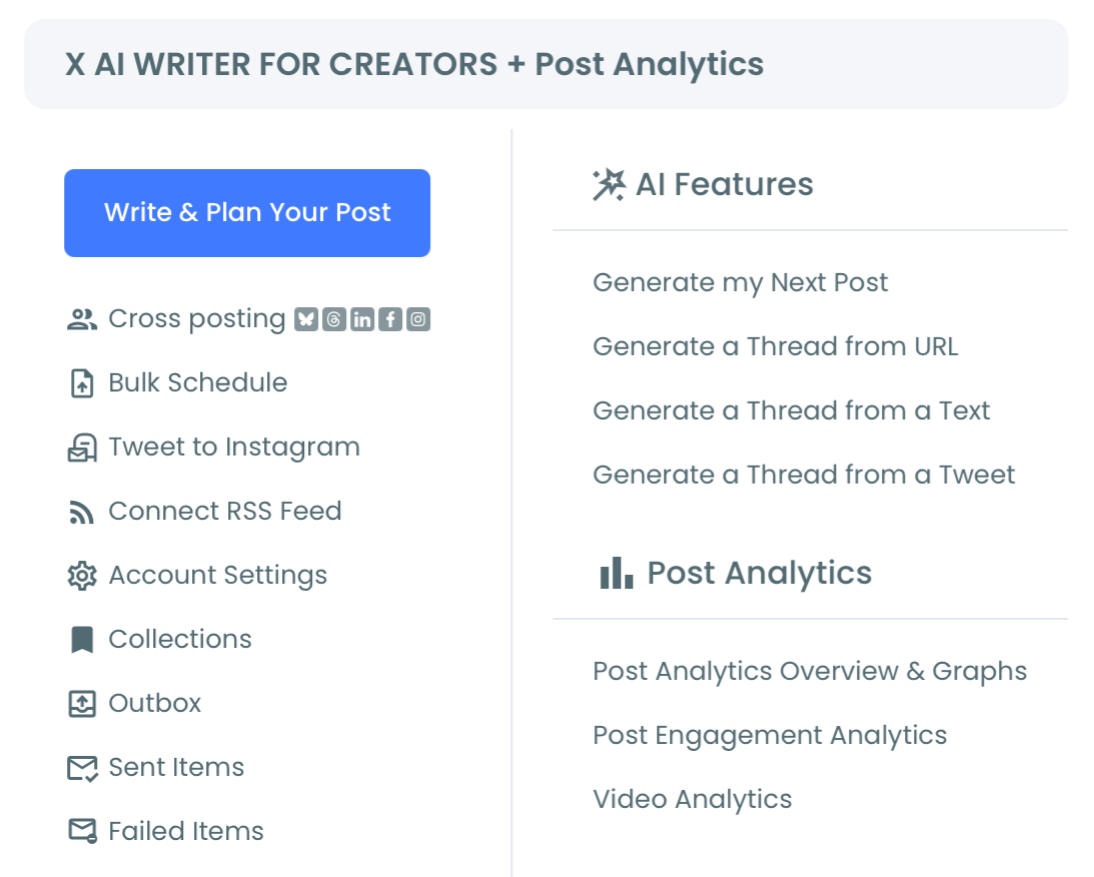
Go to the X Post Planner menu and confirm your content interest topics so the feed reflects your niche, not platform-wide noise.
Scan the Inspiration feed by engagement
Read each card's metrics, views, replies, reposts, likes, and bookmarks, and shortlist the posts that are genuinely landing with people. The numbers are your selection signal for what angle to run.
React in your own voice and schedule
Hover a card and pick Rewrite to generate an original post on the same topic, AI Reply to join the conversation, or AI Quote to add commentary. Refine the draft with "Describe and improve tweet," add your own specific perspective, then schedule it as your first tweet.
That order works because it front-loads evidence before creativity: you decide what to say based on what your audience already responds to, then shape it into your voice, and only then publish. Skip the evidence step and you are back to guessing on the post that matters most.
At a glance: connect, set topics, sort by engagement, rewrite, schedule. The feed does the "what's working" research so you can spend your effort on the angle.
Unlike opening a blank composer and hoping something lands, ideas for your first tweet arrive pre-validated by real engagement. That is a far better bet on the one post that sets your account's tone.
What You Gain from Getting the First Tweet Right
A first tweet grounded in what works does more than fill a slot. It gives new visitors a clean signal of what your account is about, so the people who land on your profile in the first week understand why to follow.
It also gives the timeline an early engagement signal to build on, which matters most before you have followers priming your reach.
Because Inspiration lives inside the X Post Planner, you can turn that first idea straight into a scheduled queue and keep the momentum going.
The compounding benefit is momentum. When your first tweet reacts to a live conversation, it can pull replies from accounts already in that thread, and each of those is a door to a new audience.
A creator with even a small starting position who reacts to trending posts consistently builds faster than one posting cold takes into an empty feed, because reaction meets an audience that is already paying attention.
Getting the first one right also makes the second one easier. Once you see which angle earned engagement, you have a template for your next post, and the blank-page problem never comes back.
If you want your early posts to keep pulling in real followers, pair this with a broader plan to gain more Twitter followers organically rather than chasing shortcuts.
If you are restarting an account rather than starting fresh, the same logic applies, plus one extra step: clear out the old posts that no longer represent you first, then treat your comeback tweet as a first tweet. It can also be the moment to fix a handle that never fit, and this guide on how to choose a Twitter username walks through the trade-offs.
A clean slate plus an evidence-backed opener resets the account's signal entirely.
The Bottom Line
You do not need followers, a polished brand, or a clever hook to post a first tweet worth reading. You just need to lead with value instead of an introduction, and let what already works in your niche pick the angle.
That is the permission most new accounts are waiting for. The scariest post becomes the easiest one when you stop trying to be original and start reacting to a conversation your audience is already having.
Circleboom's Inspiration feed is where that shift happens, showing you proven posts in your topics and turning any of them into your own first tweet in a few clicks. When you're ready, start your first tweet with evidence instead of guesswork.
→ Launch your first tweet ideas with Circleboom
Common Questions About First Tweets
What should my very first tweet say if I have no followers?
Lead with one useful idea, a clear opinion, or a question your niche cares about, not an introduction. On a follower-free account, a value-first tweet gives the reader a reason to engage, and early engagement is what the timeline uses to decide whether to show your next post.
Should a business first tweet be different from a personal one?
Yes, in emphasis. A business first tweet should still lead with value, but frame it around a customer problem your product solves rather than a personal take.
A short intro to what you do is fine as long as the benefit to the reader comes first. For setup specifics, see how to create a Twitter business account.
How do I know which first tweet idea will actually land?
Check what is already performing in your topic area before you post. Circleboom's Inspiration feed shows trending tweets in your niche ranked by real engagement, so you can pick an angle that has already earned views and replies instead of guessing.
Is it okay to reuse a trending tweet as my first tweet?
Use it as a starting point, not a copy. Rewrite it in your own voice and add your own perspective or example so the post is genuinely yours.
A near-duplicate reads as low-effort, while a fresh take on a proven angle is exactly what a strong first tweet does.