
Someone tries to message you on X and instead of a text box they get asked for a number. Not your phone number. A number they are supposed to already have.
That is an X Number doing its job, and it is the part of the feature that confuses people first. X started rolling out X Numbers on September 22, 2026, and the name does more harm than good. There is no phone involved anywhere in this.
An X Number is a private code that lives inside XChat. You generate it, you hand it to specific people, and anyone holding the current code can message you even if you do not follow them and even if your inbox is shut to strangers. That is the whole feature.
What makes it worth understanding is what it is not. It is not tied to your identity, it is not permanent, and it is not a security upgrade. Three separate things people are currently assuming about it, and all three are wrong.
What an X Number Is
A door code for your XChat inbox, valid until you change it.
Normally XChat access follows your follow graph and your message settings. Mutual follows get through. Everyone else lands in message requests or gets stopped entirely, depending on your configuration. An X Number creates a second route that ignores all of that for the people you choose.
X Numbers are here.
— XChat (@chat) September 22, 2026
Share yours with anyone you want to contact you, even if you don't follow them. It's an optional way for people to message or call you, without you needing to accept requests or follow them back. pic.twitter.com/HkObZSQMhm
Three things happen when someone uses your code.
Their message skips the request pile. The conversation opens in your main inbox, which is the difference between a feature and a formality. Message requests are where contact goes to die.
No follow is needed in either direction. You do not follow them. They do not need to follow you. The code is the entire relationship.
They can call you, if your call settings allow it. This is the part people misread. The code opens messaging. Calling stays governed by your existing call settings, so an X Number does not force your phone to ring.
The code itself is a string of digits. Coverage disagrees on how many, with some reports describing 10 and others 8, and X's Help Center has not published the format. It is meant to be shared directly rather than memorized, so the length is mostly trivia.
What an X Number Is Not
This is where most of the confusion sits, so it is worth being blunt about each one.
Not your phone number. Nothing connects an X Number to your carrier, your SIM, or the phone number in your account settings. Giving out your X Number reveals none of those. This is the point of the feature and also why the naming is unfortunate.
Not your username. Your username is public and permanent enough that it functions as your address on the platform. An X Number is private by design, visible only to people you share it with, and disposable on purpose.
Not a verification code. It has nothing to do with two factor authentication, login, or account recovery. Nobody at X will ever need it. Anyone asking for your X Number in a support context is running a scam.
Not a security feature. An X Number controls who can start a conversation. It says nothing about how protected that conversation is once it starts. More on that below, because it matters.
Not permanent. You can refresh the code whenever you want, and the old one stops working for new contacts. A leaked X Number costs you one tap. A leaked phone number costs you years.
How to Get Yours
The controls are not in your privacy settings, which is why a lot of accounts already have the feature and have not noticed.
Open Chat, enter your Chat PIN if you are prompted, tap the inbox header to open the dropdown, and select Number. The toggle in that sheet generates your code, and it is live from the moment you flip it.
Two things in there are worth handling before you share the code with anyone. Turn on Hide from others, because by default people you have already messaged can see your X Number and pass it around. Then open Chat settings and turn on Enhanced call privacy, which is off by default and leaves calls running peer to peer in a way that can expose your IP address.
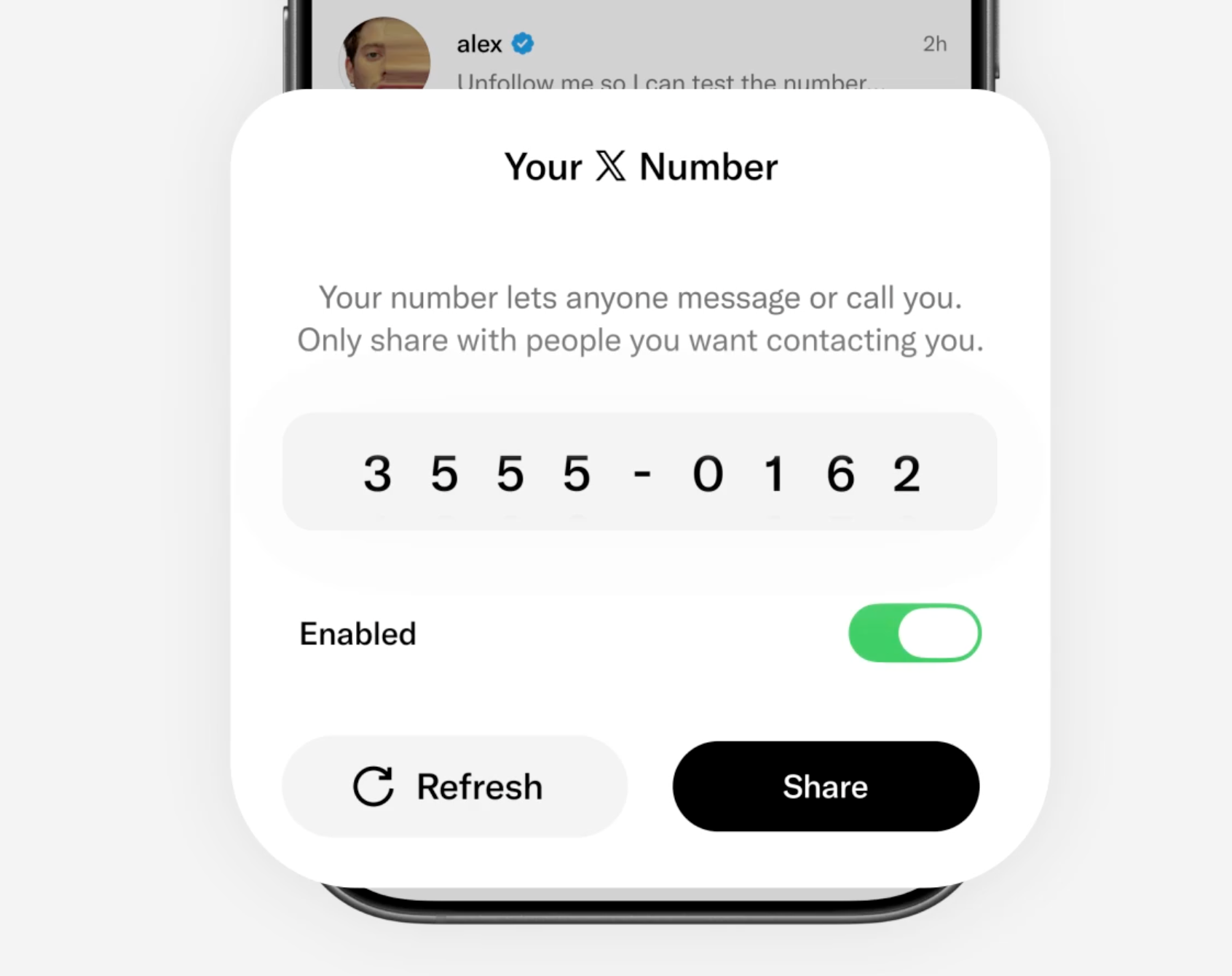
No Number option in the dropdown means the feature has not reached your account yet. It is rolling out in stages and there is no waitlist.
Who Can Reach You Without Your Code
Turning on an X Number does not lock down anything you already had open.
Mutual follows keep their access. People you already have XChat conversations with keep theirs. Whatever your message settings allowed before stays allowed. The code is purely additive, a way to let specific outsiders in rather than a way to shut insiders out.
That also means an X Number is not a privacy tool for reducing incoming messages. If your inbox is open to everyone today, enabling a code changes nothing about the volume you get. The feature only becomes useful once your inbox is closed, because closed is when a door code has a door to open.
Why the Feature Exists at All
XChat launched on a promise of no more phone number swaps. Sign in with your X account, bring your existing network, skip the exchange of digits with someone you just met at a conference. That was the pitch when XChat rolled out earlier in 2026.
X Numbers brings the pattern back in a better form. You still hand over digits, but these digits are not attached to anything else you own and they expire the moment you decide they should.
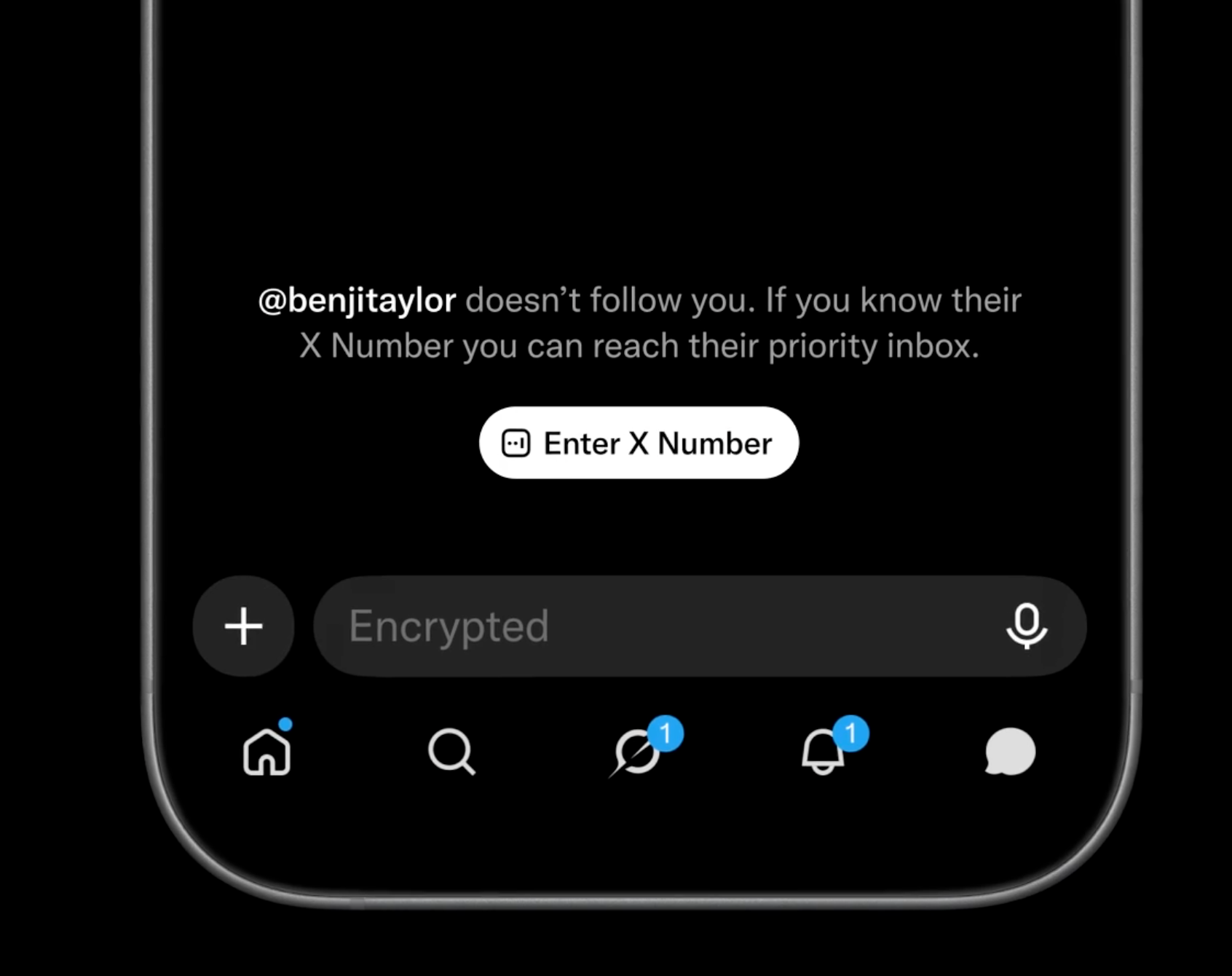
The reason it was needed is simple. Follow graphs are a poor model for who should be allowed to contact you. The person across the table at an event is not someone you follow. The reporter who needs a quote confirmed by Friday is not someone you follow. A paying customer is not someone you follow. Before X Numbers, letting any of them through meant opening your inbox to everyone.
📌 The shapes this takes in practice: a code printed on a conference badge and refreshed the day the event ends, a creator opening a line to a paid community, a business running a support channel for one campaign, a journalist collecting tips without publishing an address that gets scraped forever.
What It Does Not Protect You From
An X Number is access control. It is not encryption, and the encryption underneath it has problems.
XChat's end to end encryption has never been independently audited. There is no published protocol specification, the code is closed source, and X holds the encryption keys. There is no forward secrecy, which means a compromised private key exposes old messages and not only new ones. Recipient public keys come with no out of band verification, leaving room for a server side key substitution. Metadata is not encrypted. Adding Grok to a conversation removes encryption for as long as it is in the chat.
Matthew Green, the Johns Hopkins cryptographer, told TechCrunch that until XChat receives a full audit from someone reputable he would not trust it more than he trusts unencrypted DMs. Other security analysts have reached similar conclusions.
Two more gaps are worth knowing before you share your code with strangers. Your X Number is visible by default to people you have already messaged, who can then pass it around, unless you turn on Hide from others. And XChat calls run peer to peer with Enhanced call privacy switched off, which can expose your IP address to whoever is on the other end. That setting defaults to off.
None of this means the feature is not useful. It means you should be clear about what you bought. An X Number decides who knocks. It has no opinion about who might be listening after you open the door.
FAQ
Is an X Number the same as my phone number?
No. It is a code generated inside XChat with no link to your carrier, your SIM, or the phone number on your X account. Sharing it exposes none of those.
Do I need X Premium for an X Number?
X's Help Center lists no subscription requirement for creating one, which separates it from X Money and its Premium restriction. Availability is still rolling out, so the option may not have reached your account yet.
Can people tell whether I have an X Number enabled?
No. Someone trying to message you sees the X Number prompt whether the feature is on, off, or freshly refreshed. Only the code determines whether a message actually lands.
Does an X Number replace my message settings?
It works alongside them. Your settings still govern mutual follows, existing contacts, and open inbox behavior. The code adds one extra route in for people who would otherwise be blocked or sent to requests.
What happens if my X Number leaks?
Refresh it. The old code stops working for new contacts immediately. Conversations already open stay open, so block individual accounts separately if someone is already in your inbox.
Should I share my X Number publicly in my bio?
That defeats the purpose. A code in a public bio behaves like an open inbox, except now it looks private. If you want anyone to be able to message you, just open your inbox instead.
Final Thoughts
The clearest way to think about an X Number is as a key you can cut copies of and change the lock on whenever you like. That is a meaningfully better deal than the phone number it resembles.
The name will keep tripping people up, and the security story underneath XChat still needs an audit before anyone treats it as private. But the access problem X Numbers solves is real, and it had no solution on this platform until now.