
A low quality Twitter account is one that scores weak across several signals at once: a poor follower-to-following ratio, little or no activity, an incomplete profile, and behavior that does not match a genuine, engaged user. It is a broader category than a fake or bot account. The account is not necessarily inauthentic, it is simply the least valuable kind to follow, and no single signal defines it.
A low quality Twitter account combines a weak follow ratio with low activity, an incomplete profile, and poor engagement. Circleboom's Low Quality Following computes a quality score for every account you follow and surfaces the lowest-scoring ones, so the definition becomes a list you can actually review instead of an abstract idea.
→ low quality accounts in your following list
Here is what the definition looks like in practice.
Low Quality Is Not the Same as Fake
The most common mistake is treating low quality and fake as one category. A fake or bot account is inauthentic by design. A low quality account can be a perfectly real person whose account simply shows weak signals, an abandoned profile, a follow-for-follow account, or someone who joined, followed a few hundred people, and never posted.
The distinction matters because the response differs. Fake and bot accounts are candidates for blocking. Low quality accounts are usually candidates for a quiet unfollow, since they are not threats, just low value. Lumping them together leads to over-aggressive blocking of real people, which is why a thoughtful review separates the two rather than treating every weak account as a fake account to distinguish from a real one.
There is also a quantity difference. Truly fake accounts are usually a small slice of a following list. Low quality accounts can be a large one, because the bar for low quality is lower and the category is wider. That is exactly why the definition needs to be precise instead of a vague feeling that some of your follows are not pulling their weight.
The Signals That Define a Low Quality Account
Circleboom computes a quality score from several public signals, and the lowest scores cluster where multiple weak signals overlap. Reading them together is the whole point, because any one of them in isolation is unreliable.
- Follow ratio. The primary signal. An account following far more accounts than follow it back shows a pattern more consistent with mass-following than organic credibility.
- Activity level. A low tweet count or a long-dormant posting history means the account contributes little or nothing to your feed.
- Profile completeness. No photo, no bio, and a generic handle point to a low-effort or throwaway account.
- Engagement classification. An account marked inactive draws no interaction, so even occasional posts land in silence.
A single weak signal does not make an account low quality. A real niche expert may follow many people, post rarely, and still be worth keeping. The definition lands only when several signals fail together, which is the difference between a quiet-but-real account and one that genuinely adds nothing. The same multi-signal logic drives Circleboom's broader follower and following quality scoring.
Why Low Quality Follows Matter
Low quality accounts in your following list cost you in three ways at once, and none of them are dramatic enough to notice day to day. That is exactly why they accumulate.
First, they dilute your feed. Every dormant or low-value account you follow is a slot that could belong to someone posting things you want to read. Second, they drag your follow ratio in the wrong direction, since following many low-value accounts inflates your following count without adding reciprocal value. Third, they shape perception. Anyone evaluating your account can open your following list, and a list weighted toward low quality accounts signals undiscriminating follow habits, the same impression a feed full of unaddressed inactive and spam followers leaves on the other side.
The cumulative effect is a following list that quietly works against you. Reducing the low quality proportion improves your feed, your ratio, and your credibility in a single pass, which is why the segment is worth defining precisely and reviewing on a schedule.
How to Find Low Quality Accounts You Follow
Circleboom's Low Quality Following reads your full following list through official X access, computes a quality score for every account, and surfaces the weakest ones with their signals attached. Because Circleboom is an official X Enterprise Developer, the analysis and any unfollowing run through sanctioned API access, so your account stays safe throughout.
The process takes four steps.
Log in and connect your X account
Log in to Circleboom Twitter and authorize your account through official OAuth. The connection grants the Enterprise-API access that reads your following list.

Open the Follower & Following menu
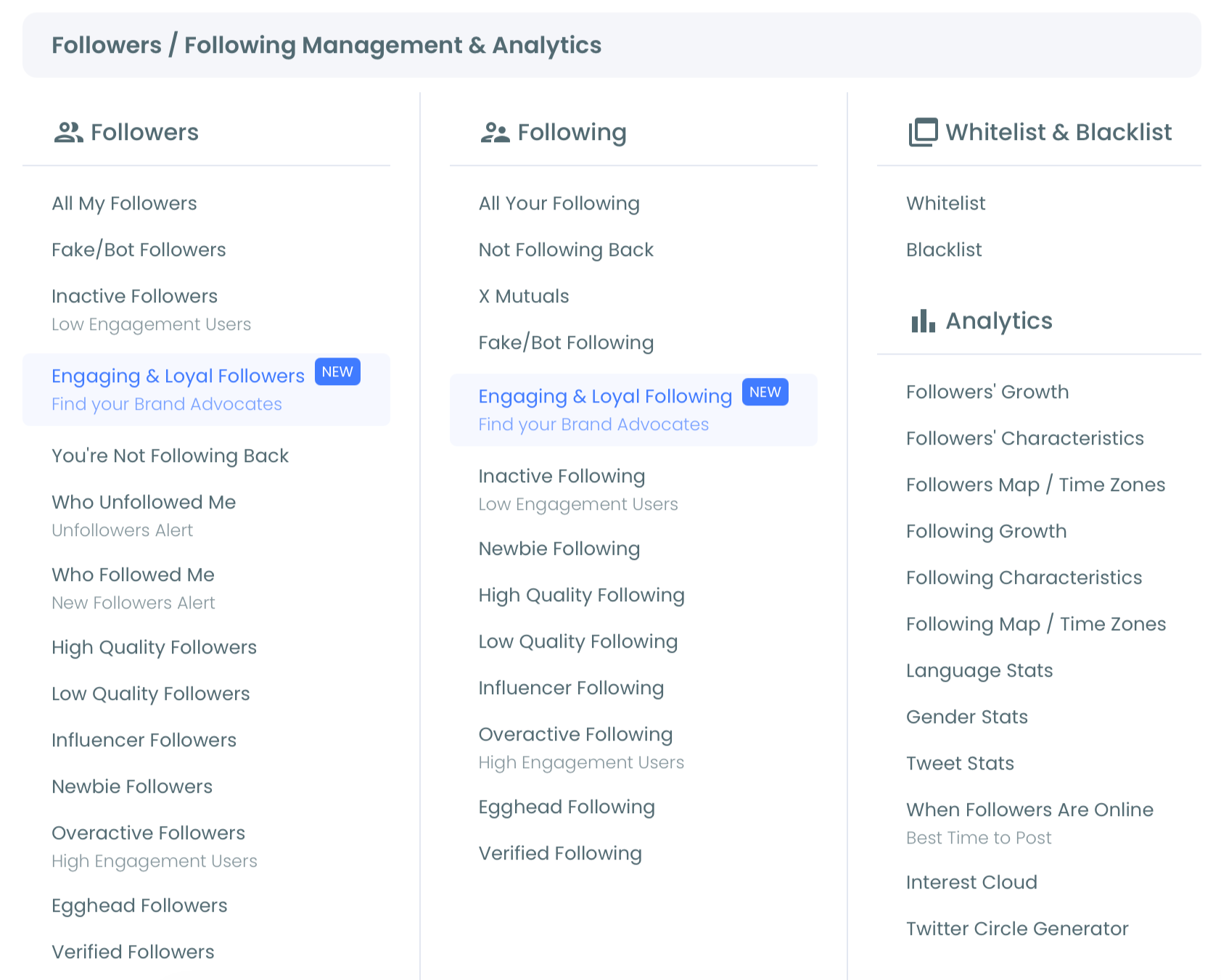
Go to the Follower & Following management menu and select Low Quality Following to load the lowest-scoring accounts you follow, each with its metrics.
Stack filters before you act
Sort by follow ratio ascending, then add the Inactive filter and a low tweet-count filter. Stacking signals narrows the broad low quality category to the accounts where several weaknesses align, the clearest cleanup candidates.
Whitelist the exceptions, unfollow the rest
Whitelist accounts that score low but matter to you personally, such as a customer or a small community account, then select the remaining accounts and unfollow them in one safe pass.
That order works because the quality score alone is too broad to act on. The login secures access, the menu scopes the list, filter stacking turns a wide category into a precise target, and whitelisting protects the real exceptions. Unlike eyeballing your following list and guessing which accounts feel weak, the scored view shows you exactly where the signals overlap, the same way analyzing any account's followers replaces a hunch with data.
What Improves After You Define and Trim Low Quality Follows
Once you can see the low quality segment clearly, the cleanup is straightforward and the payoff is immediate. Your feed carries more signal because the accounts left are the ones posting things worth reading. Your follow ratio improves as the inflated following count comes down. And your following list starts reflecting intentional choices rather than accumulated noise.
Tracking the size of the low quality segment over time turns it into a health metric. If a large share of your following list scores low, there is a real cleanup opportunity. After a pass, the same check shows whether the proportion improved, a more meaningful measure of following list health than raw follower-to-following ratio alone. It is the kind of composition view that helps when organic reach drops for small and mid-size accounts and you need to know whether your own network is part of the problem.
Done on a regular cadence, defining and trimming low quality follows keeps your following list lean and credible. It pairs naturally with checking whether an account is actually active before you keep it and with a periodic look at your audience insights to see how the cleanup changed your network's overall shape.
Frequently Asked Questions
Does low quality mean the account is fake?
No. A low quality account can be entirely real. It simply scores weak across signals like follow ratio, activity, and profile completeness. Fake and bot accounts are a narrower, inauthentic category that warrants blocking rather than a quiet unfollow.
Can a real person have a low quality account?
Yes. New users, hobby accounts, and quiet readers often follow many accounts without posting much or building a following. That is why a single weak signal means review, and only several weak signals together justify treating an account as low quality.
Is it safe to unfollow low quality accounts in bulk?
Yes. Circleboom processes unfollows through the official X API at a safe, gradual pace, and you confirm the selection first. Whitelist any low-scoring accounts you want to keep before running a bulk unfollow.
The Bottom Line
A low quality Twitter account is defined by weak signals stacking together, not by any single flaw and not by being fake. It follows too many, posts too little, looks incomplete, and draws no engagement, all at once. The way to turn that definition into action is to score your following list, stack the filters until the category is precise, protect the real exceptions, and unfollow the accounts where the signals genuinely align.