
Skip your replies during a profile cleanup and you leave the biggest, oldest, and most forgettable part of your history fully public. Replies outnumber your original tweets several times over, and the ones worth removing are almost always too old for X to even scroll you back to. I have run this cleanup on long-lived accounts, and the replies are where the real exposure sits.
What a bulk reply cleanup actually clears.Every reply you have posted, removed in one pass instead of one thread at a time.Replies older than X's 3,200-post limit, reached through your downloaded archive.Your original tweets, kept fully intact while only the comments go.
Circleboom's reply deleter clears every comment from your X account in bulk through official, rate-limited API access. Launch it with Twitter reply deleter.

X gives you no native way to bulk-delete replies. You can remove them one at a time inside each thread, which is fine for last week and hopeless for the last five years.
Replies also accumulate differently from tweets. A considered post takes effort, so you write few of them. A reply costs one line, so you write hundreds, and each one carries your name into a conversation you did not start. To delete all your Twitter replies in a single run, you need a tool that reads your full history and filters the action down to comments only.
How to Delete Every Twitter Reply in Bulk, Step by Step
The process runs in three short phases: get your archive, load it into Circleboom, and filter the deletion to replies. The archive supplies your complete record, the upload gives Circleboom something to act on, and the filter keeps original tweets safe.
Watch: the reply-only filter clearing a full comment history while original posts stay in place.
Download your X archive
- Request your archive from X settings, following the platform's own guide to downloading your X data, then wait 24 to 48 hours for the file.
- Locate the tweet.js file inside the unzipped archive folder, since that single file, not the full ZIP, is what carries your history.
Load the archive into Circleboom
- Log in to Circleboom Twitter and connect the same X account your archive came from.
- Open the Essential Toolbox menu and go to the Delete Tools area for archive-based cleanup.
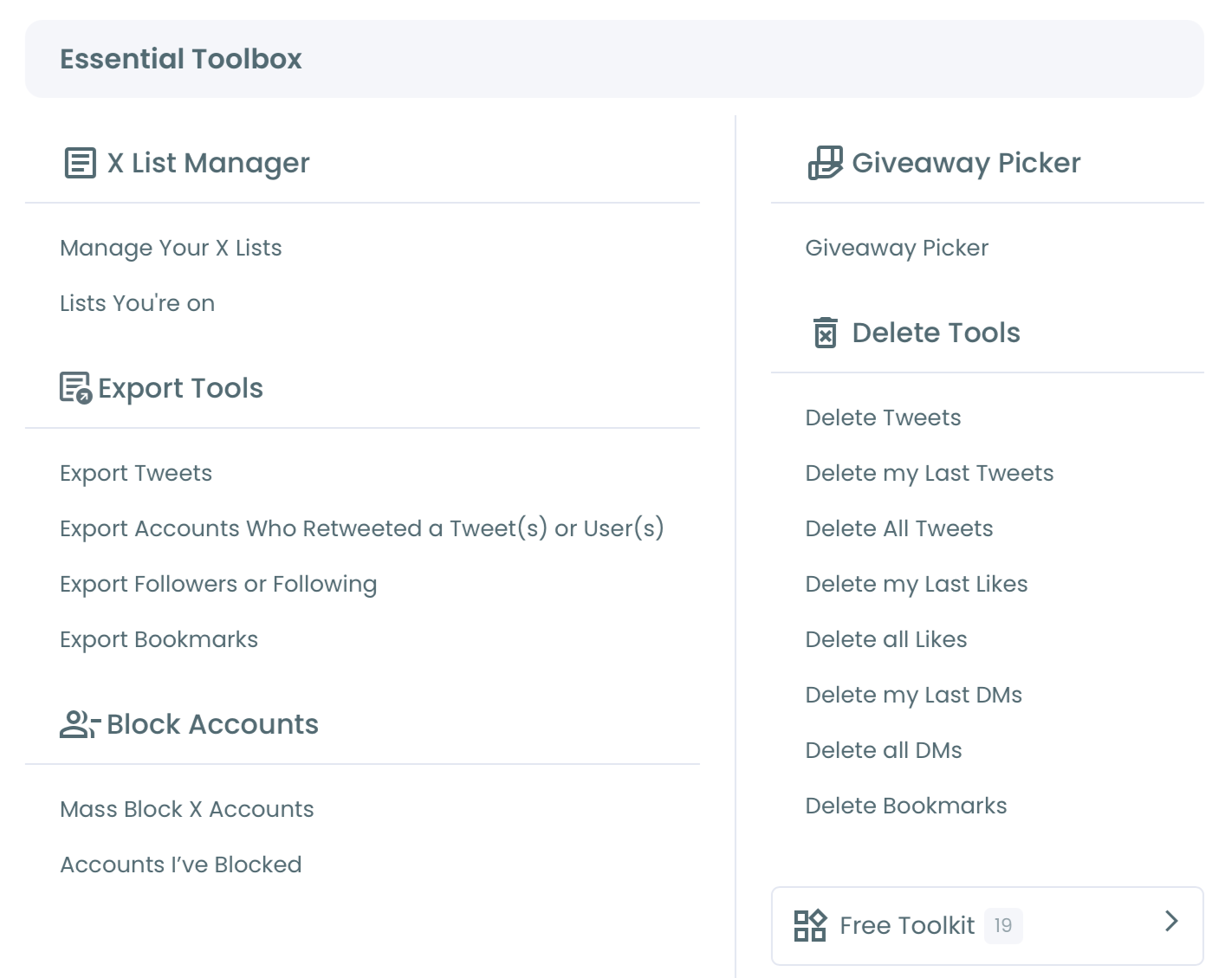
- Upload the tweet.js file and let Circleboom display your total post count.
Filter to replies and delete
- Uncheck Tweets and ReTweets so Replies is the only selected post type in the filter panel.
- Check the Approve & Delete count, then click Delete my Tweets to remove your full reply history.
That sequence works because each phase removes a different risk. The archive defeats the 3,200-post ceiling, the account match keeps the file valid, and the reply filter stops the run from touching posts you want to keep. Reverse or skip a phase and you either miss old replies or delete too much.
Quick recap:
- Request archive, grab tweet.js.
- Log in, open Essential Toolbox, upload.
- Keep Replies checked, confirm the count, delete.
If you want to trim on a narrower rule instead of clearing everything, the same archive supports a run to delete tweets by date for a clean cutoff year.
You can also mass delete tweets by popularity when the goal is to prune your worst-performing posts rather than the oldest ones. Both passes reuse the archive you already downloaded.
Why the Archive Step Is Not Optional
The archive is what separates a complete reply cleanup from a cosmetic one. X's API returns only your most recent 3,200 posts, so any reply deleter that skips the archive can never reach the older bulk of your comments. Your reply from four years ago stays public no matter how many times an API-only tool runs.
Because completeness is the whole point here, the access method matters. Circleboom pulls your full, authorized data through official X (Twitter) Enterprise APIs, so the deletion is accurate and sanctioned rather than a partial scrape. That is the difference between removing every reply and removing only the ones that happened to be recent.
This same limit is why some people find they can delete old tweets by year in two steps only through the archive path. The app cannot reach that far back, so the archive does the work the API cannot.
A dedicated Twitter archive eraser reaches exactly the content the app hides from you, which is where the majority of a heavy replier's history actually lives.
There is a second reason the archive step earns its place. Because it is a local file you keep, it doubles as a permanent backup of everything you are about to remove. You act on a copy of your own record, verify the count, and only then delete from the live account, so the workflow never asks you to gamble with data you have not saved first.
Keep the Replies Worth Protecting
Clearing every reply does not have to mean losing the few that matter. Most heavy repliers have a small set worth saving: a helpful answer to a customer, a thread that got quoted, a genuinely good exchange. Circleboom's Protect List covers that. You mark those replies before the run, and the deletion skips them while it removes the rest.
The reply-only setting also stacks with the other filters, so you can shape the run instead of firing a blanket wipe:
- Date range keeps a recent window and clears everything older.
- Keyword, username, or hashtag targets replies that mention a specific topic or account.
- Language isolates one language when your account posts in several.
Each filter changes the Approve & Delete count before you commit, so you see the exact scope first. The common result is a full reset with exceptions, which clears years of noise while a short protected set survives untouched. That is usually the difference between a cleanup you trust and one you second-guess.
Is It Safe to Bulk-Delete Replies on X?
Running a bulk action on your own account is safe when three conditions hold, and this workflow meets all of them.
- Sanctioned access. The deletion runs through official API paths with proper rate limits, not an unofficial workaround.
- A backup first. The archive you downloaded is a permanent local copy, since deletion on X cannot be undone.
- A reviewed count. The Approve & Delete panel shows the exact number of replies before anything is removed.
One caveat to expect: replies and quotes other accounts posted to you are their content, so those remain on X after your side is gone. There is no way to remove another account's posts, and that is by design rather than a limit of the tool.
If you would rather thin the noise than wipe it, you can also remove low-engagement tweets as a lighter cleanup. When the goal is a full reset of the account, weigh how to reset your Twitter account including the tweets before you commit.
Your Next Move
Here is the short checklist to run a complete reply cleanup:
- Request your X archive and keep the tweet.js file.
- Upload it to Circleboom's Delete Tools.
- Filter to Replies only and confirm the count.
- Come back later for a date or keyword pass if you need one.
For the broader version of this workflow, the guide on how to delete all your tweets at the same time covers the full timeline reset. When replies are the priority, you can wipe every reply in bulk today and keep your original tweets exactly where they are.
What to Know Before Deleting Replies
Does X have a built-in way to delete all replies at once?
No. X only lets you delete replies one at a time from inside each thread. A dedicated Twitter reply deleter is the only way to remove them in bulk, and an archive-based one is the only way to reach the older replies X will not scroll you back to.
Will a reply deleter also remove my likes and retweets?
Only if you tell it to. In the filter you choose which post types to delete, so keeping Replies checked while unchecking Tweets and ReTweets clears comments alone and leaves the rest of your activity untouched.
What happens if I delete the wrong replies?
There is no undo, so the safeguard is the review step. You confirm the Approve & Delete count before the run, and your downloaded archive stays as the only record of anything removed.
Can I run the reply cleanup more than once?
Yes. You can re-upload the same tweet.js file later and apply a different filter, and Circleboom automatically skips replies you already deleted so nothing is processed twice. That lets you run a reply-only pass first, then come back another day for a date or keyword cleanup without downloading a fresh archive.