
Recruiting on Twitter works because engineers, designers, marketers, and operators describe their skills, job titles, and availability in their own words, right in their bios and their tweet history. A candidate who writes "senior React engineer, open to work" or spends months tweeting about distributed systems is telling you exactly what they do. The problem is that Twitter's native search cannot pull all of those people into one filtered, exportable list. Deep X Account Search can.
The best recruiters treat recruiting on Twitter as a sourcing channel, not a spam channel. You find qualified people, evaluate them, and reach out with something relevant.
Recruiting on Twitter is the practice of sourcing candidates by searching X bios and historical tweets for skills, job titles, seniority signals, and availability, then filtering that pool by quality. Circleboom's Deep X Account Search scans historical bio and tweet data through official, sanctioned API access and returns up to 5,000 matching accounts per keyword, filterable by follower count, location, verification, and engagement.
→ recruiting on Twitter
Below: why bios and tweet history beat job boards, the exact filters that separate a candidate from noise, and the step-by-step sourcing flow.
Most guides on hiring through social media stop at "post your job opening and wait." That is inbound recruiting, and it only reaches people already following you. The far larger opportunity is outbound sourcing: the qualified people who never see your post because they are not in your network yet. Reaching them requires searching the platform, not broadcasting to it.
That gap is where a search tool earns its keep. When you can query every public bio and years of tweet history for a specific skill and seniority, you stop waiting for candidates to find you and start building a targeted shortlist yourself.
Why Bios and Tweet History Beat a Job Board
A job board tells you someone is looking. A Twitter bio and tweet history tell you what someone actually knows. Those are different signals, and the second one is harder to fake.
Someone who has tweeted about Kubernetes for two years, answered other engineers' questions, and shipped side projects is demonstrating expertise in public. A resume claims the same skill in one line. For technical and creative roles especially, the public track record is closer to a work sample than a bulleted CV. That is the recruiting advantage of sourcing candidates where they already show their work.
There is a second advantage: reach. Deep X Account Search regularly returns hundreds or thousands of accounts for a single keyword, because it scans historical tweet and bio data, not just who posted this week.
That matters for recruiting, where the strongest candidate is often the specialist who posts selectively but carries real authority. The same discovery muscle that powers Find Twitter Influencers is what surfaces credible, low-volume experts for a hiring shortlist.
If you are weighing whether X talent is worth pursuing, this look at whether you should hire Twitter influencers frames the tradeoffs, and much of it applies to sourcing hires too.
You can start a targeted candidate search here: source candidates on X.
The Filters That Turn a Keyword Into a Shortlist
A raw keyword search returns everyone who ever mentioned a term, including people who mentioned it once in passing. Recruiting quality comes from the filters you stack on top. Deep X Account Search applies these to the full result set, so you narrow thousands of matches down to a real shortlist.
Here are the filters that do the most work for a hiring team:
- Bio and name keyword. Match skills, stacks, or titles that live in the profile itself, like "product designer" or "growth marketer."
- Location. Scope to a city or region when the role is on-site or timezone-sensitive.
- Follower and following count. Set ranges to separate established practitioners from brand-new accounts.
- Verification and engagement tier. Prioritize active, credible accounts over dormant or low-signal ones.
- Join date. Filter by account age when tenure on the platform is a useful proxy for experience.
All filters work together with AND logic, so a query like "iOS engineer" plus a location plus a minimum follower floor returns a tight, reviewable list instead of a firehose. If you want to sharpen the query itself before filtering, this rundown of advanced search filters shows how the operators combine.
One caveat worth stating plainly: a keyword match on a tweet from two years ago is not proof of current relevance. People change focus. Review before you reach out, and treat the historical match as a lead, not a verdict.
How to Source Candidates on Twitter With Circleboom
Circleboom's Deep X Account Search turns "who on Twitter does this job" into a filtered, exportable list you can actually work. It scans historical bios and tweets in your keyword area, returns up to 5,000 accounts, and lets you narrow and export from the same screen.
Circleboom runs this as an official X Enterprise Developer, so every account you see comes through approved, policy-compliant access rather than scraping.
Here is the sourcing flow, in order.
Connect your X account and open the search
- Log in to Circleboom Twitter and connect your X account with official OAuth.

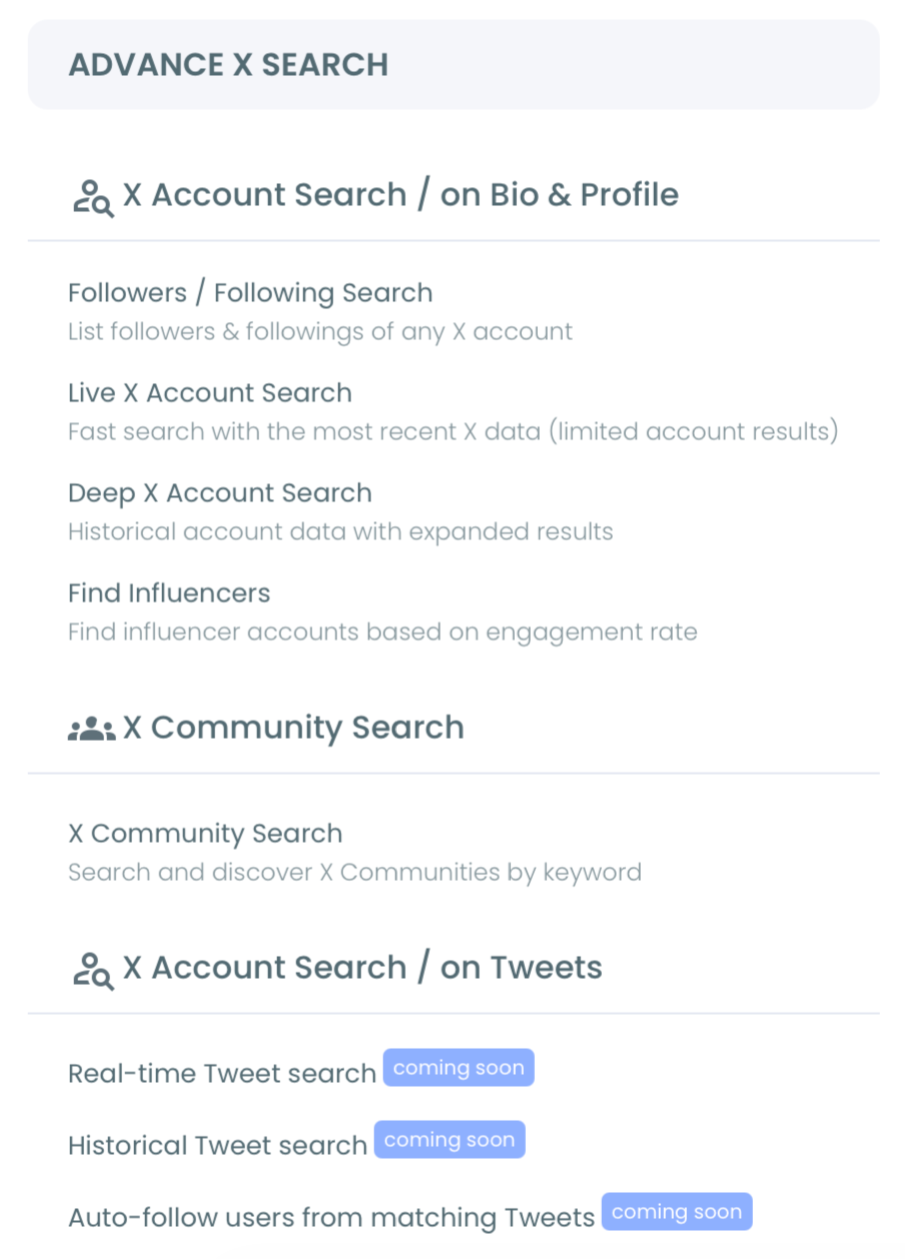
- Open the Advanced X Search menu and select Deep X Account Search so you are querying historical data, not just recent activity.
Search, filter, and evaluate the pool
- Enter your sourcing keyword. Use a skill, job title, or availability phrase like "backend engineer," "UX researcher," or "open to work," and let the historical scan return matching accounts.
- Apply your filters. Open Filter Options and layer bio keyword, location, follower range, verification, and engagement tier to cut the pool down to genuine candidates.
- Evaluate before acting. Open promising profiles, read recent tweets, and confirm the skill and availability signal is current, not a two-year-old mention.
Build the shortlist and export
- Whitelist the strong fits and blacklist the misses so your reviewed decisions persist into future searches.
- Export the shortlist as CSV to feed your ATS, CRM, or outreach tracker, or add candidates to a private X List for ongoing monitoring.
That order front-loads evidence before outreach. You source broadly, filter to fit, verify by eye, then export a clean list. Skip the filtering and evaluation steps and you are back to spraying DMs at strangers, which is exactly the behavior that gets recruiters muted.
To see keyword-based account discovery in action, this walkthrough covers finding the right accounts in any niche by keyword.
Unlike scrolling Twitter hoping to stumble on the right people, sourcing candidates on X starts from a filtered pool of accounts that already match the skill you are hiring for.
Employer Brand Monitoring Alongside Sourcing
Sourcing is only half of recruiting on Twitter. The other half is watching what people say about your company as a place to work, because your reputation shapes who replies when you reach out.
The same search approach that finds candidates finds mentions of your company, your team, and your hiring process. Search your brand name plus terms like "interview," "offer," or "culture" and you catch the unfiltered signal that a careers page never shows. That intelligence tells you whether a cold outreach will land warmly or coldly. For a broader view of pulling insight from the platform, this rundown of the best way to search Twitter bios and profiles applies directly to employer-brand listening.
There is a pipeline benefit too. If your hires need to convert into measurable outcomes, this guide to B2B lead generation campaigns shares the same discipline of sourcing, filtering, and tracking that a recruiting funnel needs. And when you want to compare your keyword targeting against what actually works, this breakdown of more targeted X account search sharpens the query stage.
The Bottom Line
Recruiting on Twitter is not about volume outreach. It is about finding the specific people whose public track record already proves they can do the job, then reaching out with relevance. The bios and tweet history are the resume you did not have to ask for.
Circleboom's Deep X Account Search is where the sourcing happens, turning a skill keyword into a filtered, exportable shortlist of real candidates in minutes. When you are ready, you can find candidates on X by the exact skills your role requires.
→ Start sourcing candidates on Twitter with Circleboom
FAQ
Is recruiting on Twitter allowed under the platform's rules?
Yes, when you source and evaluate candidates rather than spam them. Reading public bios and tweets to identify qualified people, then sending relevant, personalized outreach, is standard sourcing. Circleboom accesses that public data through official, sanctioned API access, not scraping, so the discovery step stays policy-compliant. What crosses the line is mass, identical, unsolicited DMs, which annoy recipients and hurt your employer brand.
What should I search for to find candidates on X?
Search the way candidates describe themselves. Combine a skill or stack ("Rust developer," "Figma," "demand gen"), a seniority or title term ("senior," "lead," "head of"), an availability phrase ("open to work," "looking for my next role"), and a location if the role needs one. Deep X Account Search matches these against bios and historical tweets, then lets you filter the result by follower count, verification, and engagement to reach a reviewable shortlist.
How many candidates can I find in one search?
Deep X Account Search returns up to 5,000 accounts per keyword query, paginated across up to 50 pages, because it scans historical bio and tweet data rather than only recent activity. For most roles you will not contact thousands of people. The volume matters because it lets you filter aggressively by location, seniority, and quality and still be left with a strong shortlist, instead of running out of candidates after the first ten results.