
Fifty. That is how many unfollow actions X will process for your account in any 15-minute window, and roughly 800 in a full day.
Those two numbers decide the shape of every bot cleanup you will ever run, and they are the reason a following list with hundreds of automated accounts in it takes sessions rather than one click.
Profile by profile: open each bot account, click Following, click Unfollow, repeat a few hundred times. Through Circleboom: your following list is filtered down to the accounts carrying several bot signals at once, then removed in confirmed batches on X through the official API.
→ mass unfollow bot accounts on X
An unfollow fixes your feed. It does not fix everything a bot can still do to you.
The follow you made two years ago is still shaping your timeline
Most bot follows are historical. They came from a follow-for-follow push, a giveaway, a research sprint that ended, or a week when you followed back everyone who followed you. None of that was a bad decision at the time. The accounts simply aged badly, and some were never real to begin with.
Two things carry the cost. Your feed pulls posts from accounts that publish on a script, and your public following list tells anyone who checks it that you followed several thousand accounts without looking closely.
The second one matters more than people expect, because the following list is visible to every visitor who taps it.
The fix is mechanical rather than clever. See the whole following list as data. Narrow it to accounts you can defend removing. Then unfollow bots on Twitter in batches X will accept.
Native X gives you none of those three. There is no filter panel over your following list, no way to sort it by account age or posting volume, and no bulk action beyond opening profiles one at a time.
For the broader framing on where these accounts come from in the first place, how to get rid of Twitter bots covers the ecosystem side.
Why does unfollowing a bot not stop it from bothering you?
Unfollowing changes exactly two things: what enters your timeline, and what your public following list says about you. It does not touch the account's ability to keep following you, reply under your posts, quote you, or land in your DM requests. A bot you unfollow is a bot that can still reach you.
That gap is where most cleanups go wrong. People run one pass, feel finished, and then reopen the same problem a month later when the noisy accounts are still in their mentions.
The removal decision is not a yes or no. It is a three-way fork, and each branch fixes a different problem.
Unfollow when the account only pollutes your feed
Unfollow is the right call for the large, dull middle of the segment: dormant automated accounts, abandoned profiles, scripted reposters that never interact with you. They cost you feed quality and list credibility, nothing else. Removing the follow closes the whole issue.
Not every automated account is hostile either. A weather feed, a deploy notifier, or a sports score bot posts on a script and still earns its place. The difference between bots and automated accounts on Twitter and X is a real distinction. Apply it before you select an entire filtered page.
Blacklist when you want the account remembered
Blacklist does not unfollow, block, or hide anything. It attaches a label that persists across every Circleboom feature, so the account is already flagged the next time you build a segment. Use it during review when you are not ready to act but do not want to re-evaluate the same profile in six weeks.
Block when the account is still going to interact
Mass Block is the branch people skip. It stops the account from seeing your posts, following you, replying, or messaging you, which is the part an unfollow leaves wide open.
Circleboom stages selected accounts into a Mass Block queue you can review before anything runs. The queue persists between sessions, so you can add to it across several review passes and execute once. Blocking itself runs through the Twitter X Mass Blocker Chrome extension, because X's API does not expose bulk blocking.
When the accounts are abusive rather than merely automated, Mass Block Twitter accounts is the branch that ends the problem. How to block Twitter and X bots walks through when that escalation is justified and when it is overkill.
Deciding the branch before you select anything is what keeps a cleanup from becoming two cleanups.
What Circleboom does with your following list
Circleboom pulls your complete following list through X's official API and rebuilds it as a sortable table, one row per account. Tweet count, join date, following count, follower count, follow ratio, and an engagement classification are computed and shown before you touch anything.
Nothing about that view is a scrape. As an Enterprise partner of X, Circleboom sends every unfollow through a named, authorized application rather than an anonymous browser session. The removals are therefore attributable: if the activity on your account is ever queried, the record shows which application made the calls and under whose authorization.
The filter panel is where the segment gets built. Follower Quality has a dedicated dropdown for Fake/Spam that can be set to Only, and it stacks with numeric ranges for follow ratio, tweet count, following count, and join date.
Every active filter shows as a removable tag above the table, so you can read the exact criteria before you select a single row.
One sort at a time, not two
Column sorting is single-column, and this trips people up. Clicking Follow Ratio sorts by follow ratio, and clicking Tweets afterwards replaces that sort rather than layering on top of it.
Compound criteria live in the filter panel, not in the column headers. If you want a second opinion on individual profiles before acting, the Twitter Bot Checker reads a single account rather than a batch.
That combination is what lets you bulk unfollow the bots you follow with an argument behind every removal instead of a hunch.
Two minutes on video: the following-list filter panel and the confirmed unfollow batch, running end to end.
https://www.youtube.com/watch?v=IEv-XHzQXa4
How to unfollow bots on Twitter, step by step
To remove bot accounts from your following list, protect the accounts you value first, build a multi-signal filter second, and confirm the batch before anything reaches X. The seven steps below run in three phases, and the order is what keeps the operation reversible where it can be and safe where it cannot.
Protect the accounts you cannot afford to lose
- Log in to Circleboom Twitter and connect the X account you want to clean.
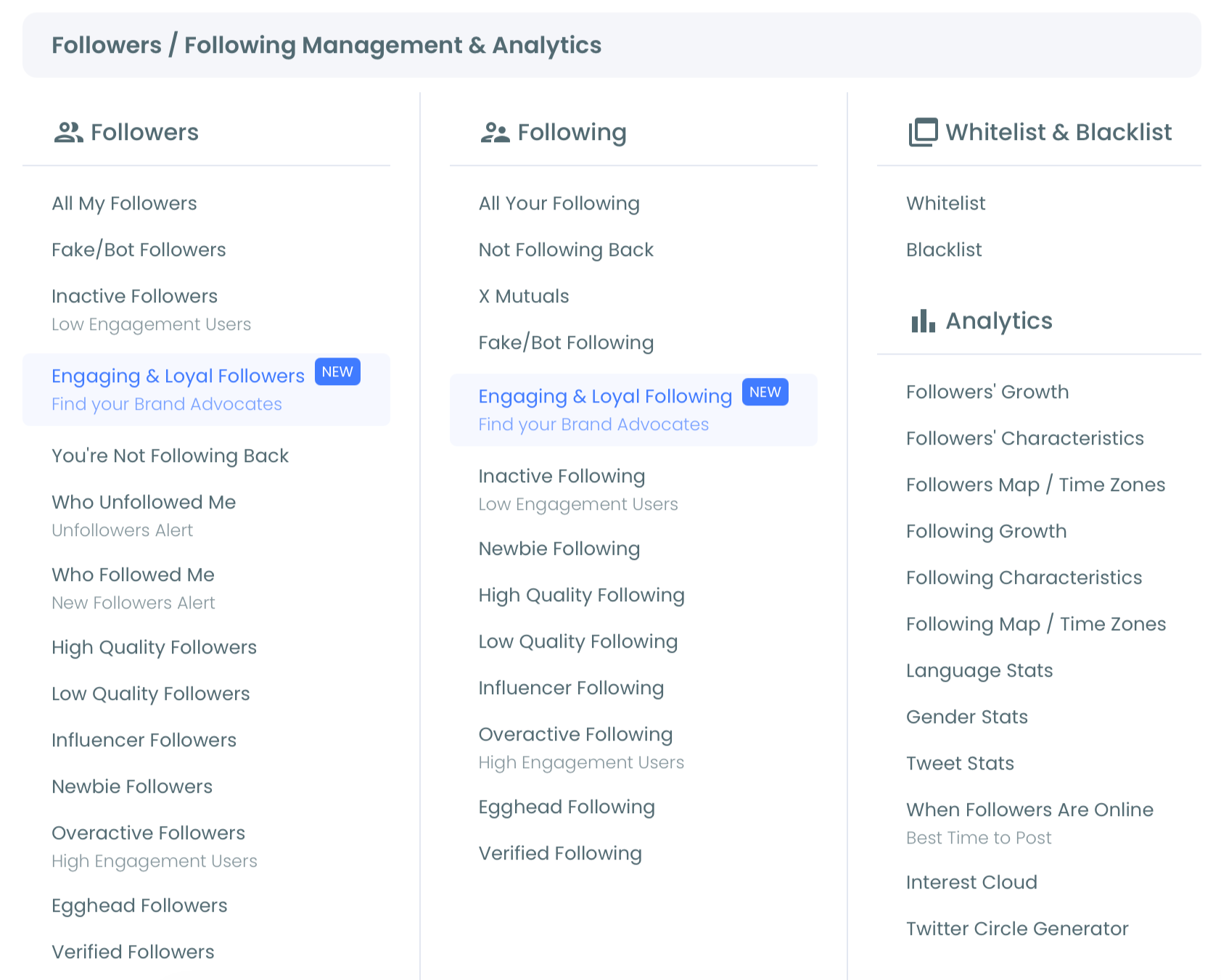
- Open the Follower & Following menu and choose All My Following for the unfiltered view of every account you follow.
- Select your partners, customers, journalists, and reference accounts, then apply Add to List and Whitelist. Whitelisted accounts are excluded from every bulk action across the platform and hidden from the grid by default.
Narrow the list to accounts with overlapping bot signals
- Open Filter Options and set Fake/Spam to Only so the table shows nothing but accounts already carrying the classification.
- Add Follow Ratio Max 0.1 and Tweet Count Max 10 so an account has to fail on several dimensions at once before it appears. One weak signal is noise. Three overlapping signals is a case.
Confirm the batch before X sees a single request
- Read the Active Filters bar, then use the master checkbox to select the visible page. The master checkbox covers the current page only, so a segment spanning several pages is selected page by page.
- Click Unfollow and confirm the count Circleboom displays. Circleboom processes 50 unfollows every 15 minutes up to about 800 a day, and recommends staying near 100 to 150 accounts per session.
Protection has to exist before a selection does, the filter has to narrow the segment before the master checkbox touches it, and the confirmation count is your last chance to notice a filter you set wrong.
That is why the phases sit in the sequence they do. The run in one line: protect, filter, confirm, then decide what still needs blocking.
What changes after the bots are gone
Your timeline stops carrying posts nobody wrote. That is the immediate one, and it lands within a day. The public following list stops broadcasting indiscriminate follow behavior, which matters in the moments when someone is deciding whether your account is worth taking seriously.
The arithmetic is worth spelling out. If 300 of the 2,000 accounts you follow are automated, you are handing 15 percent of your feed to accounts that will never read you back, never reply, and never be a real connection.
Removing them does not change your follower count. It changes what you see and what you signal.
There is also a compliance angle worth respecting. X's authenticity policy treats indiscriminate following and unfollowing of large numbers of unrelated accounts in a short window as platform manipulation, particularly when it is automated.
A filtered, evidence-backed segment run in paced sessions is the opposite of that pattern. That is exactly why the filter step is not optional dressing on top of the unfollow. For the mechanics of larger batches, how to mass unfollow Twitter accounts covers the pacing side in more depth.
One last piece of housekeeping. Export the filtered segment as CSV before you run it if the accounts matter to any reporting you keep, because the export is the only record of what the batch contained once the rows disappear from the grid.
Your next move
Pick the branch that matches what the accounts are actually doing to you. If they only clutter your feed, filter and unfollow, and the job is finished in a session or two.
If they are still replying, quoting, or messaging you after the follow is gone, stage them into the Mass Block queue and let the extension work through it.
If you are unsure about a cluster, blacklist it and revisit next month with the label already applied.
Whichever branch you take, start from the same place: the full following list, whitelist set, filters visible. You can unfollow Twitter bots in filtered batches from there.
Questions about the removal decision
Does unfollowing a bot stop it from replying to my posts?
No. Unfollowing removes the account from your feed and from your public following list, and nothing else. The account can still follow you, reply, quote, and send message requests. Use Add to Mass Block List when interaction is the actual problem.
How long does a 500-account bot cleanup take on X?
Circleboom processes 50 unfollow actions every 15 minutes, so 500 accounts is roughly two and a half hours of processing time if you run it in one stretch. Splitting it across three or four sessions of 100 to 150 is the recommended approach, and it keeps the pattern well inside normal account behavior.
Can I get my follows back if I unfollow the wrong account?
Not automatically. Bulk unfollow cannot be reversed through Circleboom, and there is no batch re-follow of a previous segment. You can re-follow an account manually. That irreversibility is the reason the whitelist step sits before the filter step rather than after it.
Is blocking better than unfollowing for spam accounts?
It depends on whether the account still reaches you. Unfollow is the normal cleanup action for accounts that only pollute your feed. Blocking is the stronger response for accounts that are abusive, scam-shaped, or likely to keep interacting after the follow disappears.
Do I need a Chrome extension to unfollow bots on Twitter?
No. Unfollowing runs directly through the official X API inside Circleboom with no extension involved. The Chrome extension requirement applies to Mass Block and Remove Follower, because X's API does not support those operations, so they are processed through a browser session instead.