
Skip the trim and your timeline keeps handing space to accounts that stopped posting years ago.
There is a harder cost behind that one. X caps every account at 5,000 follows until your own follower count catches up, so a swollen following list eventually blocks you from following anyone new.
The fix is not a mass purge. It is a selective pass that clears dead weight and protects the accounts you actually read.
Trimming a Twitter following list means filtering the accounts you follow by activity, follow ratio, and join date, protecting the ones that matter, then unfollowing the rest in paced batches. Circleboom pulls your complete following list from X through Enterprise-tier API access and turns it into a sortable, filterable table with unfollow, whitelist, and export controls on every row.
→ trim your Twitter following list
The order of operations matters more than the filters do, and most walkthroughs get that order backwards.
Why a swollen Twitter following list costs more than clutter
A following list is a budget, and most people spend it without noticing.
Every account you follow claims a share of a feed that has a fixed amount of attention behind it. If you follow 3,000 accounts and 40% of them have gone quiet, you are not looking at a 3,000-account feed. You are looking at an 1,800-account feed with 1,200 empty seats reserved.
The second cost is public. Your following list is visible to anyone who opens your profile, which makes it a statement about who you associate with. A recruiter, a client, or a partner can scroll it in ten seconds.
Most people have never audited it once. A single pass to view who you're following on Twitter usually turns up accounts nobody remembers adding.
The third cost is mechanical, and it is the one people hit without warning. Per X's follow limit and ratio rules, every account is capped at 5,000 follows, and going past that depends on your follower count rather than your intent. Once you are near the ceiling, every new follow requires an unfollow first.
Trimming stops being cosmetic and starts being the thing that unblocks you.
There is a discipline cost too. Aggressive follow-and-unfollow churn is against X's rules, so the answer is never a scripted sweep of everything you follow. It is a reviewed, paced reduction. You get that when you prune the accounts you follow from a filtered table instead of X's native list.
What trimming means that mass unfollowing does not
Trimming is subtraction with a protected set. Mass unfollowing is subtraction with nothing protected, which is why it so often ends with a message to a client explaining why you dropped them.
The difference shows up in the order you do things. Most guides on who to unfollow on Twitter start with the filter: find the inactive ones, find the bots, unfollow them. That order works right up until the filter catches something valuable, and by then the action has already run.
Protect first, filter second, act last. That single reordering is what separates a trim from a purge.
Here is why it holds. Quality signals are indicators, not verdicts.
An account classified as Inactive may be a researcher who posts four times a year and is worth every one of those posts. A partner account with a low follow ratio and no profile photo scores badly on every metric and still belongs in your feed.
Circleboom's whitelist exists for exactly this gap. Whitelisted accounts are excluded from bulk unfollow operations across the entire platform, not just the view you happen to be in.
So the protected set gets built before any filter runs. Partners, customers, journalists you track, the three people whose posts you would notice missing.
Circleboom applies that shield to every account you follow on X, so a label you set today still holds on a pass you run three months from now. Once they carry it, you can be aggressive with everything else, because the aggressive part can no longer reach them.
The rest of the list splits into narrower jobs. Accounts that went quiet are a job you can hand to a dedicated view for unfollow inactive Twitter accounts. Accounts you follow for reference but not for the feed are a list-building job, not an unfollow job. Only what survives both passes is a genuine trim candidate.
That is the whole method, and it is why you can trim your Twitter following list aggressively without anxiety. The protection is already in place before the aggression starts.
How to trim your Twitter following list with Circleboom
The whole pass on video: full table, whitelist, filtered unfollow, one sitting.
https://www.youtube.com/watch?v=IEv-XHzQXa4
Phase one loads and records. Phase two protects. Phase three cuts.
Doing them out of order is what produces the regret this article opened with.
Load the full following list before you touch a filter
- Log in to Circleboom Twitter and authorize the X account you are about to trim. Every filter, whitelist label, and unfollow below applies to that one account and nothing else.

- Open the Follower & Following menu and select the All My Following view, which loads every account you currently follow as one sortable table.
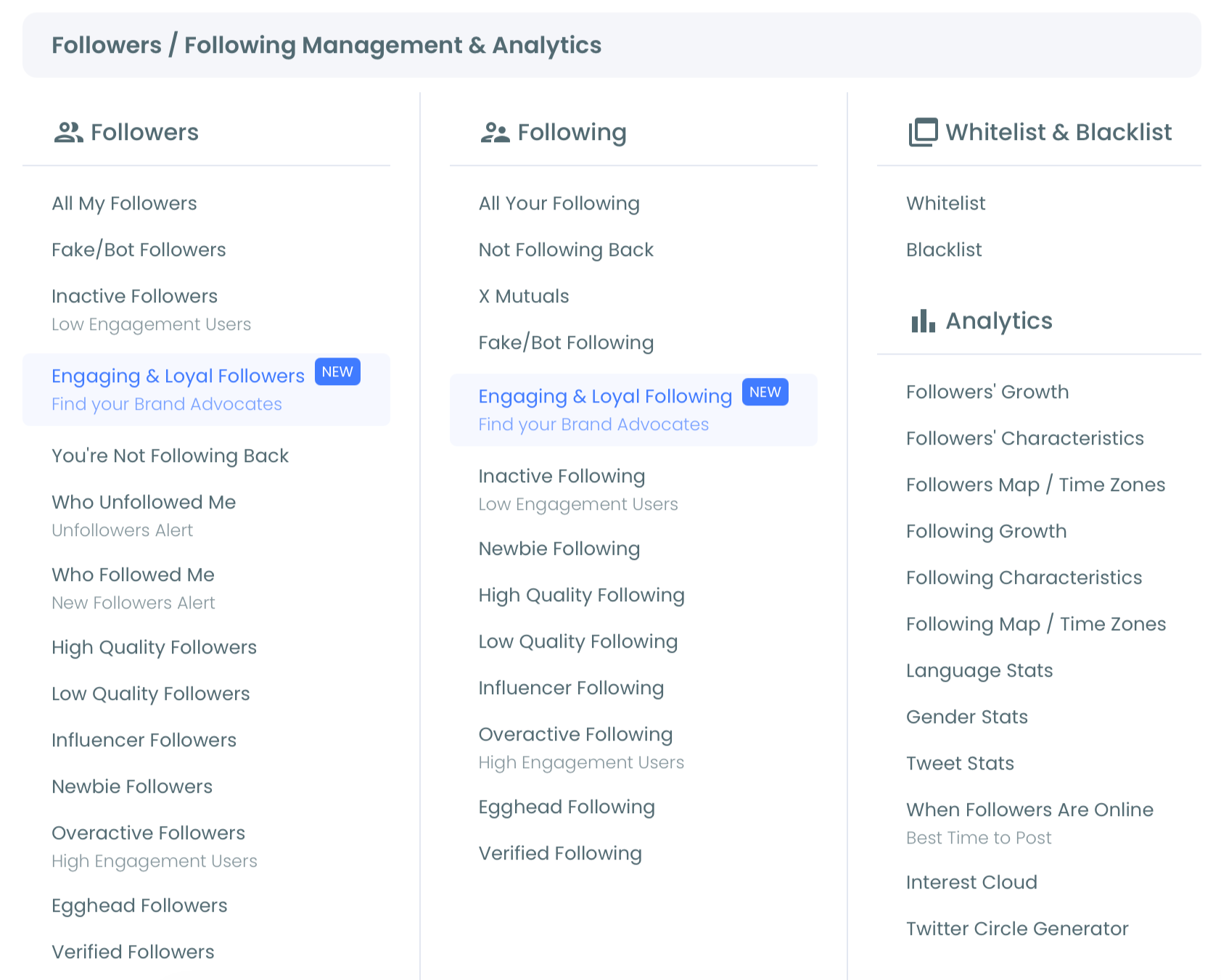
- Export the current list as CSV using the Export button before you change anything. Bulk unfollow cannot be reversed through Circleboom, so the export is your record of what the list looked like going in.
Protect the accounts the trim must never reach
- Select every account you want to keep with the row checkboxes, then use Add to List and choose Whitelist. Whitelisted accounts sit outside every bulk unfollow operation on the platform from that moment on.
- Whitelist per row as you review, using the shield icon on any account that looks weak on paper but matters in context. Customers, partners, and low-volume expert accounts belong here.
Build the trim segment and run it in paced batches
- Open Filter Options and set your criteria. The panel combines every filter as an AND condition, so a segment like Inactive engagement plus a Tweet Count maximum plus a Follow Ratio maximum returns only accounts that fail on all three counts at once.
- Sort the filtered view by Follow Ratio ascending, then re-sort by Tweets ascending to read the same segment from a second angle. Sorting applies to one column at a time, so the second sort replaces the first rather than nesting inside it. Check the Active Filters bar above the table before you select anything so you know exactly which segment you are about to act on.
- Select 100 to 150 accounts and click Unfollow. X allows 50 unfollows per 15-minute window and up to 800 per day, and Circleboom recommends staying well under that daily ceiling per session to avoid tripping X's automated detection.
- Run the next pass on a different segment, not a bigger one. Language, join date, and location filters each produce a different slice of the same list, and a second small pass reads far more naturally to the platform than one enormous sweep.
Swap step 3 and step 8 and the whole thing falls over. Unfollow first and the CSV records a list you no longer have, the shield lands on accounts that have already left, and the Active Filters bar describes a segment you have already acted on.
Batch size is the only part of this order you can adjust safely, and even that only downward.
The short version of the pass:
- Pull the CSV while the list is still intact.
- Shield the accounts you would have to apologize for losing.
- Build a segment out of three criteria rather than one.
- Take 100 to 150 rows, stop, and come back for a different slice.
Is it safe to unfollow accounts in bulk on X?
Bulk unfollowing is safe when it is paced, reviewed, and run through official access.
Circleboom is named on X's Enterprise customer directory, which is what makes the loading step possible at all: your entire following list arrives in one authorized read instead of being assembled page by page off a rendered screen. The segment you filter is therefore the whole list, not the portion something managed to reach before it gave up.
The pacing rules are published, not guessed. Circleboom processes 50 unfollows every 15 minutes, up to 800 in a day, and when the daily limit is reached it queues the remainder and resumes the following day on its own. If X returns a "too many requests" response, the request is not forced through.
The risk that remains is behavioral, not technical. Unfollowing several hundred accounts in an hour looks like churn regardless of how you did it. That pattern is what sits behind most advice on how to unfollow Twitter accounts without getting suspended. Spread the trim across a few sessions and the signal disappears.
One thing genuinely does not come back. There is no restore button for a bulk unfollow, and re-following has to happen manually, one account at a time. That is the whole argument for the CSV export in step 3 and the whitelist in step 4.
What your Twitter timeline looks like after the trim
The change is visible within a day, not a quarter. Removing quiet accounts does not just shorten the list; it raises the share of your feed that comes from accounts still posting, because the same amount of feed real estate is now split between fewer, more active sources.
Your ratio moves too. Follower-to-following ratio is one of the first things a visitor reads on a profile, and cutting a few hundred one-way follows shifts it in the direction you want without you posting anything at all.
If reciprocity is what you care about, the Twitter Mutuals view shows exactly which relationships run both ways before you decide what stays.
There is a second-order effect worth naming. A cleaner following list changes what X shows you next, because recommendations are built from the accounts you already follow. Trimming the noise narrows the input, and the suggestions that come back tend to match your actual interests more closely. Readers who check mutual followers on Twitter after a trim usually notice the shift in the "who to follow" panel first.
None of this requires a dramatic number. A following list that drops from 3,000 to 2,200 with the right 800 removed beats one that drops to 400 with the wrong 2,600 removed.
Your trim checklist
Run the pass in this order and the whole thing takes one sitting:
- Export your current following list as CSV before any change.
- Whitelist partners, customers, and low-volume accounts you value.
- Filter to a multi-criteria segment instead of one broad rule.
- Unfollow 100 to 150 accounts, then stop for the session.
- Repeat on a different slice, not a larger batch.
The accounts you keep are the point. The ones you remove are just what was in the way.
→ start trimming your following list on X
Doubts and questions that come up mid-trim
How many accounts should I unfollow in one session?
Stay in the 100 to 150 range per session. X permits 50 unfollows per 15-minute window and up to 800 per day, but sitting near the daily ceiling repeatedly is the behavior its automated systems watch for.
Will people be notified when I unfollow them on Twitter?
No. X sends no notification for an unfollow. The account can see the change if it checks its own follower list, and it can still follow you, mention you, and reply to your posts, because unfollowing is not blocking.
Does the whitelist survive between sessions?
Yes. The label is stored against your account rather than against a view or a browser session, and it applies across every following and follower screen in Circleboom. Rebuilding a protected set is the slowest part of any repeat trim, which is the argument for setting it carefully the first time.
Does unfollowing inactive accounts hurt my follower count?
It does not. Unfollowing changes who you follow, not who follows you. The only number that moves is your following count, which is what pulls your follower-to-following ratio in a better direction.
What happens to the accounts still queued when the daily limit is reached?
They stay queued. Circleboom stops at 800 unfollows for the day and resumes on its own the next day, so a segment larger than the daily ceiling finishes across two or three sittings rather than failing partway. You do not need to leave anything open overnight for the remainder to survive.