
How do you find every post that talks about your brand on X when most of them never tag you? You match your keywords against the text of public posts instead of watching notifications, then pull the accounts out of the matches.
That is the whole method. The setup below takes about five minutes, and the part that decides whether it stays useful is the filter panel, not the keyword.
Mention tracking on X works by matching a keyword set against public post text, not by waiting on @handle notifications. Circleboom scans public tweets on X for your keywords and returns every matching post alongside the account that wrote it, using X Enterprise API access. Historical search looks backward across a date range; real-time search collects forward from a start date you set.
→ track Twitter mentions
Two views come out of one query, and the second one is the reason to bother.
Why the notifications tab is not a mention list
The notifications tab reports people who addressed you. It says nothing about people who talked about you, and those are two different populations.
X's own search documentation describes searching posts, people, and more from the search bar, which is a different surface from notifications for exactly this reason. Notifications are an addressing system; search is a content-matching system.
I have seen brand-monitoring projects stall at this exact point. Somebody sets up alerts on the handle, watches a thin trickle for a month, and concludes the brand is not being discussed. The volume was there the whole time in posts that spelled out the product name and tagged nobody.
Three things handle-only monitoring costs you
- Slow discovery. A complaint thread runs for days before anyone internal reads it.
- Missed intent. Somebody asks their followers for a recommendation in your category and gets competitor answers.
- No memory. A notification proves a post existed; it does not give you the person, their reach, or a way to keep them.
Fixing all three starts with a query that reads post content. That is what it means to track mentions on X properly rather than watching a tab.
It is also the dividing line worth applying when comparing the best social media monitoring tools. Ask what each one hands back after the alert fires. If the answer is a notification and nothing else, you are buying a faster version of the tab you already have.
What a proper mention search needs to cover
A mention query has to match four things, because customers write your name in four different ways.
- Your handle. The tagged mentions you already receive.
- Your names. Brand name, legal name, product names, lowercase and abbreviated forms.
- Your assets. Domain, landing-page URLs, campaign hashtags, named features.
- Your misspellings. The two or three variants that come from phone keyboards.
Write all four groups down before you run anything. The exercise takes ten minutes and it is the difference between a monitoring setup that reports the real volume and one that reports the polite fraction of it.
X documents a full advanced search form for combining words, exclusions, accounts, engagement minimums, and date ranges. That form is the right mental model for what your keyword set should look like. What the native form cannot do is save the result, extract the authors, or hand you the set as a file.
How to track Twitter mentions step by step
Short demo: running a historical keyword pass so past mentions come back as a result set you can sort, not a feed you scroll.
https://www.youtube.com/watch?v=ZRslhxkc43Y
The process, step by step.
Connect your account and open the right search
- Log in to Circleboom and authorize the X account that will run the searches.
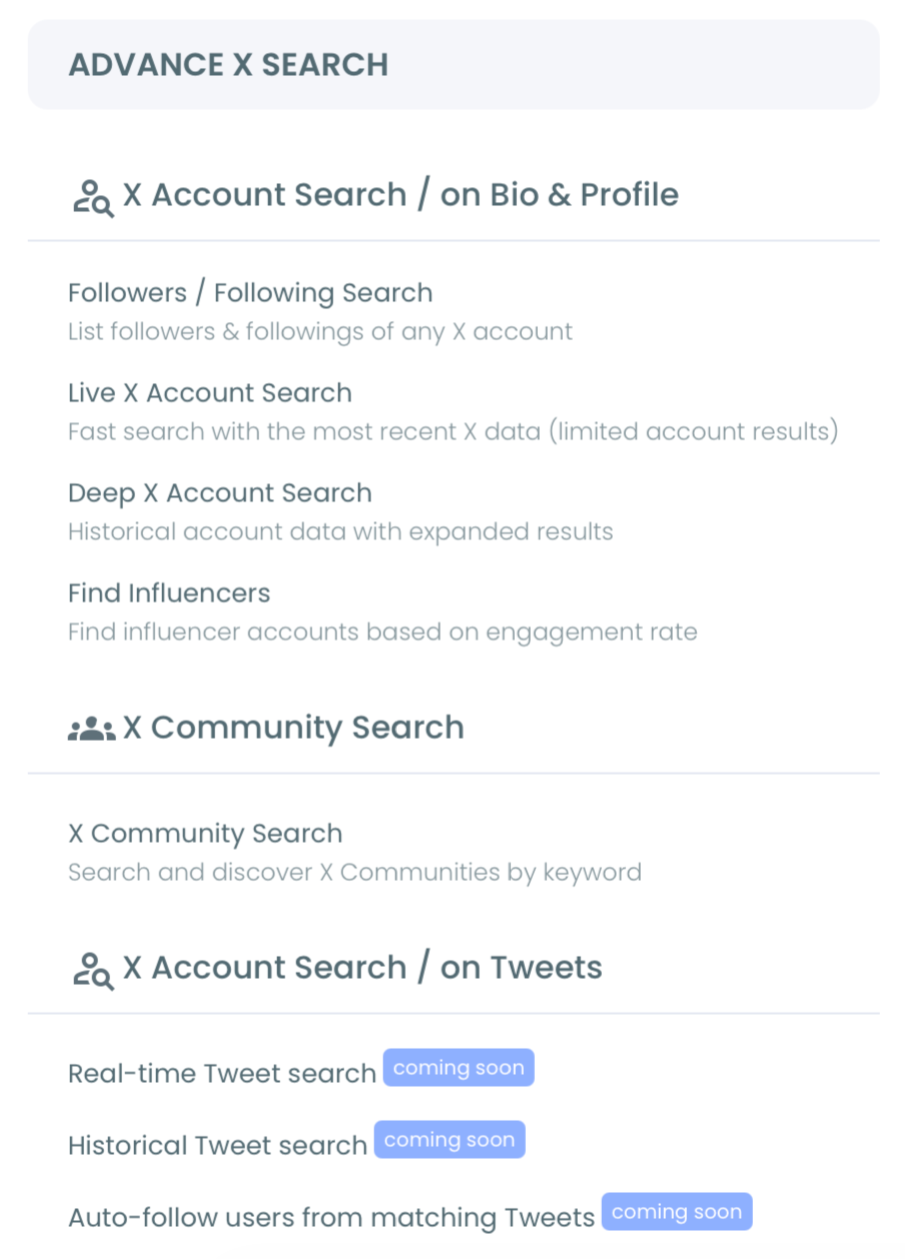
- Navigate to the Advanced X Search menu and choose your direction: historical tweet search for mentions already posted, real-time tweet search for mentions posted from a start date onward.
- Enter the keyword set in plain language, covering the handle, the brand and product names, the domain, and the misspellings. The search interface accepts a natural-language description and can propose refined variants of it.
Narrow the set, then keep it
- Set the window and the filters together. Historical search takes a date range of 30, 60, 90 days, one year, or a custom window; real-time search takes a start date. Then apply exclude terms, language, replies on or off, links on or off, media type, and a minimum engagement threshold.
- Open the profile view and act on the accounts. Click "Display Profiles of this search" to get the deduplicated author list, then follow, add to a Twitter List, whitelist your advocates, blacklist the spam, or export the set as CSV.
The sequence works because it front-loads the decisions that cannot be undone cheaply. Direction determines what kind of list is even possible, the window determines volume, and the filters determine how much of that volume is worth a human's attention. Leave the filters until after you have read the results and you have already paid the cost the filters exist to prevent.
Quick recap:
- Log in and connect the X account.
- Pick historical or real-time.
- Write the full keyword set, not just the handle.
- Set the window, then the exclude and engagement filters.
- Pivot to the profile view and export.
Which filters actually change your results?
Four filters do most of the work, and the rest are situational. Knowing which is which saves a lot of trial and error.
Exclude terms are the highest-leverage control on any brand keyword that doubles as a common word. Adding two or three exclusions typically removes more noise than any other single change.
Engagement minimums cut the long tail of zero-reach posts. During a trending moment this is the filter that keeps a result set readable, because breaking conversations generate volume faster than relevance.
Language matters more than people expect. A brand name that is meaningless in English can be a common word in another language, and the filter removes an entire category of false positive in one click.
Replies on or off changes the shape of the result completely. Replies included gives you conversation depth; replies excluded gives you original posts, which is usually what you want when the goal is finding new accounts rather than reading threads.
Match type and the scoping controls
Keyword match type sits just behind those four. Exact phrase, contains, and partial produce very different sets.
Exact phrase is what you reach for when the question is closer to whether you can search specific words a Twitter account said. Contains is the safer default for a brand sweep, because it catches the possessive, the plural, and the hashtag form of your name in one pass. Partial is the widest of the three and needs the most aggressive exclude list to stay usable.
The remaining controls, links, hashtags, cashtags, verified-only, and media type, are scoping tools rather than noise filters. Verified-only is useful when you want the loudest accounts and nothing else. Media type matters when a mention pattern is visual, such as people posting screenshots of your pricing page without typing your name at all.
One habit worth building: change one filter at a time. When four settings move together and the result improves, you have learned nothing about which one did it, and the next search starts from guesswork again.
What to do with the account list once you have it
The exported profile view is the part of mention tracking that keeps paying after the conversation ends. Each row carries follower count, following count, follow ratio, tweet count, join date, and an active or inactive classification.
Four uses cover most teams:
- A watchlist. Add recurring critics and advocates to a Twitter List and check it deliberately instead of hoping the timeline shows you.
- An outreach set. Export the accounts that expressed a buying question, then work the list on your own schedule.
- A research sample. Sort by engagement and read what the highest-reach mentions have in common.
- A whitelist. Protect your genuine advocates so no future bulk action touches them by mistake.
Circleboom is listed on X's Enterprise customer directory, so all of this runs on sanctioned data access rather than scraping. That matters for mention data specifically: a complete result inside the queried window and a partial crawl of it lead to different conclusions about how often something was said.
Where the account list goes next
Reading a year of mentions sorted by engagement is one of the cheapest research methods available. That is the argument behind treating Twitter as a market research tool rather than only a support channel.
The same data supports ongoing X account monitoring when the subject is a competitor rather than yourself. Circleboom's Twitter mention monitoring view is where both workflows start. The export is what lets the research version accumulate over time instead of resetting every month.
Two practical limits to plan for. Searches draw GetTweetTokens in proportion to the tweets collected, and exporting draws separately, so a wide keyword over a long window burns balance quickly. Start narrow, check the ratio of useful to useless, then widen.
The second limit is judgment. A keyword match proves the words appeared, not that the account behind them fits your goal, so read the profile view before running any bulk action on it. Whitelisting your known advocates first is a cheap insurance policy against a mistimed batch operation later.
Why old mention lists decay
Historical results carry a specific kind of staleness that catches people out on their second or third pass.
An account that posted about you eight months ago may since have been suspended, deactivated, or switched to private. It still appears in the result because the tweet was public when the API indexed it, but its current state can be different from what the row shows. Follower counts and activity classifications age the same way.
Edited posts add a second wrinkle. Depending on when indexing happened, a tweet can come back in its original or its edited form, so a quote you pull from a historical set is worth checking against the live post before you cite it anywhere public.
None of that makes historical data unreliable. It makes it a snapshot with a date on it, which is the right way to read any archive. Re-run the same query on a schedule and the drift between runs becomes information rather than a surprise.
Pick the setup that matches your situation
Mention tracking is not one workflow, it is three, and the right one depends on what you are watching for.
If you are auditing a brand for the first time, run a single historical search over the past 90 days with the full keyword set, then export the profile view as your baseline. You need volume and vocabulary before you need speed.
If you are running a launch, an event, or a live incident, set a real-time collection with the start date at the moment things began and keep an engagement minimum switched on. Add accounts to a list as they arrive, because speed is the whole value here and it decays by the hour.
If you are monitoring continuously, keep both running: a live collection for what is happening and a monthly historical pass for whether it is unusual. Compare each export against the last one, and if you want the raw posts alongside the accounts, export tweets covers that side of the result.
Whichever of the three you are in, the first move is the same. Write the keyword list, run one search over 90 days, and read what the volume says before you decide anything else.
I have never seen that first run come back with nothing interesting in it. The usual reaction is the opposite: more people were talking about the brand than anyone expected, in language nobody internally would have chosen, and none of it arrived through the notifications tab.
Setup questions worth answering first
How long does mention tracking take to set up?
About five minutes for the first search, plus ten minutes of thinking about the keyword list beforehand. The keyword list is the part worth slowing down for, because a search built on the handle alone returns a fraction of the real volume and looks correct while doing it.
Can I track mentions of a competitor instead of my own brand?
Yes. The search matches post content, so any keyword works, including a competitor's brand name, product name, or domain. Scoping a historical search to a competitor's name plus a complaint word produces the most targeted displacement list organic research can build. Read the profile view before acting on any of it.
What if I want to remove old mentions of my own account?
Tracking and removal are separate jobs. Mention search finds public posts written by other accounts, and you cannot delete someone else's post. You can clean up your own side of those conversations, and the walkthrough on deleting Twitter mentions covers the replies and quote posts sitting under your own handle.