
To set up Twitter alerts for keywords, you monitor a live stream of tweets that match your terms instead of refreshing native X search by hand. You define the keywords, phrases, hashtags, or mentions you care about, set a start date, and let a monitor collect matching tweets from that moment forward.
Native X search shows you what exists right now, then forgets you were ever there. It has no persistent alerting layer, so the brand mention, the buying-intent phrase, or the support complaint you needed to catch scrolls past while you are looking somewhere else.
How do you get alerted when someone tweets your keyword?
You run a live keyword monitor, not a saved search. Circleboom's Real-time Tweet Search collects public tweets matching your terms from a chosen start date onward through official, sanctioned API access, streaming each match as it posts and extracting the account behind it so you can reply, follow, or track.
→ Twitter alerts for keywords
One thing to be honest about up front: this is a live monitor, not an email push notification. It streams matching tweets into a working view you check, filter, and act on, and the value is in acting while the conversation is still warm.
Most guides on this topic stop at "use X search operators." The gap they leave is the part that matters: how do you keep watching a keyword over time, and turn a matching tweet into an action before the moment cools?
Why Native X Search Can't Alert You
Native X search is a snapshot tool, and that is the whole limitation. You type a query, you see results as of that second, and nothing persists. There is no saved monitor that keeps watching your keyword for you.
That matters because the tweets you most want to catch are time-sensitive. A customer complaining about your product, a prospect asking for a tool recommendation, a competitor's outage going public: each has a short window where a reply lands and a longer window where it reads as late.
Checking X search manually every hour is not monitoring. It is guessing when to look, and the guesses miss the tweets posted in the gaps.
There is also a structured-data problem. Even when you catch a relevant tweet, you still have to open the profile and judge the account one at a time, with no way to filter the stream or export the accounts as a list. Circleboom's keyword and hashtag tracker is built for exactly that structured side of monitoring.
You can already see the shape of a better system here: keep a keyword under continuous watch, filter the live results for quality, and read the account behind every match. That is what a real keyword alert does, and it is where Twitter alerts for keywords move from a manual chore to a workflow.
How Circleboom Turns Keywords Into a Live Alert Stream
Circleboom's Real-time Tweet Search collects live public tweets matching your keywords from a start date you choose, and shows you both the tweets and the accounts that posted them. It is built for the case native search can't handle: watching a term as the conversation develops, not querying a frozen archive.
Circleboom runs this as an official X Enterprise Developer, so every tweet in your stream arrives through approved, policy-compliant access rather than scraping. That distinction is not cosmetic. It is why the data is complete and why acting on it never puts your account at risk.
The setup is a guided flow. You describe the tweets you want in plain language, refine with filters, pick a start date, and choose how many tweets to collect. From there the results split into a tweet view and a deduplicated account view, so you evaluate both what is being said and who is saying it.
Here is the flow, in order.
Connect your X account to Circleboom
Log in to Circleboom Twitter and connect your X account with official OAuth. This is the entry point for every search you run.
Open Advanced X Search and start Real-time Tweet Search
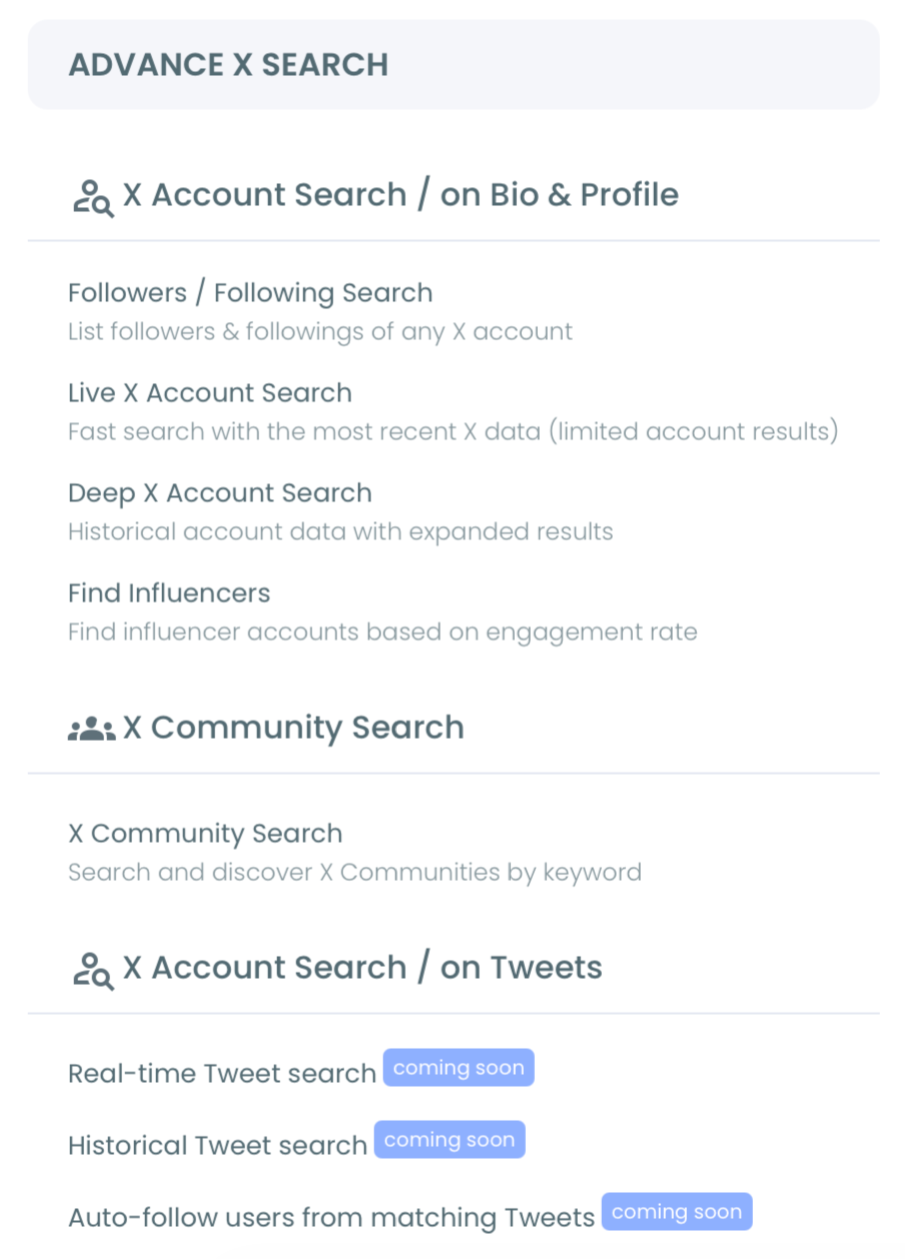
Go to the Advanced X Search menu and open Real-time Tweet Search. Describe the tweets you want to monitor in your own words, and the system offers refined query suggestions you can accept or edit.
Build the keyword query with filters
Set your keywords and match type, then narrow with the filter panel. You can exclude terms, filter by language, include or drop replies and links, target hashtags or cashtags, restrict to verified accounts, choose a media type, and set engagement minimums to cut low-signal noise. To watch who is talking about you specifically, pair this with Circleboom's Twitter mentions tracker.
Set the start date and collection size
Choose Last 24 Hours, Last 7 Days, Last 30 Days, or a custom date to anchor the monitor forward from that moment, then pick how many tweets to collect. A recent start date keeps the stream current; a start date set too far back behaves more like a historical pull.
Act on the stream while it's live
Switch to the profile view to see the deduplicated accounts behind the matches. From there you can follow high-fit accounts, add them to a Twitter List for follow-up, or export the set as CSV for outreach.
That order works because it front-loads scope before action. You narrow what counts as a match with filters and a start date first, so the accounts you act on are already the relevant ones, not the raw noisy volume a broad keyword returns during a spike.
At a glance: connect, open the monitor, build the query, set the window, act on the accounts. The filters do the noise control so you spend your attention on the accounts worth reaching.
Video walkthrough: how a live keyword monitor collects matching tweets and pulls out the accounts behind them in one Circleboom view.
Unlike scrolling native X search on a loop and hoping to catch the right tweet, a real-time keyword monitor watches the term for you and hands you the accounts, filtered and exportable, the moment they post.
What to Watch: Keyword Alert Use Cases
The keywords worth monitoring fall into a few clear buckets, and each turns a live stream into a specific action. Choosing the right terms is what separates a useful alert from a firehose.
- Brand and product mentions. Catch people talking about you, including the ones who never tag your handle.
- Competitor mentions and incidents. Reach accounts expressing frustration with an alternative while the moment is fresh.
- Buying-intent phrases. Monitor "looking for recommendations" style tweets so you find prospects mid-decision.
- Support and complaint terms. Spot issues early, before a quiet complaint becomes a public thread.
A well-scoped keyword list is worth more than a broad one. A narrow phrase during a live moment returns accounts you can actually act on. A broad keyword during a spike returns volume you will never work through.
For deeper coverage of the query side, this walkthrough of Twitter advanced search shows how operators and filters combine, and it pairs naturally with a live monitor once you know which terms to watch. If you are evaluating the category more broadly, this rundown of social media monitoring tools frames where real-time keyword tracking fits.
There is a marketing insight most people miss here. The real value of keyword monitoring is not the tweet, it is the account. A single mention is a data point. The account behind it is a relationship you can build, and a live monitor is the only way to reach that account while the shared context still exists.
What You Gain From a Live Keyword Monitor
A working keyword alert changes what you can respond to. Instead of finding out about a mention days later in a report, you see it while a reply still matters and the person is still paying attention.
It also compounds. Every relevant account you follow or list from the stream becomes an ongoing signal source, so the monitor doesn't just catch one tweet, it builds a targeted audience around a topic over time.
Because the account view is exportable, a single monitor feeds directly into outreach, campaign targeting, or a live-event engagement list. The reader who wanted to "get alerted" ends up with something more useful: a filtered, current list of the exact accounts a keyword brought in.
If your goal is watching a topic's whole conversation rather than one term, this guide on a good app to monitor Twitter activity explains the wider monitoring picture. And this piece on how social media listening increases customer advocacy shows why acting on live mentions builds loyalty, not just data.
When you are ready to put a keyword under continuous watch, set up your real-time keyword tracker. Let the stream bring the conversation to you.
→ Start monitoring keywords on X with Circleboom
Frequently Asked Questions
Does Circleboom send an email or push notification when my keyword is tweeted?
No. Real-time Tweet Search is a live monitor, not an email alert. It collects matching tweets from your chosen start date forward into a working view you open, filter, and act on. The value is in reaching accounts while the conversation is still active, so check the stream during the moments that matter to you.
How is this different from just using X search?
Native X search is a one-time snapshot with no persistence, and it can search specific words an account said only in that instant. A live keyword monitor keeps collecting matches over time, lets you filter the stream for quality, and extracts the accounts behind the tweets. You can see how narrow a native query gets in searching specific words a Twitter account said.
Can I monitor hashtags and mentions, not just plain keywords?
Yes. The query supports keywords, exact phrases, hashtags, cashtags, and exclusion terms, plus filters for language, replies, links, verified accounts, and media type. That lets you scope a monitor tightly around a campaign hashtag, a brand mention, or a buying-intent phrase.
What happens if a tweet gets deleted after I see it?
Live tweets can be deleted, edited, or made private within minutes, so a match you saw may no longer exist on X by the time you act. Export or list strong findings quickly, because the account view stays actionable even after individual tweets change.