A smaller follower count answers only one question: the total changed. It does not tell you which people left, whether they were valuable to your work, or whether the change happened after something you did.
X alone: a current follower count and list, not an unfollower record. Circleboom: historical comparisons show which accounts stopped following in a selected time window through official X Enterprise APIs.
→ See lost Twitter followers
Start with a short date range, inspect the account mix, and treat a cluster as a question to investigate rather than a reason to confront anyone.

The important distinction is easy to miss. “Does not follow me now” is a current relationship check. “Unfollowed me” is a historical claim. The second claim needs two points in time.
X's own Following FAQs explain how to view current followers and following relationships, and note that X does not send a notification when you unfollow someone. Its help documentation also says a follower count can fall when accounts are locked, so a count movement is not automatically a content verdict.
A lost-follower list is evidence of change, not evidence of motive.
What it means to see lost Twitter followers
When people say they want to see lost Twitter followers, they often mean one of three different things:
- They noticed a lower profile count and want names.
- They follow people who no longer follow them back.
- They want to know whether a campaign, post, or topic change affected retention.
Only the first and third questions require history. A live followers page cannot recreate a departure that happened before you started recording it. It can show who is present today, which is useful, but it cannot prove who was present last week.
Circleboom's Who Unfollowed Me feature compares saved follower snapshots with the current list. The result is account-level change data: people who were previously in the tracked audience and are no longer there.
→ See lost Twitter followers with Circleboom
That record is most useful when it changes the question from “why did they leave?” to “what changed, who left together, and is there a pattern worth testing?” A single account may leave for private reasons. A concentrated group after a visible event deserves a calmer review.
The lost-follower view: what you can actually inspect
The Who Unfollowed Me view is not just a roster of usernames. It gives context that helps prevent overreaction. The table can show a display name and username, account age, tweet count, following and follower totals, follow ratio, and an activity classification.
Use those fields to form a reasonable first read:
- A handful of inactive or low-quality accounts may be routine attrition.
- A cluster from one language, location, or niche can indicate an audience-fit question.
- A departure near a campaign or topic shift creates a correlation to examine.
- A large count change with suspicious or locked accounts may reflect platform-level movement.
The feature has a time selector for windows from recent days through a year. It also includes filters for quality signals, verification, profile text, follower and following counts, join date, engagement, language, and location. The active-filter bar is worth reading before you draw a conclusion, because it makes the segment visible.
For a broader account-level baseline, Twitter follower growth statistics put departures beside the overall direction of the audience. A net gain can coexist with the loss of a niche group. A net decline can still be mostly low-quality churn.
A four-part review that keeps the signal intact
The best review sequence is not to start by searching every name. Start by defining the window, then narrow the evidence.
1. choose the event window
Pick the shortest period that matches your question. If you published a new positioning post on Wednesday, look at that interval rather than six months of unrelated movement. If your concern is a gradual decline, choose a longer comparison period and write down what changed during it.
Log in to Circleboom Twitter and connect the X account you want to monitor. Then open the Who Unfollowed Me section and choose the relevant time period.
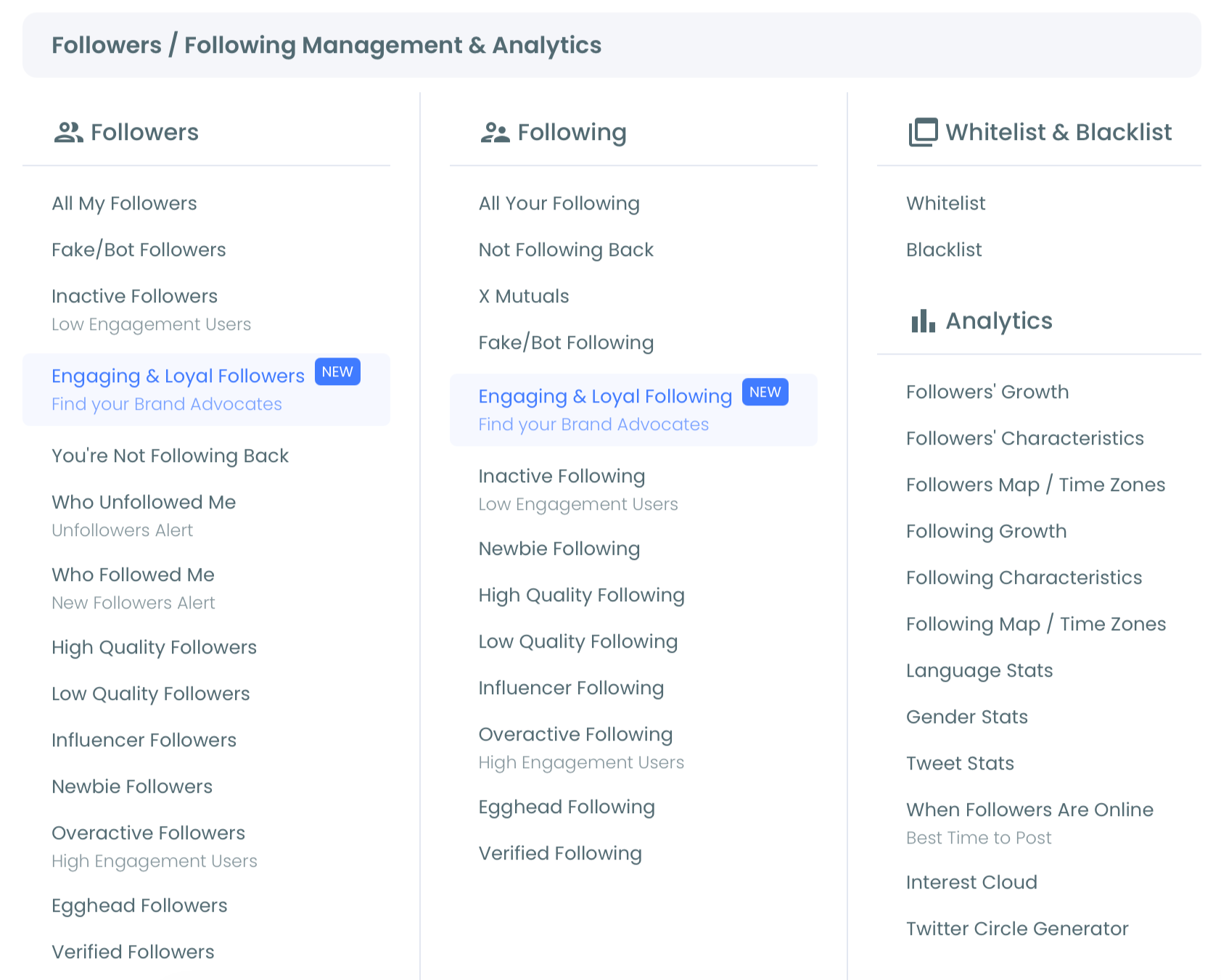
!Circleboom Twitter follower and following management menu
Circleboom updates follower data daily. A very recent departure may not appear until the next update, and occasional API discrepancies can correct on a later fetch. That is another reason not to turn an individual row into an immediate action.
2. read the shape before the names
Sort or filter the resulting accounts before you inspect individual profiles. For example, the follower-to-following ratio can help characterize whether a group looks like a follow-back cohort, while activity and join-date signals can show whether the change is concentrated among dormant accounts.
Do not make an accusation from one metric. A small follow ratio is context, not intent. The useful outcome is a segment you can describe honestly: “accounts that left in this window and share these traits.”
3. compare the window with your own activity
Now look at your post history, campaign calendar, and publishing cadence. Ask whether the loss clusters around a genuine change: a new topic, a higher posting frequency, a campaign ending, or a message that intentionally narrowed your positioning.
This is where a follower tracker is different from a scorecard. The goal is not to make every loss disappear. The goal is to learn whether your audience is changing in a way that affects the work you want to do.
The older guide to losing Twitter followers and finding who unfollowed you is a useful companion when you need the basic tracking question framed clearly. Keep its core lesson in view: names make a count more interpretable, but they do not reveal private motives.
4. preserve the finding and choose a proportionate response
If a segment matters, export it as a CSV for a team review or client report. Exports use Circleboom's token system, with the available balance shown beside the Export control. Pair the account-level data with a content timeline, rather than relying on memory after the fact.
You may also decide that some departed accounts no longer belong in your own following list. Circleboom offers per-row and bulk Unfollow from this view. These actions follow X limits, and large operations are processed gradually. Review first, whitelist accounts you value, and select only the segment you intend to change.
→ Open the lost-follower record before your next review
The less dramatic outcome is often the better one: record the pattern, make no immediate account change, and check whether the same pattern recurs.
Why a follower-count drop can be misleading
A follower count is an aggregate. It cannot distinguish one hundred quiet departures from a small but strategically meaningful group. It also cannot distinguish a person who unfollowed from an account that became unavailable or was removed from count calculations.
X's common following issues guidance notes that a person who no longer appears in a followers list may have unfollowed, been hidden for spam activity, or deactivated their account. That makes a historical tracker useful, but it also sets a boundary: the dashboard records a relationship change; it cannot establish the person's reason.
Circleboom is an official X Enterprise Developer company, and its tracking uses official X Enterprise APIs. The data source gives the workflow a legitimate foundation. It does not turn imperfect platform data into mind-reading.
If you want a recurring top-level view as well as the named changes, the Twitter Follower Tracker page is the right companion. Use growth information to orient yourself, then use the lost-follower view when you need to understand the composition of a specific change.
Build a low-drama alert routine
Checking after every small fluctuation creates more noise than insight. A scheduled summary makes monitoring quieter and easier to sustain. Circleboom's Twitter unfollower alert can send email summaries so you can decide when a review is warranted.
A practical routine has three layers:
- Check the overall trend on a regular reporting cadence.
- Investigate named departures when an event or cluster gives you a reason.
- Export meaningful segments before a team or strategy discussion.
→ Set up a measured X unfollower review
The goal is to preserve context. If an audience change is real, you want a record you can compare with future results. If it is routine churn, you want enough context to let it stay routine.
Watch the walkthrough: tracking an X unfollower record
A note for teams and agencies
For a brand, creator team, or agency, lost followers can become a reporting problem before they become a strategy problem. A stakeholder may see a count drop and ask for a cause immediately. The accurate response is to separate observation from explanation.
Report the time window, total change, the traits of the departing group, and the relevant content or campaign activity. Then label any causal interpretation as a hypothesis. This is more useful than pretending that a dashboard can assign intent to every person.
The free Twitter unfollowers app overview can provide additional background on the category. Keep one link per question: individual loss, overall trend, and next action are different jobs.
For another monitoring perspective, read how to know who unfollowed you on Twitter. It explains why an old live list cannot substitute for a recorded comparison.
Keep the action decision separate
One further operational question is whether a team wants relationship cleanup after analysis. The guide to unfollowing non-followers on Twitter is relevant only after the retention question is complete. A team should not collapse “who left” and “who should we follow” into one automated decision.
For reporting, use a fixed vocabulary. Call the measured result a departure list. Call a repeated trait a pattern. Call a possible reason a hypothesis. These labels make it easier for a client or colleague to see what the data establishes and what still needs observation.
If a pattern includes high-value accounts, inspect what they had in common with your intended audience before changing direction. If it consists mostly of low-engagement accounts, the appropriate response may be to continue the work that is attracting a more relevant audience.
This approach also makes the next review faster. Your team already knows which window to open, which filters to apply, and which questions the evidence can answer. The dashboard becomes part of a repeatable retention process instead of an emergency destination after a surprising count drop.
Turn a count drop into a useful question
To see lost Twitter followers well, you need history, timing, and restraint. Start recording before the next unexplained drop. When the data arrives, inspect a segment before a name, compare it with the relevant activity window, and preserve the finding if it matters.
The most reliable answer is not a list by itself. It is a repeatable way to tell normal churn from a change that deserves attention.
→ Start tracking lost Twitter followers with Circleboom
FAQ: lost Twitter follower tracking
Can I see who unfollowed me on X today?
You can see tracked departures after the data update, but a same-day event may not appear immediately. Circleboom updates follower data daily, so wait for the next sync before treating an absence as final.
Does X show a list of people who unfollowed me?
No. X provides a current followers list and notifications for new followers, but it does not provide a native unfollower history. A historical tracker needs to compare saved follower snapshots over time.
Should I unfollow everyone who unfollows me?
No. Review the list first. A follow-back cleanup may make sense for some accounts, but a lost-follower record is primarily a monitoring tool. Do not retaliate, call people out, or assume that every departure deserves a response.
Why did my follower count drop if I did nothing different?
Normal churn, locked or deactivated accounts, spam-related changes, and platform-level account actions can all affect the number. Inspect the time window and account characteristics before attributing the change to content.