
To look at old tweets on Twitter, you have four honest routes: scroll your own profile, download your X archive, use X advanced search with `from:` and date operators like `until:` and `since:`, or query past posts at depth with a dedicated tool. Each covers a different need, and the right one depends on whether you want your own history or someone else's, and how far back you need to reach.
Native scrolling works for last week. Once you are chasing a tweet from two years ago, or every post an account made during a specific month, the manual routes fall apart. That is where structured historical search earns its place.
Manual: scroll for hours, hit a lazy-load wall, and still miss the post. Circleboom: Historical Tweet Search retrieves past public tweets by keyword, account, and date range on X through official, sanctioned API access, then surfaces both the tweets and the accounts behind them.
→ how to look at old tweets on Twitter
Set a window, describe what you want, and the matching posts come to you.
Most guides on this topic stop at "scroll down and be patient" or "download your archive." The gap they leave is the hard case: finding a specific old tweet by content, or every tweet an account posted inside a date window. Scrolling would take hours, and the archive only covers your own posts.
That is the real reason people search for how to look at old tweets on Twitter. They already know the timeline exists. They need a way to reach a moment in it on purpose.
Why Looking at Old Tweets Is Harder Than It Should Be
Twitter's timeline is built for the present, not the past. The interface loads recent posts first and makes you scroll for everything older, with no jump-to-date control and no reliable way to filter your own history by topic.
The friction gets worse the further back you reach. Reverse-chronological scrolling means a tweet from 2022 sits behind thousands of newer posts, and X lazy-loads the feed, so a long scroll can stall or reset before you arrive.
There are legitimate reasons to want that old post anyway:
- Reflection and cleanup. You want to see what you posted years ago before deciding what to keep or remove.
- Repurposing. An old tweet that performed well is raw material for a fresh thread or post.
- Receipts and research. You need what someone actually said on a date, not a paraphrase.
- Context. You want to reconstruct how a topic was discussed at a specific past moment.
The manual timeline answers none of these on purpose, which is why a structured search matters. Circleboom's historical tweet lookup exists for exactly the cases the native scroll cannot handle.
The Native Ways to Look at Old Tweets
Before reaching for a tool, it helps to know what X gives you for free, because each native path solves one slice of the problem.
- Scroll your profile. Fine for recent posts; painful past a few months.
- Download your X archive. Settings lets you request a full archive of your own account, which arrives as a downloadable file with every tweet you have posted. It covers only your account, and the request can take time to process.
- Use X advanced search. The `from:username`, `since:YYYY-MM-DD`, and `until:YYYY-MM-DD` operators let you scope search to one account and a date window right on X.
The archive is the strongest native option for your own history. If your real goal is clearing it out afterward, this walkthrough on how to search old tweets on Twitter pairs the lookup step with a cleanup plan.
X advanced search is genuinely useful, but it is capped. It surfaces indexed results, not deep historical coverage, and it has no export, no account-level rollup, and no way to act on the accounts it finds.
Circleboom's own Twitter advanced search adds the filter depth the native operators skip. For a plain-English breakdown of what those operators can and cannot do, the Twitter search history guide is a good companion read.
How to Look at Old Tweets on Twitter with Circleboom
To look at old tweets by content or date at real depth, run a query against historical tweet data, scope it to the account and window you care about, then review both the tweets and the profiles behind them. The four-phase flow below moves from setup to a saved, exportable result through official, sanctioned API access.
Set up and connect your account
- Log in to Circleboom Twitter and connect your X account with official OAuth.
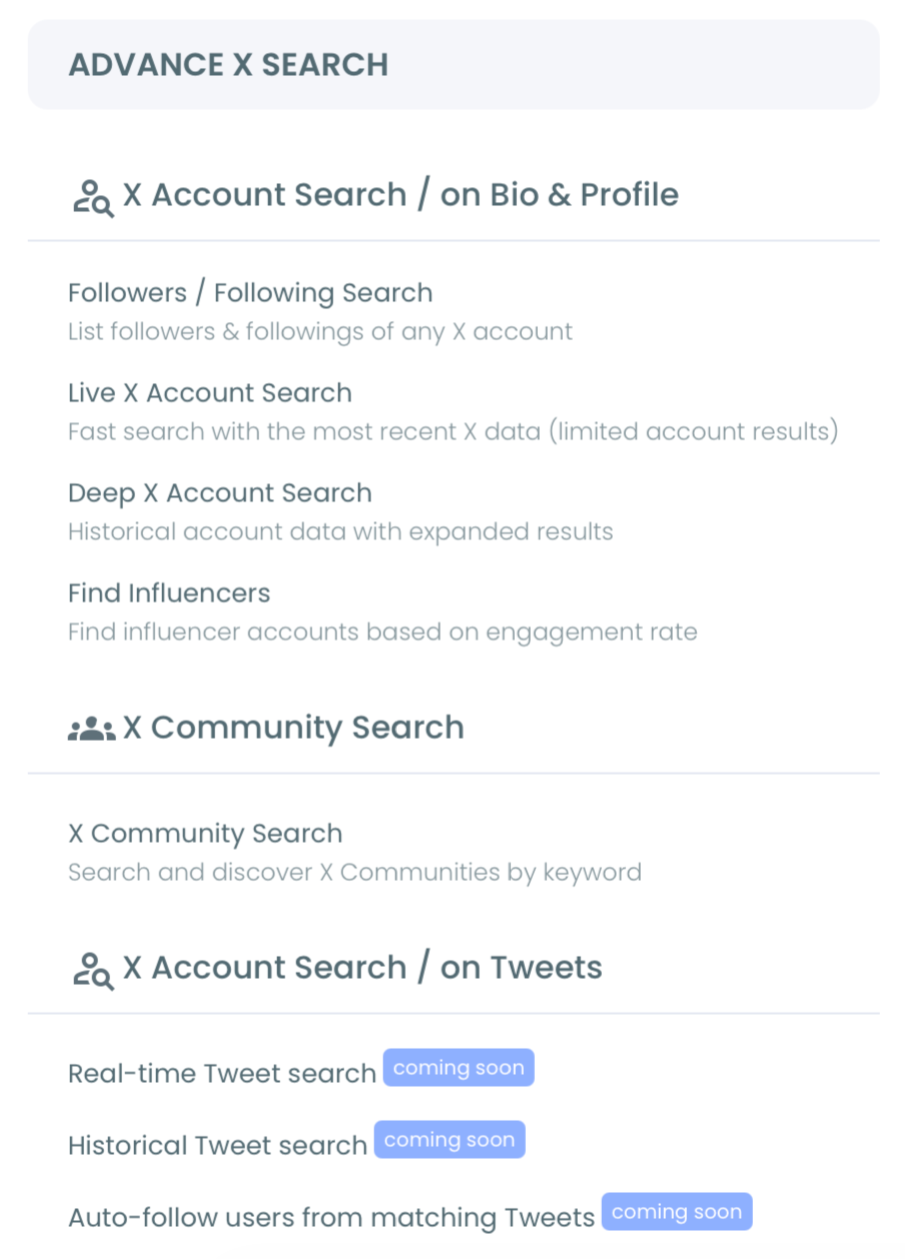
- Open the Advanced X Search menu and select Historical Tweet Search.
Describe what you are looking for
- Write the search in plain language, naming the keyword, phrase, or account whose old posts you want. Circleboom can suggest refined AI variations of your query.
- Add filters to sharpen it: exact-phrase match, exclude terms, language, replies, links, hashtags, verified-only, media type, and engagement minimums.
Scope the historical window
- Select a date range to reach the moment you care about. Choose a preset (last 30, 60, 90 days, or 1 year) or set a custom window around a specific past event.
- Choose how many tweets to collect. This controls the size of the pull, not the guaranteed number of unique accounts.
Review, export, and act
- Read the collected tweets with full metadata: impressions, likes, retweets, quotes, bookmarks, replies, and the exact creation timestamp.
- Switch to the profile view to see the deduplicated accounts behind those tweets, then export the set as CSV, or open any post directly on X.
That ordering holds up because each phase narrows before the next: connecting earns official API access, the query and filters cut noise, the date range fixes the window, and only then do you pull and act, so you never sift a wall of irrelevant posts. Circleboom runs the whole retrieval as an official X Enterprise Developer, so every old tweet you see comes through approved access, not scraping.
At a glance: connect, describe, set the window, review and export. The date range is what turns a vague "find old tweets" into a precise reach into a specific past.
Video walkthrough: how a keyword plus a date range pulls historical tweets and the accounts behind them in one Circleboom search.
What You Gain from Reaching the Right Old Tweet
Looking at old tweets on purpose changes what you can do with your own history and everyone else's. Instead of an unsearchable scroll, you get a queryable record you can pull from on demand.
For your own account, that means faster cleanup decisions and easier repurposing. You can find the posts that once landed well and rebuild them, or surface the ones that no longer represent you before you decide what to delete.
For research and receipts, it means precision. A tweet from a specific week is a dated, timestamped record rather than a memory, and the profile view hands you the accounts behind a past conversation as a list you can export tweets from directly.
Unlike copy-pasting operators into native search and hoping the index reaches far enough, Historical Tweet Search gives you depth, filters, and an export in one pass.
If your review turns into a cleanup project, you can then delete old tweets by year instead of removing them one at a time. And you can find old tweets again later whenever you need the record back.
The Bottom Line
Looking at old tweets on Twitter is only hard when you rely on the timeline, which was never built to travel backward. Pick the native route that fits, the archive for your own posts, advanced search operators for a quick account-and-date scope, and reach for structured historical search when you need depth, filters, and an export.
The moment you stop scrolling and start querying by keyword and date, your whole tweet history becomes something you can actually use. When you are ready, run a historical tweet lookup and pull the exact posts you came for.
→ Open Historical Tweet Search
Common Questions About Finding Old Tweets
Can I look at someone else's old tweets, not just my own?
Yes. Historical Tweet Search retrieves public tweets by keyword, account, and date range regardless of whose posts they are, then shows the accounts behind them. Only publicly available posts are returned; private, protected, and deleted tweets cannot be retrieved.
How far back can I reach when looking at old tweets?
You can scope a search to presets like the last 90 days or 1 year, or set a custom window around a specific past date. Historical coverage depends on what the X Enterprise API has indexed for that range, so very old or rapidly deleted content may have gaps.
Do I have to scroll to find a specific old tweet?
No. Instead of scrolling, you describe the tweet by keyword or phrase, add filters, and set a date window, and the search pulls matching posts directly. That is the core difference between the manual timeline and a structured historical lookup.