
A passive follower on Twitter is an account that still counts in your follower total but has stopped posting, replying, or reacting for long stretches of time.
You find them by reading two signals together: how old the account is, and how often it has tweeted across that whole lifespan.
How do you identify passive followers on X?
Circleboom evaluates account age and total tweet frequency through official API access, then lists every follower it classifies as Inactive or Low Engagement in one sortable table on X. Sort by tweet count, filter by join date, protect the quiet accounts that matter, and act on what remains.
→ passive followers on Twitter
What counts as a passive follower on X
A passive follower is a real person or brand whose account has gone quiet, not a bot. That distinction matters, because the fix is different for each one.
Circleboom's classification of a passive follower on X rests on two observable inputs: account age and tweet frequency across that account's lifespan. Two behavior patterns fall inside the definition:
- Accounts that tweeted recently but showed no activity for the past year.
- Accounts that tweet sporadically, even when some of that activity is recent.
Sporadic posting is the pattern that slips past most audits.
A single tweet last week does not make an account active.
An account that has existed for six years and published 40 tweets total is passive no matter when the last one landed, and treating it as an engaged audience member distorts every number you calculate afterward.
Authenticity is a separate question with a separate answer. If you want to know whether an account is a real human at all, the Fake Twitter Account Checker settles that.
Counting the automated accounts already inside your audience is a third investigation again, and how many of my X followers are bots works through it.
Why passive followers on Twitter drag your engagement rate down
Passive followers sit in the denominator of every engagement calculation without ever contributing to the numerator.
Work the arithmetic.
An account with 15,000 followers that earns 200 likes on a post is reporting 1.33 percent engagement. If 5,000 of those followers are dormant and will never react regardless of what you publish, the rate among followers who actually see and process content is closer to 2 percent.
Same post, same audience, very different reading of performance.
That gap has practical consequences. It makes good content look like weak content, which pushes people to rewrite a strategy that was working.
It also widens the distance between headline follower count and real reachable audience, and that distance gets checked closely during sponsorship reviews and partnership conversations.
Cleaning the dormant segment is the fastest way to make your reported rate honest without touching your posting strategy at all.
If you want a benchmark to measure against before and after, what is a good engagement rate on Twitter sets the reference range. When you are ready to see the segment itself, you can spot passive followers on X inside your own audience in a few minutes.
Before you rewrite a strategy that may be working, check whether the audience is still capable of responding to it.
The signals that separate passive followers from fake ones
Passivity and inauthenticity produce similar damage and demand different judgment calls.
A fake account was never a person. A passive account usually was, and sometimes still is: a customer who signed up years ago, a journalist who reads without posting, an investor watching quietly.
X itself enforces an inactive account policy that requires periodic sign-in, which tells you the platform treats dormancy as a real category worth naming.
The columns Circleboom reads from X make the difference visible at a glance:
- Tweets for total published volume across the account's life.
- Joined for account age in days.
- Follow Ratio for the follower-to-following balance.
- Active & Inactive for the classification itself.
Read those four together and the picture resolves.
An account joined in 2016 with 22 tweets and a lopsided follow ratio is a cleanup candidate. An account joined in 2016 with 22 tweets that belongs to a client is a whitelist candidate.
The data does not make that call for you, which is exactly why the whitelist step exists before the removal step.
Adjacent segments are worth knowing too, because the same audience usually carries more than one kind of drag. Accounts with no profile photo sit in their own bucket, walked through in remove egghead Twitter followers.
The broader sorting job, where inactivity is one input among several, is covered in identify and remove low-quality followers on Twitter.
How to identify passive followers on Twitter step by step
To find passive followers on Twitter, connect your X account to Circleboom, open the Inactive Followers view, then filter and sort that segment before taking any action on it.
The flow below runs in three phases: reach the segment, narrow it, then act.
Circleboom pulls the full follower list through official API access, so the classification runs across every follower rather than a sample of the most recent ones.
Watch the workflow end to end:
https://www.youtube.com/watch?v=98vUhoyxDDg
Open the inactive segment
- Log in to Circleboom Twitter and connect your X account.

- Go to the Follower & Following menu, which holds every audience-segmentation view Circleboom builds from your follower list.
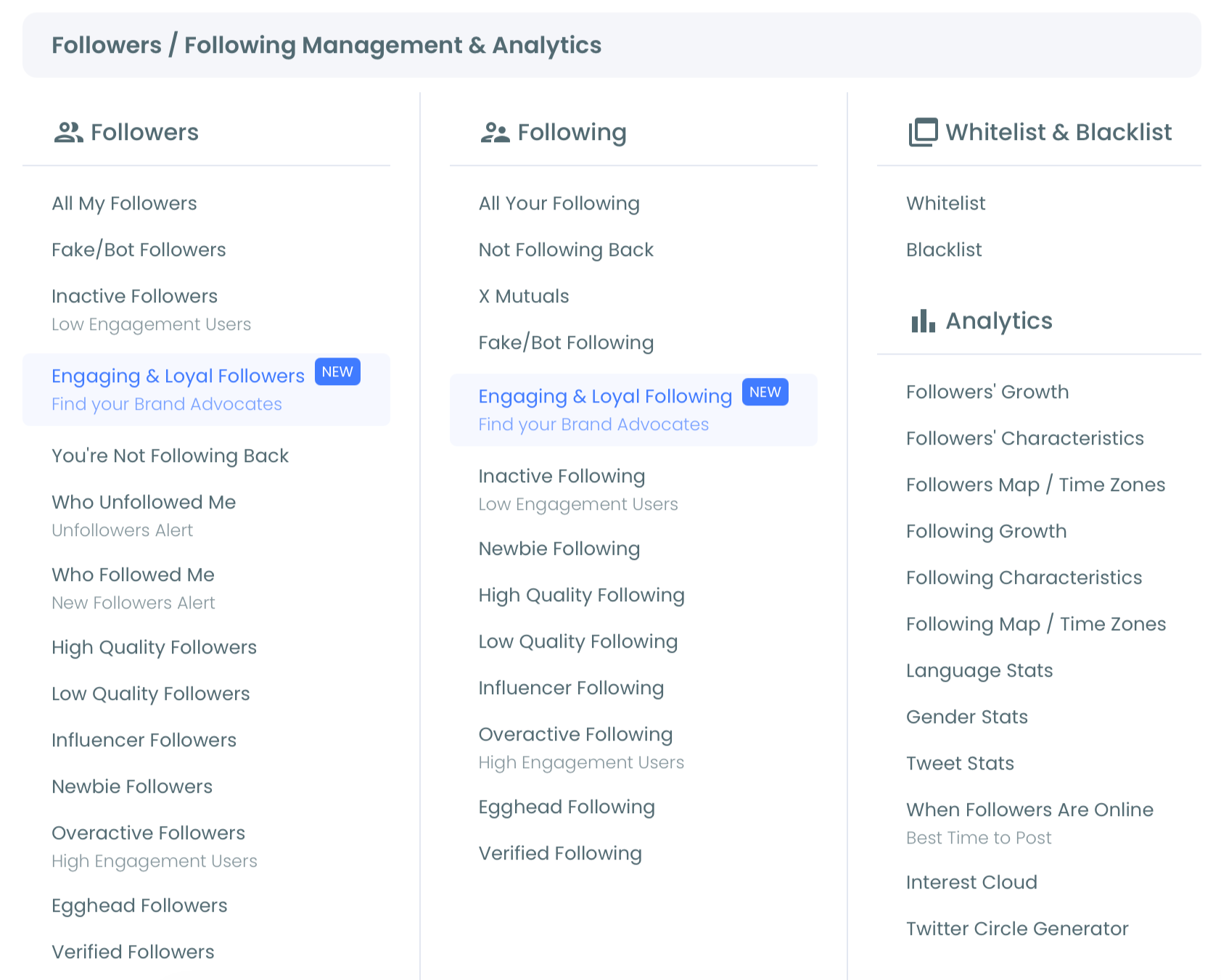
- Select Inactive Followers (Low Engagement Users) from the Followers group. The page header reads "Displaying your N Inactive of [Total] followers," which gives you the raw size of the segment before you filter anything.
Narrow the segment before you act
- Open Filter Options and combine inactivity with the other signals that matter to you. Tweet Count minimum and maximum, Join Date earliest and latest, Follow Ratio range, and the Follower Quality dropdowns for Eggheads, Protected, Fake/Spam, Inactive, and Overactive all stack together.
- Sort the table by any column header to rank the segment. Clicking Tweets sorts ascending, clicking again sorts descending, so the lowest-volume accounts across the longest lifespans rise to the top of the review queue.
- Whitelist every account you want protected using the per-row whitelist icon or the bulk Add to List dropdown. Whitelist status persists across all Circleboom features, so a client you protect here stays protected in every future cleanup.
Act on what is left
- Export the remaining segment as CSV using the Export button if you need documentation before anything changes. Exports draw on a token allowance, and the balance you have left is displayed on the button itself.
- Select accounts with the per-row checkboxes, or use the master checkbox at the top to take every currently visible row at once.
- Run Remove Follower per row or in bulk. Bulk removal is processed through the Circleboom Remove Twitter/X Followers Extension, which pauses automatically when the X rate limit is hit and posts a message telling you how many minutes remain. Those pauses run between 1 and 20 minutes.
That ordering is what keeps the process safe.
The login earns official API access before any data is read, the filters narrow the segment before you select anything, and the whitelist protects your exceptions before a bulk action can reach them.
Reverse any two of those steps and you are removing accounts you cannot restore, because Remove Follower has no undo inside Circleboom.
At a glance: connect, open Inactive Followers, filter and sort, whitelist, export, remove.
Which passive followers deserve to stay
Some passive followers are worth more than most of your active ones, and the classification cannot tell you which.
The signals Circleboom reads (tweet count, join date, follow ratio, engagement classification) describe publishing behavior.
None of them describe reading behavior.
A decision-maker at a company you are pitching may read every post you publish and never once tweet.
Silence carries no information about attention. A follower can consume everything you publish and leave no trace of that in any column Circleboom is able to read, which is why the classification opens a review rather than closing one.
Protect these categories before any bulk action:
- Anyone who has paid you, or who is inside a live deal right now.
- Institutional accounts: partner organizations, associations, industry bodies.
- Press and research contacts who monitor a beat without posting about it.
- People you know offline whose account exists but is barely used.
Use the Find in Bio & Name search inside the filter panel, or the inline search bar above the table, to pull those accounts up by name and whitelist them one at a time.
It takes a few minutes and it is the only step in this workflow that cannot be redone later.
What changes after the cleanup
Removing dormant accounts shrinks the denominator, which tends to raise the reported rate for content that was already earning genuine reactions.
The second effect is slower and more useful.
Once the audience that remains skews toward accounts that still open the app, a larger share of everyone a post reaches is physically able to react to it, and reactions are the raw input distribution runs on.
Do not expect a reach spike the next morning.
Compare engagement rate and audience quality over the following weeks instead, and treat the cleanup as a measurement correction rather than a growth tactic.
Run it as a repeatable pass rather than a one-time event. Follower bases age on their own as people change interests or leave the platform, an argument made in full in regularly clean your Twitter followers.
Pair the cleanup with the positive side of the same audit. Checking your high quality followers on Twitter keeps the exercise honest, so it produces a healthier audience rather than only a smaller one.
How often should you audit passive followers on X
Audit the segment whenever the numbers you report stop matching the reactions you see, and at minimum before anything you publish externally.
Three moments make the check worth running:
- Before a media kit, pitch deck, or campaign report leaves your hands.
- Once a growth spike has settled, so you can see which of those arrivals stayed and which went quiet.
- Straight after an authenticity sweep, because the dormant real accounts sit directly beneath the inauthentic ones.
The order of those last two matters. Authenticity screening removes accounts that were never people; the passive pass then removes the real accounts that stopped behaving like an audience.
Running them back to back in that sequence produces the most accurate picture of who is genuinely reachable, and it keeps you from removing an account twice under two different labels.
Timing context helps as well. Followers' Growth inside the same menu shows whether the dormant segment accumulated slowly across years or arrived in a single burst.
Slow accumulation is what ordinary network drift looks like on an older account. A burst points back at one specific acquisition event, and that event is the thing worth not repeating.
Set the cadence to your account's age rather than the calendar.
A three-month-old account has barely had time to accumulate dormancy; a six-year-old account that has never been maintained is carrying years of it. When you are ready, you can clear passive followers from your X audience in one filtered pass and keep the record of what you removed.
The bottom line
Passive followers are a measurement problem before they are an audience problem.
They inflate a number you report, hide the real performance of content that is working, and grow quietly every year an account stays open without maintenance.
Two signals identify them, one filter panel narrows them, and one whitelist pass protects the exceptions that matter.
Circleboom reads those signals across your full follower list on X as an official X Enterprise Developer company. That is why the classification covers every follower instead of a scraped sample, and why your account stays inside X's rules while you work.
→ review your passive Twitter followers
Common questions about passive followers on X
Does Circleboom remove passive followers on its own?
No. Nothing leaves your audience unless you select it first. Circleboom classifies the segment and lists it; the filtering, the whitelist pass, and the Remove Follower action are each triggered by you. The pacing that follows a bulk selection exists to keep the batch inside X's limits, not to let the tool run unattended.
Does removing a follower notify them?
Remove Follower takes the account out of your followers without blocking it. The person is not alerted by Circleboom, and they can follow you again voluntarily, but there is no restoration mechanism on your side once the removal is processed.
How many passive followers can I remove at once?
As many as you select, but selection is the part to watch. Results are paginated, and the master checkbox at the top takes every row currently visible rather than the whole segment, so apply your filters first and confirm the Active Filters bar before you tick it. Removal then runs in batches through the Circleboom Remove Twitter/X Followers Extension rather than in one burst.
Is it safe for my account?
Yes. Every action runs through the official X API within platform limits, and the pacing exists specifically so X does not read a large cleanup as aggressive behavior. Reviewing the segment before you act is still the right habit, because a quiet account is not always a low-value one.