
Your timeline fills with giveaway threads, airdrop replies, and "DM for promo" bios, and none of the accounts producing it look broken. They have real join dates, believable follower counts, and a follow ratio that would pass any audit you ran on them.
That is the root cause. Spam on X is defined by what an account posts, not by how its profile is built, so the numeric filters most cleanup advice reaches for first are simply the wrong instrument.
Spam accounts in your following list are a content problem wearing an ordinary-looking profile, so the fastest way out starts with the words in their bios rather than the numbers in their columns. Circleboom pulls your complete X following list through official API access and lets you filter it by bio keyword, language, and engagement tier before a single account is removed.
→ spam accounts you follow on Twitter
The filter combination below is the part most cleanup instructions leave out.
Why do the usual filters miss spam accounts on Twitter?
Structural filters describe how an account is assembled, and promotional spam is assembled well:
- A crypto-giveaway account that has been running for three years has an old join date.
- A reply-bait account that posts forty times a day has a very high tweet count, not a low one.
- An engagement-farming account that ran a follow-back campaign has thousands of followers and a ratio near 1.0.
Every one of those signals reads as healthy.
This is why generic follower-hygiene advice transfers badly to the following side.
Guidance built around low quality friends and followers leans on ratio and activity thresholds, and those thresholds were tuned for empty shell accounts rather than for busy commercial ones.
Spam accounts are not empty. They are loud.
The practical consequence is that you can run every numeric filter available and still be following the accounts that annoy you most.
Circleboom pulls your full Twitter following list and scores each account on bio text and activity, not on the profile geometry a promo operation can build to order. If you want to see the composition of what you actually follow, start from the scored view of spam accounts in your Twitter following list rather than from a threshold you picked in advance.
What spam looks like in a timeline, not in a metrics table
Spam identifies itself through vocabulary, and the vocabulary is remarkably stable across categories. Before you open any filter, it helps to name the shapes you are actually trying to remove:
- Promo-for-hire accounts, whose bios advertise paid shoutouts, "DM for promo," or a rate card.
- Giveaway and airdrop accounts, whose bios carry the giveaway, airdrop, and entry vocabulary their posts then repeat daily.
- Engagement-bait accounts, whose bios name the reply-farm format itself: engagement group, follow train, comment pod.
- Affiliate and dropship accounts, whose bios hold the discount code and the storefront link every post ends in.
- Compromised accounts, which posted normally for years and then switched to one of the four patterns above overnight, bio unchanged.
Four of those five categories announce themselves in the bio. The fifth announces itself only in the feed.
That split decides the whole workflow. Four categories can be caught by a text filter run once.
The fifth needs a human read, which is why the steps below put the export and the review before the removal instead of after it.
Category one and category two are worth separating in practice, even though they look alike in a list. Paid-promo accounts want your attention for resale.
Giveaway and gambling accounts want something different: a reply, a quote, or a follow-back loop. They recruit through your replies rather than your feed.
If that is the pattern that reached you, how to find and clean your Twitter accounts from gambling bots covers the vocabulary those accounts use.
The compromised category deserves its own note. An account you followed three years ago for good reasons can be sold, hijacked, or simply repurposed by its owner, and nothing in the profile updates to tell you.
Join date stays old. Follower count stays high.
Only the posts change, which means the only reliable detector is that you stopped recognising what shows up under the name.
Circleboom reads the following list as text, not just numbers
Circleboom turns your X following list into a sortable table where bio text is a filterable field alongside tweet count, join date, follow ratio, and engagement tier.
The Find in Bio & Name control inside the Filter Options drawer searches display names and bio content, which is the only place in the panel where a spam vocabulary can be expressed directly.
That matters because of where the data originates. As an official X Enterprise developer, Circleboom retrieves the complete following list rather than the truncated slice standard API tiers return.
The concrete payoff: a bio keyword search runs against every account you follow, not just the first few thousand rows a lighter integration can reach.
Circleboom also opens the same scored table that makes spam accounts following Twitter cleanup a filtering job rather than a scrolling one.
You can pair the text search with the Filter by Language control when the promotional accounts you picked up came from a region you no longer follow, and with the Engagement dropdown when you want only the high-volume posters inside that language.
One caution worth setting now: column sorting is single-column. Clicking Follow Ratio sorts by follow ratio and nothing else, so a compound view has to be built in the filter drawer rather than by stacking two sorts.
If you want a targeted starting point instead of a broad sweep, search Twitter bios and profiles works the same way against accounts you have not followed yet.
The following-side table on video: loading, enriching, and sorting before a single row is selected.
https://www.youtube.com/watch?v=smnyhWZMZgU
How to remove spam accounts you follow on Twitter, step by step
The process, in the order that keeps it reversible for as long as possible.
Open your full following list, not a pre-built segment
- Log in to Circleboom Twitter and connect the X account whose following list you want to audit.

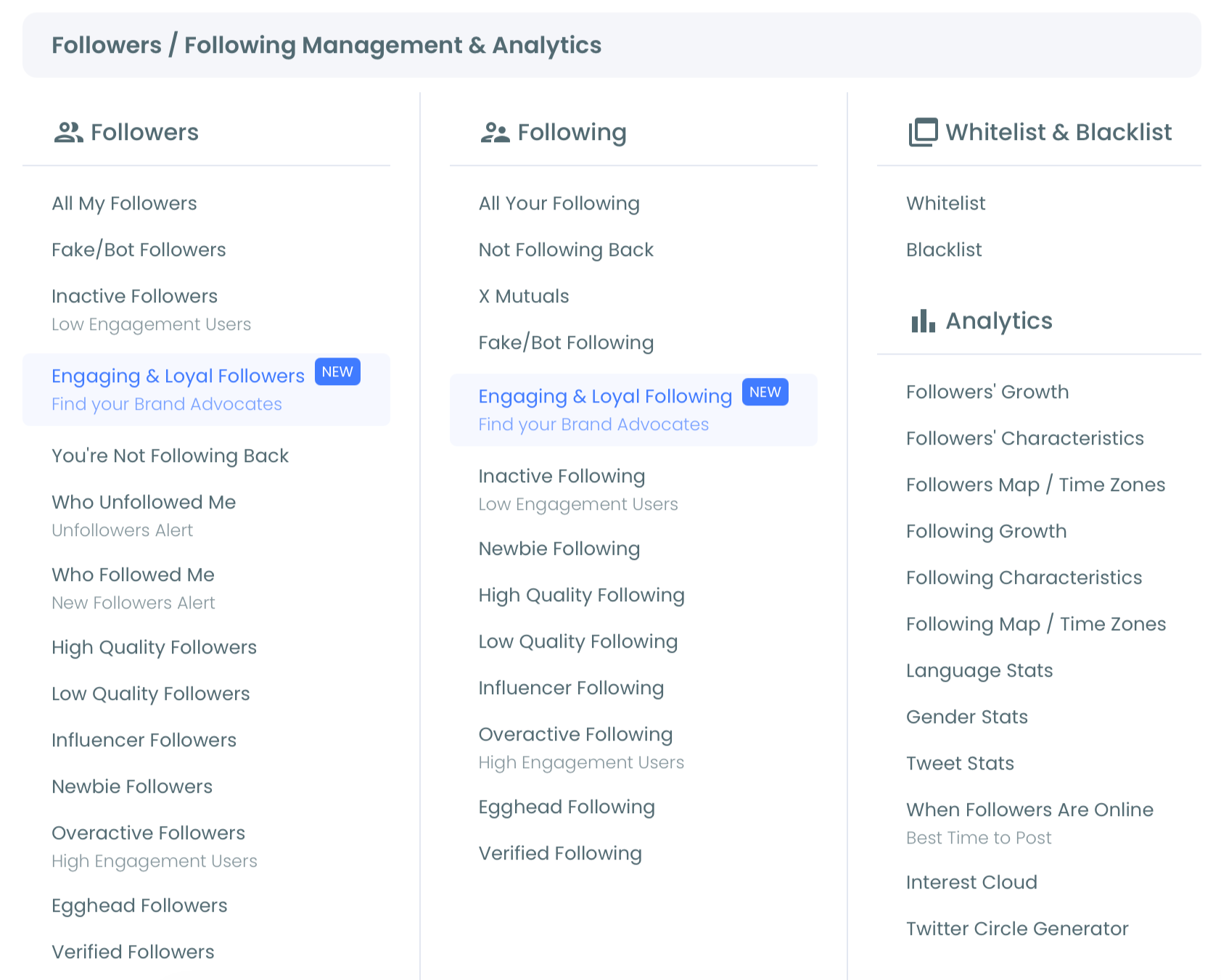
- Open the Follower and Following management menu, then choose the All My Following view, which loads every account you follow with no segment applied.
Build the vocabulary filter before you sort anything
- Click Filter Options to open the side drawer holding every filter group, including the text controls.
- Enter one promotional term in Find in Bio & Name, such as a shoutout phrase or a giveaway word, and read the result count before adding anything else.
- Add Filter by Language and the Engagement dropdown when the segment is still too broad, so the view narrows to constant posters writing in a language you no longer read.
Protect the accounts a text filter will catch by accident
- Check the Active Filters bar above the table to confirm the exact combination in force, since the filters stack rather than compete and each one narrows whatever the previous one left.
- Whitelist anything worth keeping with the per-row shield icon, or select several rows and use Add to List then Whitelist. Whitelist status persists platform-wide and excludes those accounts from every future bulk action.
Remove in reviewed batches and keep a record first
- Export the filtered segment as CSV, which consumes export tokens and preserves the bio text, verification status, and creation date outside Circleboom.
- Select rows with the checkboxes or the master checkbox, remembering that the master checkbox covers only the accounts on the visible page.
- Run Unfollow on roughly 100 to 150 accounts, then stop for the session rather than working toward the platform ceiling.
The sequence matters because the text filter is the only control in the panel that reads what an account says rather than how it is shaped.
The full list has to load before Find in Bio & Name has anything to match, the whitelist has to exist before a selection does, and the export has to run before an action Circleboom cannot reverse.
Reorder any two of those and you are working on guesswork.
X processes 50 unfollows per 15-minute window and up to 800 per day. Circleboom queues requests inside those windows and resumes the next day once the daily total is reached.
The 100-to-150 recommendation sits deliberately below that ceiling, and Circleboom does not enforce it on your behalf.
It exists because X's authenticity rules treat following or unfollowing a large number of unrelated accounts in a short period as engagement spam in its own right.
That is an awkward outcome to earn while cleaning up spam.
What changes in the feed after the spam follows are gone
The visible change is disproportionate to the number of accounts removed, because promotional accounts post far more often than ordinary ones. Removing a small share of your follows can clear a large share of your timeline volume, which is why the feed feels different long before the following count looks different.
There is a second effect that has nothing to do with reading. Your following list is public, and anyone evaluating your account can see it.
A list full of paid-shoutout and airdrop accounts reads as an account that follows back indiscriminately, whatever the rest of the profile says.
The accounts left behind are also easier to organise. Genuinely useful but noisy sources belong in a Twitter List Manager rather than in the main feed, which keeps the source available without paying for it in timeline space.
Measuring the change is worth one extra minute. Running a quick 1-min Twitter audit to find your real followers before and after a pass gives you a composition read rather than an impression. The same read tells you whether next month's sweep needs a wider vocabulary or a narrower one.
The five-line version of this sweep
Run the sweep as a short list rather than a project:
- Load the full following list first, before any segment or sort.
- Search one promotional term at a time in Find in Bio & Name, and read the count before narrowing further.
- Whitelist partners, customers, and contacts before you select a single row.
- Export the segment to CSV, since bulk unfollow cannot be undone inside Circleboom.
- Remove 100 to 150 accounts per session and repeat the same saved vocabulary next month.
The vocabulary is the reusable part.
Once you know which five or six phrases describe the spam that reaches your account, the whole cleanup is a filter you rerun rather than a decision you remake.
→ Clear spam accounts you follow on X
Questions about spam that filters cannot settle
Will a bio keyword search catch accounts that only spam in their posts?
No, and that is the known gap in this method. Find in Bio & Name reads display names and bio text, so an account with a clean bio that posts promotional content stays invisible to the text filter and has to be caught during the review pass or by sorting on posting volume instead.
Is unfollowing enough, or should I block spam accounts too?
Unfollowing removes the account from your feed but leaves it able to reply, quote, and mention you. Mass Block is the stronger action and needs the Twitter X Mass Blocker Chrome extension installed and running in an open browser session, because X's API does not support bulk blocking on its own.
What happens if I unfollow an account and want it back?
Bulk unfollow cannot be reversed through Circleboom, and there is no automatic restore. You can refollow manually, which is exactly why the CSV export in step 8 is worth the tokens: it keeps the usernames and bios of everything you removed.
Does removing spam follows affect who follows me?
No. Unfollowing changes only your own following list; the accounts you remove stay on your follower list unless you also remove or block them. If your follower side is the real problem, check my unfollowers, fake, spam and inactive followers covers that direction separately.