
The verified-account economy on X changed structurally in 2023, and most operators still have not updated their audience-analytics workflow to match. The legacy verification badge, awarded through editorial review to public figures and institutions, was replaced with X Premium, a paid subscription that grants the blue check to any subscriber meeting basic eligibility criteria. The badge that once meant "this account has been editorially confirmed" now means "this account pays for the badge or qualifies for it through Premium tier rules."
The shift mattered for two reasons. The signal value of the blue check collapsed for some audiences and held for others, depending on the use case. And the native X app began gating some verified-audience views behind Premium, which means an operator without a Premium subscription cannot run the verified-followers audit through the native interface at all. The audit that used to be straightforward became either expensive or impossible to run through native tooling, and the analytics layer became the working alternative.
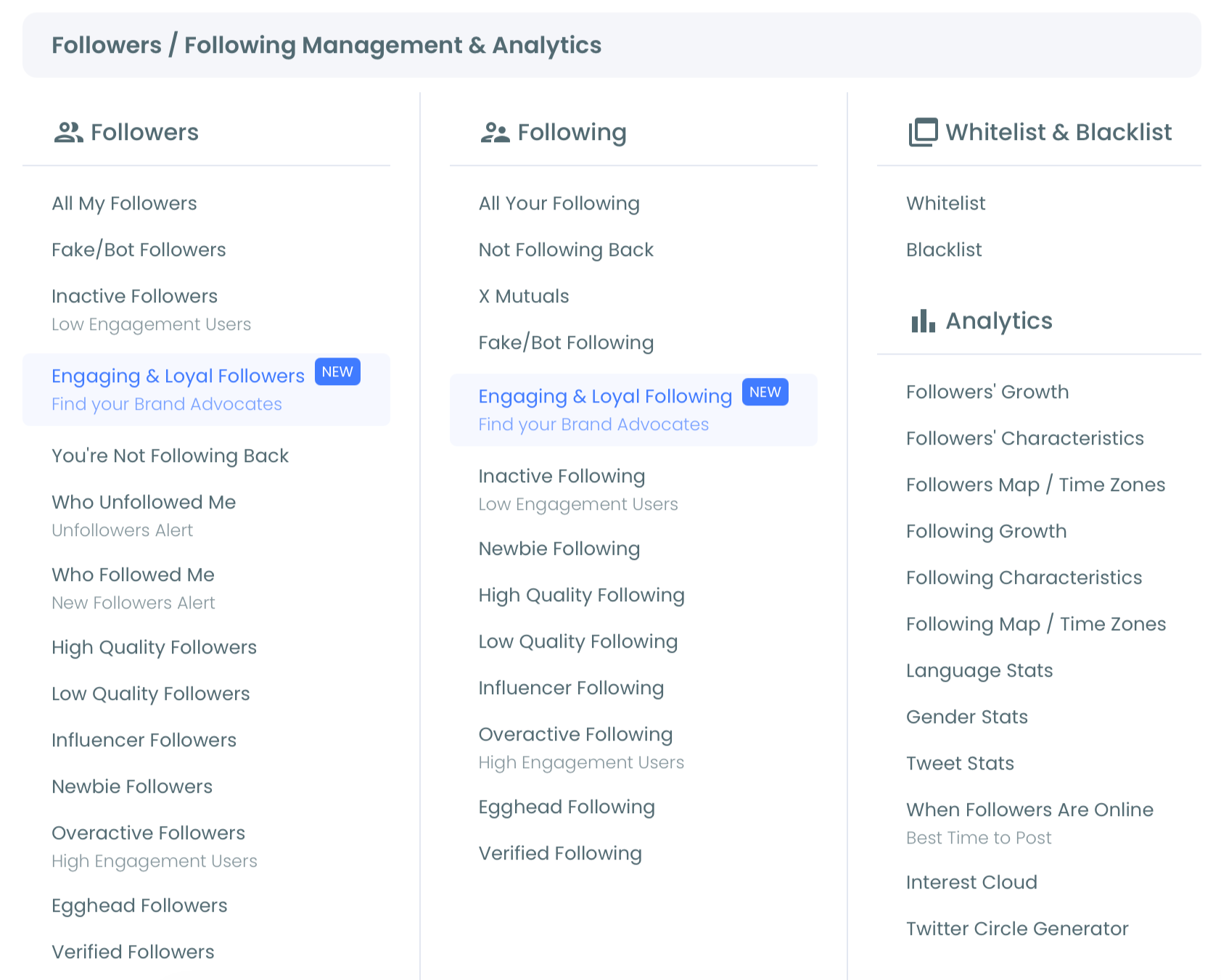
The reliable verified-followers workflow runs through the analytics layer.The starting point is the Verified Followers section under the Follower-Following menu.The list includes legacy-verified accounts, X Premium subscribers, and gold-verified organizations as separate filterable categories.The four sortable columns are profile name, follower count, verification type, and most-recent activity date.The export option produces a CSV for use in partnership briefs, sponsor decks, or outreach CRMs.The audit runs through the official X Enterprise APIs and does not require an X Premium subscription on the audited account.
→ Pull your Verified Followers list
Why the 2023 Verification Shift Changed the Audit Workflow
Before 2023, the operator could read verification status off the followers list as a quick visual scan. The badge appeared next to a small fraction of accounts (typically 0.1 to 0.5% of any sufficiently large follower base), and the operator could spot-check the verified followers in a manual review without much effort. The audit was casual because the data was sparse and the badge meaning was stable.
After 2023, the verified-follower count typically lifted by 5 to 20x as X Premium subscribers replaced the legacy-verified set. An account that had 50 legacy-verified followers in 2022 might have 500 to 1,000 verified followers in 2024, almost all of them X Premium subscribers rather than editorially-verified figures. The casual visual scan stopped working; the audit needed a structured tool.
The Circleboom piece on what a verified follower on X means today covers the post-shift definition and is the right reference for operators who need to communicate the verification meaning to internal stakeholders or sponsors.
What the Three Verification Tiers Mean for the Audit
The current verified-follower set on X breaks into three categories, and most audit use cases want to distinguish among them rather than treat all verified accounts as equivalent.
The first category is legacy-verified accounts, the small set of profiles that earned the badge before 2023 through editorial review. These accounts include established public figures, journalists, athletes, and institutions. The signal value is still strong for outreach and credibility use cases, because the editorial verification carried meaningful gatekeeping.
The second category is X Premium subscribers, the much larger set of accounts that pay for the badge. The signal value is weaker because the verification is essentially a paid feature, but the set still matters for monetization analysis (because X Premium subscribers are eligible for engagement payouts that other accounts are not).
The third category is gold-verified organizations, the institutional tier for businesses. These accounts pay for organizational verification and the signal value is strong because the verification requires a verified business entity rather than just a paid subscription.
The Circleboom piece on listing someone's verified followers on Twitter covers the audit workflow for the inverse use case (auditing a competitor's verified followers rather than your own) and the tier-breakdown carries through identically.
How to Find Your Verified Twitter Followers Step by Step
The workflow runs in two phases: the account connection, then the verification-tier filter. Connection takes under a minute; the filter runs in seconds.
Phase 1: Connect the Account
Log in to Circleboom Twitter
- Log in to Circleboom Twitter with the X account you want to audit. OAuth keeps the credentials with X directly and pulls the follower list through the sanctioned API.

Open the Follower-Following menu and find Verified Followers
- Open the Follower-Following menu in the left navigation and find the Verified Followers section under the Followers grouping.
Load the verified-followers list
- Load the verified-followers list. The system filters the full follower base to accounts with active verification badges and presents the result in a sortable table.
Phase 2: Apply the Tier Filter
Apply the verification-type filter for the use case
- Apply the verification-type filter for the use case. Partnership outreach typically wants legacy plus gold; monetization analysis wants X Premium; credibility audits often want all three categorized separately.
Sort the filtered set for the operational order
- Sort the filtered set by follower count descending for outreach prioritization, by activity date for engagement-likelihood ranking, or by profile name for alphabetic reference.
Export the list or take action from the dashboard
- Export the list as CSV for use in a partnership brief or outreach CRM. The dashboard also supports adding the verified followers to a Twitter list, following the accounts that the operator does not already follow back, or sending DMs.
The six-step sequence is the full workflow. The tier filter is the strategic step; everything else is mechanical.
Video walkthrough: how to see your verified followers on Twitter without Premium.
https://www.youtube.com/watch?v=97bwzHB16aA
What the Workflow Produces for the Post-2023 Operator
The output is a working list that supports the four common use cases (partnership outreach, credibility audits, monetization analysis, journalist outreach) with the tier-aware filtering that the post-2023 verification economy requires. The list is sortable, filterable, exportable, and refreshable on a recurring schedule.
The compounding payoff is operational visibility. The operator runs the audit quarterly, tracks the verified-follower trend by tier, and uses the change to calibrate audience-development strategy. A growing legacy-verified count signals that the account is attracting editorially-verified figures, which is a different growth signal than an X Premium count that rises with general subscriber adoption.
The Circleboom piece on finding out which blue checks follow you on Twitter covers the practical-use-case framing and pairs cleanly with the tier-aware workflow described above.
Two adjacent surfaces extend the verified-followers analysis. The Search Twitter Bios and Profiles landing covers the bio-keyword filter that combines with verification status for highly-targeted outreach lists. The Twitter Follower Tracker landing covers the trend-tracking dimension that supports the recurring-audit framing.
Related Circleboom reading on the verified-followers theme.
- How to get verified followers on Twitter on the audience-development tactics that grow the verified-follower count over time.
Where the Workflow Goes Next
A first quarter of running the audit usually produces enough trend data to calibrate the recurring cadence for the operator's account. Heavy-outreach accounts with active partnership pipelines often settle on monthly audits; archival or research-use accounts settle on twice-yearly audits without losing accuracy.
Pull your Verified Followers list and the post-2023 verification audit stops being a manual scroll through 14,000 follower profiles and starts being a five-minute query against a structured, tier-aware table.
Still Wondering?
Can I distinguish legacy-verified from X Premium subscribers in the list?
Yes. The verification-type filter separates the three categories (legacy, X Premium, gold-verified organizations) into distinct filterable sets. The platform's underlying data exposes the verification type through the sanctioned API, and the analytics layer surfaces the distinction in the dashboard. Most partnership-outreach use cases want legacy plus gold; most monetization-analysis use cases want X Premium.
How accurate is the verification status if a follower lets X Premium lapse between audits?
The list reflects current verification status at the moment of the query. Accounts that have let X Premium lapse since the prior audit do not appear in the current list; accounts that subscribed since the prior audit do appear. The trend line across multiple audits shows the verification churn in the follower base, which is sometimes a useful signal for understanding how much of the verified count is paid-subscription churn versus stable verification.
Does my own account need to be on X Premium to run this audit?
No. The verified-followers workflow runs through the sanctioned API at the account-data level and does not require an X Premium subscription on the audited account. The native X app gates some audience-analytics views behind Premium; the analytics layer does not.
What if my account has more X Premium followers than I expected after running the audit?
A higher-than-expected X Premium count usually reflects general platform adoption rather than anything specific to the audited account. Roughly 1 to 3% of any large follower base subscribes to X Premium at current adoption rates, and accounts in technology, business, or media niches often see higher rates. The audit surfaces the count without making a judgment about whether the count is high or low; the operator interprets it against the use case.
How does verified-follower analysis interact with the monetization eligibility rules?
X Premium engagement payouts depend on engagement from other Premium subscribers, which means the count of verified (X Premium) followers in the audience directly affects monetization eligibility. The verified-followers audit is the right starting point for any operator evaluating monetization viability, and the X Premium tier filter is the relevant subset for that specific use case.