
The overlap between two Twitter influencer audiences is the set of accounts that follow both influencers at the same time. You find it by entering both handles into a comparison tool that pulls each follower list and computes the intersection. Twitter itself shows you a follower count and nothing about who two accounts share, so the calculation has to happen outside the app.
Circleboom compares two X accounts and returns the exact list of accounts that follow both, computed through the official X API.
→ overlap between two Twitter influencer audiences
One screen, two handles, a real list of shared followers you can sort and act on.
That shared list is the most useful audience signal on the platform, because an account following two influencers in the same niche has already self-selected into that market twice.
What the Overlap Actually Tells You
The overlap between two influencer audiences is an intent signal, not a vanity metric. When someone follows two creators who cover the same subject, that person is demonstrably interested in the topic, aware of the category, and active enough to follow more than one voice in it. A single shared follower means little. A list of 800 shared followers between two influencers in your niche is a map of the most engaged audience in that space.
Circleboom computes this intersection for any two public X accounts using the official X API, so the data comes from the platform itself rather than scraping. As an official X Enterprise developer, Circleboom retrieves full follower lists within X's own access framework, which keeps the comparison compliant and the results trustworthy.
The overlap answers questions a raw follower count never can:
- Which accounts already follow both influencers you are studying.
- How much audience two creators genuinely share versus reach separately.
- Which followers sit at the center of a niche, worth engaging before competitors notice them.
Knowing the overlap also tells you the inverse: the non-overlapping portion. If you compare your own account against an influencer's, the accounts that follow them but not you are your cleanest growth target, already interested but not yet yours.
This is why the overlap matters more for influencers than for ordinary accounts. Two creators in the same niche are competing for, and partly sharing, the same pool of attention. The size and quality of that shared pool decides whether a collaboration is a fresh-reach play or a redundant one, and whether two voices are genuine rivals or simply neighbors in the same room. The intersection makes that relationship measurable instead of assumed.
How to Find the Overlap Between Two Twitter Influencer Audiences
You will enter two handles, choose follower comparison, run the report, and review the shared list. Each step takes seconds.
Set Up the Comparison
- log in to Circleboom Twitter with your X account to reach the dashboard.
- Open the Monitoring menu, where Circleboom groups its external-account tracking tools.
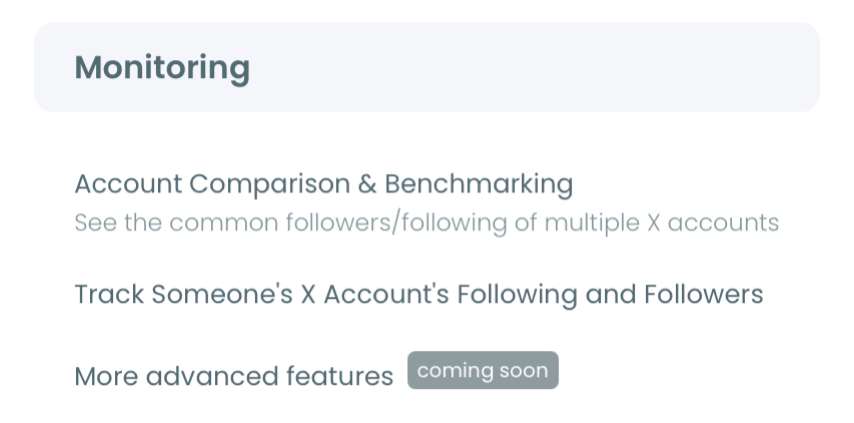
- Select Account Comparison & Benchmark Report from the Monitoring tools.
Run It and Read the Result
- Enter the first influencer's @ handle in one field and the second influencer's @ handle in the other.
- Choose the Followers radio button to compare who follows both accounts, then click Compare X Accounts.
- Review the result table, which lists every shared account with its follower count, follow ratio, account age, and engagement tier.
- Sort by any column or search bios by keyword to surface the highest-value accounts inside the overlap.
Running the comparison on followers rather than following is what isolates the shared audience: it returns the people who chose to follow both influencers, which is the exact group a partnership or growth play targets.
What the Shared-Follower Report Actually Contains
The overlap is not a single number. Each account in the intersection arrives as a full profile row, so you can judge quality before you act. Every shared follower in the result table carries the fields you need to separate a worthwhile contact from a dormant one:
- Name, username, verification badge, and location, so you can read who the account is at a glance.
- Tweet count and join date, which together show whether the account is active or a long-dormant shell.
- Following count, follower count, and follow ratio, the quickest proxy for reach versus follow-back behavior.
- An engagement tier labeling each account active, moderate, or inactive, so you sort the overlap by signal rather than size.
The results header states the scope plainly, for example how many common accounts were found and how many followers were fetched from each side. The default view lists up to 5,000 shared accounts, and sorting by a different column surfaces subsets beyond that order. An inline search bar reads name, username, and bio together, so a single keyword like "founder" or a city name filters the overlap down to the slice that fits your goal. The same filter panel that powers Live X Account Search applies here, covering follower quality, verification, count ranges, follow ratio, join date, and location.
This is why the overlap beats a manual count. Scrolling two profiles and eyeballing shared names is impossible past a few thousand followers, and it gives you no quality signal even when it works.
The report computes the exact intersection through the official X API and hands back a dataset you can sort, filter, and export, which is the difference between a guess and a decision. For the export side specifically, our walkthrough on how to export Twitter followers to a spreadsheet covers what the CSV holds once you pull the overlap out for reporting.
Followers Overlap vs Following Overlap
The comparison works two ways, and the choice changes what the overlap means. Comparing followers shows who follows both influencers, your shared audience and the pool a collaboration would reach. Comparing following shows which accounts both influencers themselves follow, which surfaces the shared connections and emerging voices that credible people in a niche have independently decided to watch.
For audience overlap between two influencers, followers comparison is the default. If you are instead trying to find the accounts every leader in a space pays attention to, switch to following comparison and read the intersection as a list of high-value nodes. Circleboom's find Twitter influencers tool pairs well here when you need to expand a promising overlap into a broader shortlist.
What to Do With the Overlap
A shared-follower list is only valuable once you act on it. The result table includes per-row and bulk actions, so the overlap becomes a workflow rather than a screenshot. You can follow relevant shared accounts, add them to a Twitter List for ongoing monitoring, or export the whole intersection to CSV for partnership reporting.
If a brand offers you a sponsorship, comparing your follower list against theirs quantifies incremental reach before you sign. A 10% overlap means the deal reaches 90% new audience, while a 60% overlap means most of that audience already sees your content. The number turns a vague pitch into a decision you can defend. Circleboom's find your brand advocates on X guide shows how to read the same shared accounts as your most valuable supporters rather than just a count.
For deeper work, pair the comparison with the broader Monitoring tools to track how an influencer's audience shifts over time. Or read our walkthrough on how to find common followers between Twitter accounts without coding for a no-script approach to the same calculation.
The same intersection doubles as a competitive map. The accounts that follow both you and a rival are aware of both options, so they tell you where positioning overlaps and where it does not. Influencer marketing is now a market Statista values at $30 billion in 2023, growing toward $52 billion by 2028, which is why measuring real shared reach beats guessing from follower totals. A larger overlap is not automatically better. It depends on whether you want incremental reach (favoring low overlap) or proof that an audience is concentrated in your niche (favoring high overlap).
To Summarize
The overlap between two Twitter influencer audiences is the list of accounts that follow both, and you find it by running a follower comparison rather than eyeballing two profiles. Circleboom enters both handles, pulls each list through the official X API, and returns a sortable, exportable intersection in seconds.
Use followers comparison for shared audience and partnership math, then switch to following comparison to find shared niche nodes. Once you have the list, follow the relevant accounts, group them into a Twitter List, or export the set for reporting. The overlap stops being a curiosity and becomes a repeatable input to growth and partnership decisions.
To go further, our guide on finding the hidden influencer among your X followers and the regional approach to influential Twitter users on a specific topic both build on the same overlap logic.
→ find the audience overlap between two X accounts
Questions People Ask About Influencer Audience Overlap
Can I find shared followers between two accounts that aren't mine?
Yes. The comparison works for any two public X accounts, and neither has to be yours. Enter two influencers, two competitors, or two investors, and the tool returns the accounts they share.
Does a small overlap mean the comparison failed?
No. A small overlap between two influencers means their audiences are mostly distinct, which is a strong signal for a collaboration because each side reaches people the other does not. Small is informative, not broken.
What if an influencer has millions of followers?
The official X API retrieves up to a set number of followers per account, and the results page shows exactly how many were fetched from each side. For very large accounts the intersection is computed from the fetched portion, and you can refresh to update it.
Does running a comparison cost anything?
Running the comparison itself surfaces the shared list on screen for free. Exporting that list to CSV is what consumes export tokens, and your remaining balance shows as a yellow badge at the top right. When the balance reaches zero, a Buy now prompt replaces the export button, so you always see the cost before it applies.
Is the overlap a live number or a snapshot?
It is a snapshot from the moment the data was retrieved. Accounts that follow or unfollow either influencer afterward will not appear until you refresh the comparison. Circleboom records each run in a Comparison History panel with the date and type, so you can reopen an old run or refresh it to see how the overlap has shifted as both audiences grow.