
Finding the right followers for a niche is a filtering problem, not a posting problem. The accounts you want already exist on X, already discuss your topic, and are already reachable. What most people lack is a way to pull them into one list and narrow that list down to the accounts genuinely worth following.
What this guide gives you.A repeatable search that reaches every account aligned with your niche.A filter stack that separates targeted followers from casual mentions.A safe way to follow, list, and export the segment you build.
Circleboom finds targeted Twitter followers across X through official, compliant access, so start by learning to find targeted Twitter followers.
I have run this process on niches from B2B software to local service audiences, and the approach that holds up every time is the same: search wide, filter hard, act carefully. The steps below walk through exactly that.

How to Find Targeted Twitter Followers Step by Step
To find targeted Twitter followers, you connect your account, run a historical keyword search, filter the results by the signals that define your niche, and act on the clean segment. The process moves through three phases, and the order is what keeps it precise.
Watch it in action: how to surface the followers that actually extend your reach on X.
Connect your account and build the pool
- Log in to Circleboom Twitter and connect your X account with official OAuth.
- Open the Advanced X Search menu and select Deep X Account Search.
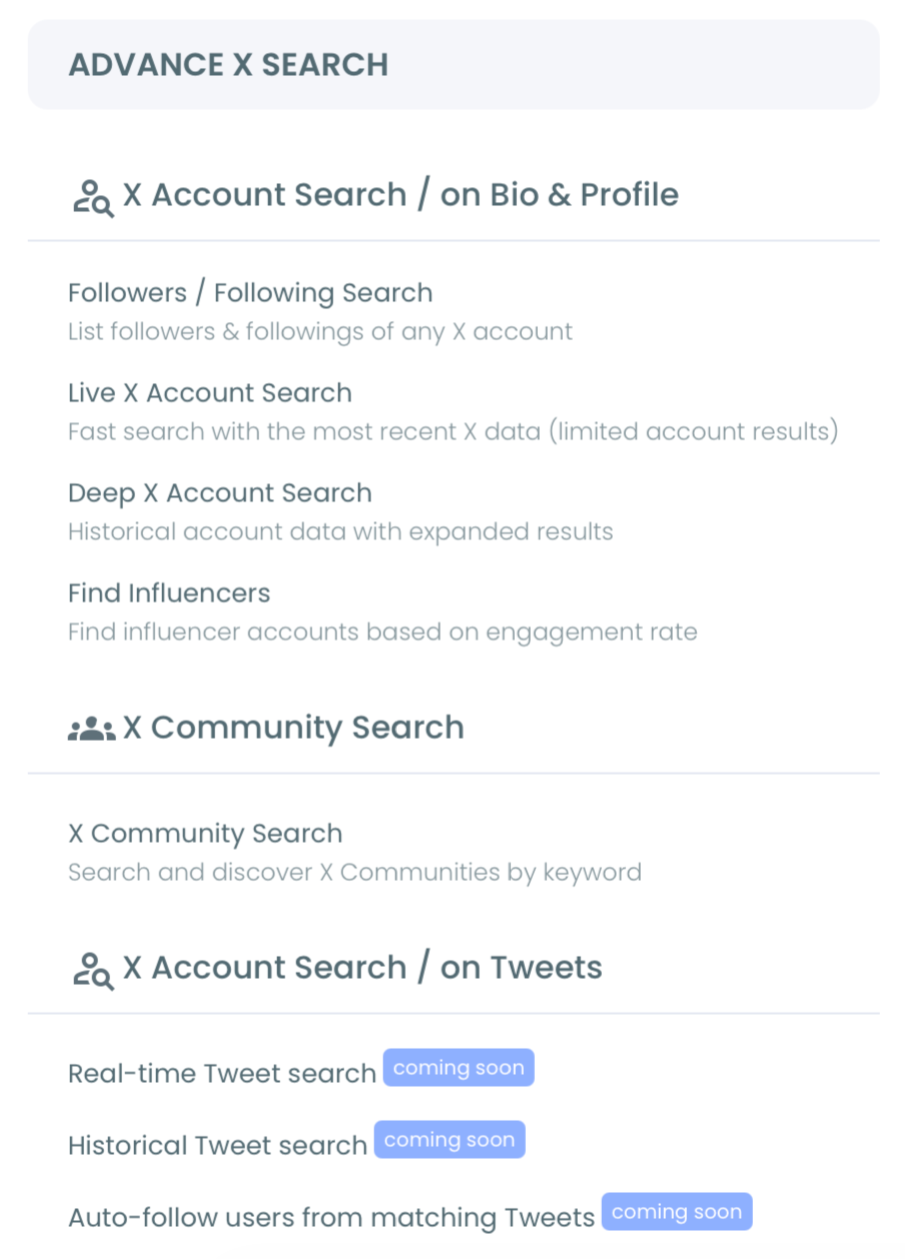
- Enter a niche keyword that your ideal follower would use in a bio or an older tweet. Deep Search reads historical data and returns up to 5,000 matching accounts, each with follower count, engagement tier, account age, and follow ratio.
Filter the pool down to your niche
- Open the Filter Options panel and set your criteria: bio keyword to confirm topical alignment, follower count range for the tier you want, engagement classification to drop dormant accounts, and verification status when credibility matters for your niche. Every filter applies as AND logic, so each one tightens the segment.
- Sort by follow ratio or tweet count to push suspicious or empty accounts to the bottom, then review the strongest matches first. If you are unsure whether a batch is real, a quick check of whether someone's Twitter followers are fake or real confirms it before you act.
Act on the segment
- Select the qualifying accounts using the checkboxes and the master checkbox on each page.
- Follow, list, or export. Follow the segment at Circleboom's safe pace of 50 accounts every 15 minutes and up to 400 a day, add them to a Twitter List, or export them as a CSV for outreach.
That sequence is what makes the process hold up. The login earns official API access, the search builds coverage across your niche, the filters convert that coverage into precision, and the paced follow keeps the whole run inside X's rules. Skip the filter phase and you follow noise; rush the follow and you strain the account.
Why Native X Search Cannot Do This Alone
X gives you visibility but not discoverability. You can run the official X search and see posts that match a phrase, and you can open any public account's follower list. What you cannot do is filter that list by quality, sort it by engagement, or export it.
That limitation is the whole reason a dedicated tool exists. Circleboom performs the search as an official X Enterprise developer, which means the historical data is pulled through compliant, authorized access rather than scraping. Your account stays safe, and the data stays complete. That is what lets you find your niche's Twitter followers at scale without any policy risk.
Two native gaps matter most for niche targeting. First, X search returns content, not a scored list of people, so you cannot find specific followers of another Twitter account and filter them in one place. Second, native search only reflects recent activity, so the credible specialists who post rarely never show up at all.
Deep X Account Search closes both gaps in a single query, which is why a historical scan beats manual scrolling for niche work.
How to Sharpen Your Targeting Further
Once the basic search works, a few refinements raise precision sharply.
Run more than one keyword. An account that appears across two or three of your niche terms is a far stronger match than one that mentioned a single term once. Keeping the overlap is the fastest way to collect Twitter followers without coding at a quality bar most manual methods never reach.
Layer location and language when your niche is regional. A local audience is defined as much by place as by topic, and both are filter fields in the same panel. For a fuller keyword strategy, this complete guide to Twitter Advanced Search pairs cleanly with the filter stack above.
Compare candidate accounts before you commit at scale. The Twitter Account Comparison view shows overlap and reach side by side, so you can tell a genuinely central account from one that only looks big.
Narrow the pool even earlier when you can. Searching directly across Twitter bios and profiles trims the result set before you open a single filter, which saves review time on large niches.
A targeted list of 300 aligned accounts beats a random list of 3,000 every time. Precision is the product here, not volume, and every filter you apply is protecting that.
What to Do With the List Once You Have It
A targeted segment is only useful if it feeds real work. Circleboom keeps the output actionable, so the same list can drive several next steps without leaving the results view.
Add the accounts to a Twitter List to monitor and engage them over time. Follow them selectively when they belong in your feed. When you need the data outside Circleboom, export Twitter followers to a spreadsheet and the CSV carries username, bio, follower and following counts, verification type, and account age straight into a CRM or outreach tool.
The point is that discovery and action live in one place. You are not exporting a raw list and rebuilding it elsewhere; you are working a clean, filtered segment that is ready to use. Ready to search targeted Twitter followers and put the list to work.
How Long Does It Take to Build a Targeted List?
A single niche search and filter pass takes only a few minutes. The search itself returns results quickly, and the filtering is where you spend most of your attention, usually 10 to 15 minutes to review and refine a segment you trust.
Acting on the list takes longer by design. Because follows run at 50 every 15 minutes to stay compliant, a segment of a few hundred accounts follows out gradually over a day rather than all at once. That pace is the safeguard, not a delay to work around. You can build the segment in one sitting and let the follows complete in the background while you move on to other work.
The takeaway is that the slow part is the safe part. The discovery and filtering are fast because they are just reading data, and the follow is paced because it changes your account on X. Keeping those two speeds separate is what lets you target aggressively without ever putting the account at risk.
What to Do Next
Building a targeted niche audience follows a short, repeatable checklist:
- Run Deep X Account Search on your core niche keyword.
- Filter by bio keyword, engagement tier, follower range, and verification.
- Cross-reference two or three keywords and keep the overlap.
- Add the survivors to a Twitter List and follow selectively at a safe pace.
- Export the segment when you are ready to run outreach.
Work that list once and you have a targeted audience you can engage for months, instead of a follower count that never converts. Start the search and let the filters do the heavy lifting.
→ build a targeted Twitter follower list
What to Know Before You Start
Do I need the Chrome extension to find and follow targeted accounts?
No. Search, filtering, following, adding to Lists, and exporting all run through Circleboom's official API access with no extension required. Only stronger actions like mass block use a separate extension, which niche targeting does not need.
How many accounts can I follow per day?
Circleboom follows 50 accounts every 15 minutes, up to 400 per day, and resumes automatically the next day when the limit is reached. The pacing keeps your account compliant with X's platform rules during any bulk follow.
Will historical search include inactive accounts?
It can, because it covers past activity as well as current. That is useful for finding credible accounts that post rarely, but it is also why the filters matter. Use the engagement and follow-ratio filters to keep or remove less active accounts based on your goal.
Can I reuse the same search later?
Yes. Document your keyword and filter combination, and you can rebuild the same targeted segment whenever you want to refresh it. Repeatable searches are what turn a one-time discovery into an ongoing niche growth routine.