
Your follower number moved, you opened the new profile, and every post sat behind a padlock. That is a protected account, and the reason you cannot count how many of them follow you is that X hands you a chronological follower list with no filter for account type.
Native X: padlocked profiles one at a time, no list, no count. Circleboom: one Protected switch turns your follower table into a list of every private account following you on Twitter, read through the official X API.
→ see the private accounts following you on Twitter
Their identity is retrievable. Their posts are not, and the follow does not change that.
How to find private accounts following you on Twitter
The switch that does it sits inside the follower filter drawer, under a group called Follower Quality.
Open the unfiltered follower table
- Log in to Circleboom Twitter, authorizing the profile whose follower base you are about to filter.

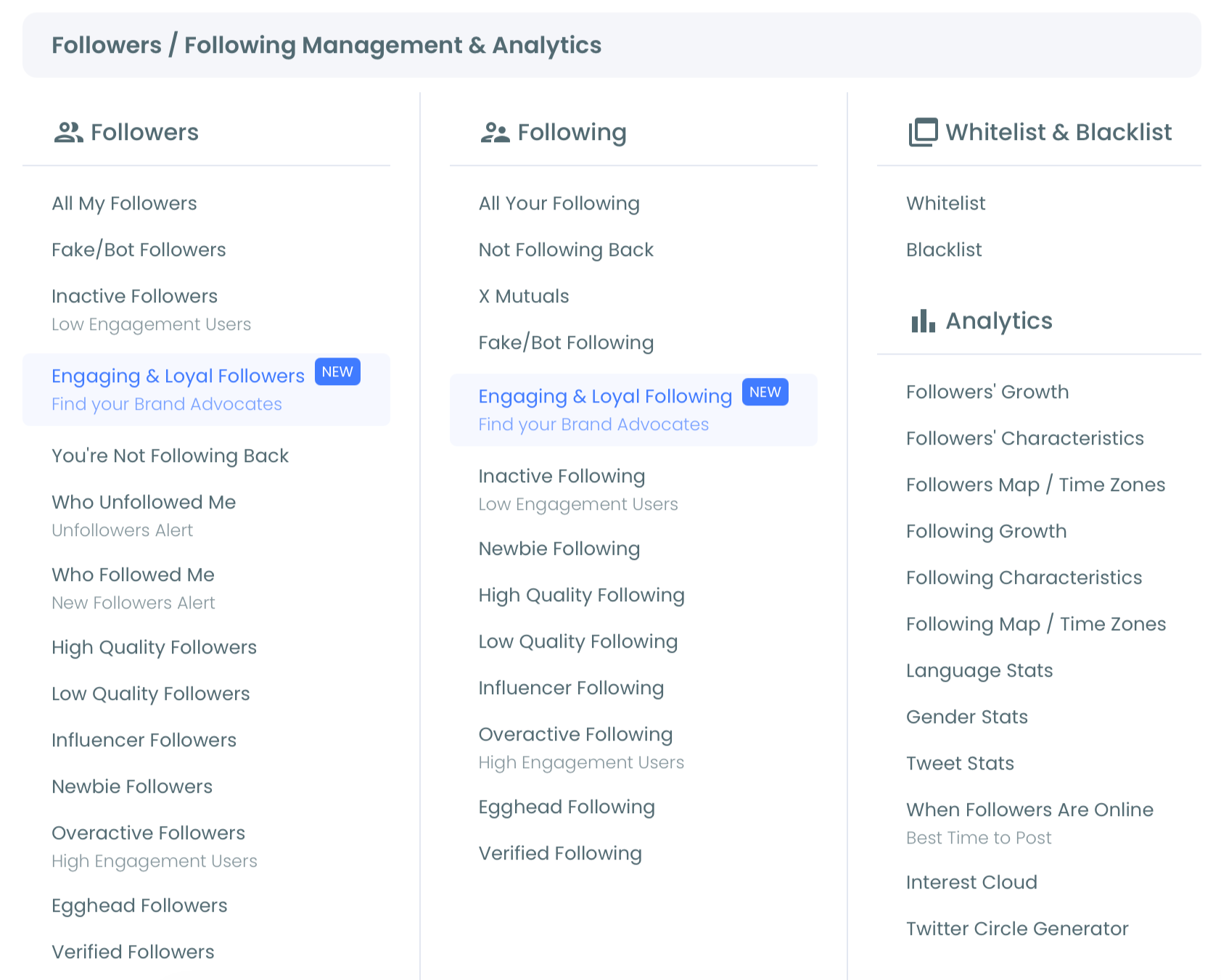
- Choose All My Followers inside Follower / Following Management and Analytics. It shows everyone who follows you, with no segment applied.
Isolate the protected rows
- Click Filter Options to open the side drawer that holds all twelve filter dimensions.
- Set the Protected dropdown under Follower Quality to Only. Each of the five quality dropdowns carries three states, Show, Hide and Only, and Only leaves nothing in the table except protected accounts.
- Read the Active Filters bar above the table to confirm Protected is the one criterion applied. Filters stack as AND conditions, so a leftover language or join-date filter quietly shrinks your count.
Keep the segment you built
- Sort by Joined, descending to see whether your private followers arrived in a recent cluster or have been sitting in your audience for years.
- Export the filtered table as a CSV. The file carries an IsProtected column, so the flag travels with the row into your spreadsheet.
That sequence works because the confirmation step comes before the count. The Active Filters bar is the only place that tells you whether you are reading protected accounts alone, or protected accounts minus whatever else you forgot to clear.
A number read off an unconfirmed filter is a number you will check twice.
At a glance: log in, open All My Followers, set Protected to Only, confirm the filter bar, then sort or export.
Screen recording: the segmentation pass that narrows a full follower table down to a single account type.
https://www.youtube.com/watch?v=Oz77r2o8X-M
Why the X app cannot give you this list
X has the data and does not expose it as a control.
Its developer reference lists protected among the fields you can request on the followers endpoint, described as an indicator that the user has chosen to keep their posts private. The same followers endpoint returns name, username, bio, location and join date on every account it hands back.
None of that reaches the app you scroll. There is no account-type filter on your follower list, no sort, no badge count.
A padlock icon on a profile page is the only signal, and it arrives one profile at a time.
The gap matters more than it sounds, because people misjudge their own settings constantly.
Pew Research studied Twitter users who said their account was private or were unsure of their settings. 83% of them in reality had a public profile.
Self-reported privacy is not a reliable read even for the person setting it. The flag on the account record is worth more than anybody's assumption about it.
Sometimes the native list looks shorter or stranger than your follower number suggests. Our note on Twitter followers and followings not showing in your followers list covers the display side of that problem.
Check the private accounts among your Twitter followers once, and you replace a scroll-and-squint habit with a number you can put in a document.
→ list the protected accounts in your Twitter followers
What Circleboom can and cannot see about a protected follower
The boundary runs through the follow, not through the account. Somebody who follows you has already handed you the one thing the count depends on, which is their presence in a list your authenticated account owns.
That is why the row exists beside every public one, carrying the same seven columns as everyone else: name, tweet count, join date, following, followers, follow ratio and engagement tier.
What the row does not give you is anything the padlock covers. Protected posts and their permanent links go only to approved followers. They stay out of third-party search engines, and nobody can repost or quote post them.
Circleboom does not open protected content, and no tool operating inside X's rules does. As an official X Enterprise Developer company, Circleboom reads what the connected account is entitled to read.
That constraint is why the protected list is trustworthy, and it is exactly where the list stops.
Can you read a protected account's posts if they follow you?
No. Visibility on a protected account keys entirely off approved-follower status in the other direction, so their following you grants you nothing. X states that protected posts are visible only to that account's own followers.
It adds that replies they send to an account not following them will not be seen by that account either.
Two consequences most people miss:
- A padlocked follower can read every post you publish, indefinitely, while you cannot read one of theirs.
- You cannot repost or quote post their content even after they follow you, because the repost control is disabled on protected posts for everyone.
The follow runs one way. Circleboom can name that account for you, and that is the whole of what anyone can do.
Circleboom works inside that first direction and never crosses into the second. The outward version of the question gets its own answer in our post on whether a protected Twitter X account hides your following list.
Why a protected follower is not a low-quality follower
Every automated quality signal reads a protected account badly, for an honest reason. Circleboom computes engagement classification, follow ratio and account age from publicly available signals rather than from anything X labels directly. A protected account publishes almost none of those signals.
The feature documentation is blunt about it. Private or restricted accounts may have limited data available, and some columns can be incomplete for those rows.
Worth saying plainly: those classifications are Circleboom's, computed from what X publishes. They are behavioral indicators rather than labels X hands over, and on a protected row they are indicators built from thin evidence. Read them as prompts to look closer, not as findings.
So a padlocked follower lands in your table looking dormant: thin visible activity, an engagement tier reading low, a follow ratio built on numbers you cannot cross-check.
The account may be a customer who reads everything you publish and keeps their own timeline closed.
The mistake I see most often, and the one worth naming before you act, is treating that low tier as a verdict rather than an indicator. Removing a follower is one-way in Circleboom and cannot be reversed from inside the platform.
The correction is small. Before any bulk pass, set Protected to Hide so those rows never enter the selection, or whitelist them so they sit out every bulk action across the platform.
Our note on how to remove followers on a private Twitter account covers the reverse case, when your own account is the protected one.
What the protected count tells you about your audience
A protected share is a composition signal, not a defect to fix. Read it the way you read a language breakdown or a join-date cluster.
A small protected share on a large audience is unremarkable. A protected share that jumps in a single week alongside a wave of newly created accounts deserves a second look, and sorting by Joined makes that pattern visible in seconds.
The segment also changes what your other numbers mean. If a real slice of your followers keeps a closed timeline, part of your engagement gap is structural rather than a content failure, because their replies never reach your timeline and their reposts do not exist.
Naming the segment beats guessing at it, which is the same case our egghead follower cleanup notes make for a different account type. Check the Twitter follower quality breakdown next to the protected count and the picture fills in fast.
One more wrinkle is worth knowing before you compare numbers. X's help pages note that a quality filter keeps suspected spam accounts out of the follower list you see natively. The roster on your profile is already filtered before you start counting it.
What to do with the segment once you have it
Three moves cover almost every reason people run this filter, and none of them involve removing anybody.
- Whitelist the segment. Select the filtered rows and apply the bulk Whitelist action. The label is permanent until you remove it, and it excludes those accounts from every bulk operation across the platform, not just the one you are running today.
- Add them to a private X List. From the same Add to List dropdown you can create a new list and set it to private, which gives you a standing view of the segment without announcing anything to the accounts in it.
- Export a baseline. The CSV records the segment on a date, so the next run tells you whether the protected share is growing, shrinking or holding.
Exports run on a token balance, and the Export button carries the remaining count beside its label, so a large audience does not cost you a surprise. Start with the whitelist if you are heading into any cleanup this month, because that is the move that is hard to undo if you skip it.
The list route is the one people underuse. A private list of protected followers is a quiet way to keep track of readers whose activity you will never see in your notifications, and it costs nothing to maintain once it exists.
→ check which private accounts follow you on Twitter
The cost of skipping this pass
Skip this filter and you keep guessing at a segment you could name in under a minute. You will read a low engagement tier as disinterest when it is a privacy setting.
You will build a cleanup list that includes real readers. You will quote an engagement rate to a sponsor without knowing how much of your audience is structurally invisible to it.
Run it once and the guessing stops. You get a count, a dated arrival pattern, and a whitelist that keeps those accounts out of every future bulk action.
You can take an export of the Twitter accounts with you as a baseline. It takes one dropdown.
Kick off the audit with the segment nobody else in your analytics is counting.
→ find private accounts following you on Twitter
Padlock questions people still ask
Does a protected account know I filtered for it?
No. Filtering, sorting and exporting are read operations on your own follower list, and none of them are visible to the accounts in the table.
The only moves a follower can notice are the ones that change the relationship, such as a follow back or a removal.
What happens to my protected followers if they unprotect their account later?
Their older posts become public. X notes that unprotecting posts makes any previously protected posts public, so the row you exported today can turn into a fully readable timeline tomorrow without anything changing on your side.
Re-run the filter periodically rather than trusting a stale export.
What is the biggest mistake people make with this segment?
Treating it as a cleanup queue. In my experience the protected slice holds a higher share of quiet loyalists than any other segment in a follower table, and the signals that would prove it are exactly the signals protection hides.
Whitelist first, judge later, and revisit only if the count moves in a way you cannot explain.