
Finding bots in your Twitter followers requires looking at four signals at once: account age, lifetime tweet count, follower-to-following ratio, and visible activity pattern. Any single signal can mislead you because real users can also have weak ratios or low tweet counts. The combination, scored across the full follower base, is what produces a reliable bot-detection list rather than a noisy guess.
Circleboom's Fake/Bot Followers feature retrieves your follower base through official X Enterprise APIs and scores each account against multiple bot-pattern signals. The output is a structured list of suspicious accounts with the evidence visible per row, so the bot classification is auditable before any cleanup action.
→ Find bots in your Twitter followers
Keep reading for the structural reason bot detection requires multi-signal scoring, the four-step audit workflow, and the false-positive guardrails that prevent removing real accounts.
Why Single-Signal Bot Detection Misses Most Bots
A common mistake is treating one signal as definitive. Low tweet count looks like a bot signal until you realize that many real users barely tweet. A weak follower-to-following ratio looks like a bot signal until you realize that many real users follow thousands of accounts they enjoy reading. Account age younger than 90 days looks like a bot signal until you realize that real users also join the platform every day.
The signals only become reliable when they are scored together. An account that combines an account age over 18 months, lifetime tweet count under 20, a follower-to-following ratio below 0.05, and no visible activity in the last 90 days is structurally consistent with a bot pattern in a way that no single signal would produce.
The detection model is multi-axis, not single-threshold. Circleboom's piece on how many of my X followers are bots walks through the typical bot share that audits surface across different account sizes.
The third structural point is that bot signals evolve. The bot operators behind large follower-farm accounts adjust their account patterns when one detection model becomes obvious, which means the scoring needs to evaluate multiple signals at once rather than relying on any single bright line. Circleboom's deep dive on the Twitter bot checker covers the multi-signal scoring approach.
What Counts as a Bot in This Context
A bot in this context is an account that does not appear to be operated by a real human reader and is unlikely to engage with your content. The category includes scripted accounts running follower-farm services, abandoned accounts that were originally human-operated but have not been used in years, and accounts created in bulk for follower-count inflation campaigns.
The audit cannot perfectly distinguish among those subtypes, and it does not have to for most cleanup decisions. The shared property that matters is engagement intent toward your content, which is near zero for all three subtypes. Circleboom's piece on spotting fake Twitter followers covers the visible patterns that the audit uses as classification inputs.
What the audit explicitly excludes is the category of low-activity-but-real accounts. Industry experts who rarely tweet, private individuals who follow a few accounts for personal reading, and niche operators with deliberately small posting habits all look superficially like bots on a single signal but score differently on the combined signals. The whitelist review step is what prevents the cleanup from removing those accounts.
How to Find Bots in Twitter Followers Step by Step
Four actions. The setup is one-time and the audit completes in about fifteen minutes for an audience under 50,000 followers.
Connect your X account to Circleboom
- Log in to Circleboom Twitter and authorize the account with the official OAuth flow.

Open the Follower-Following menu
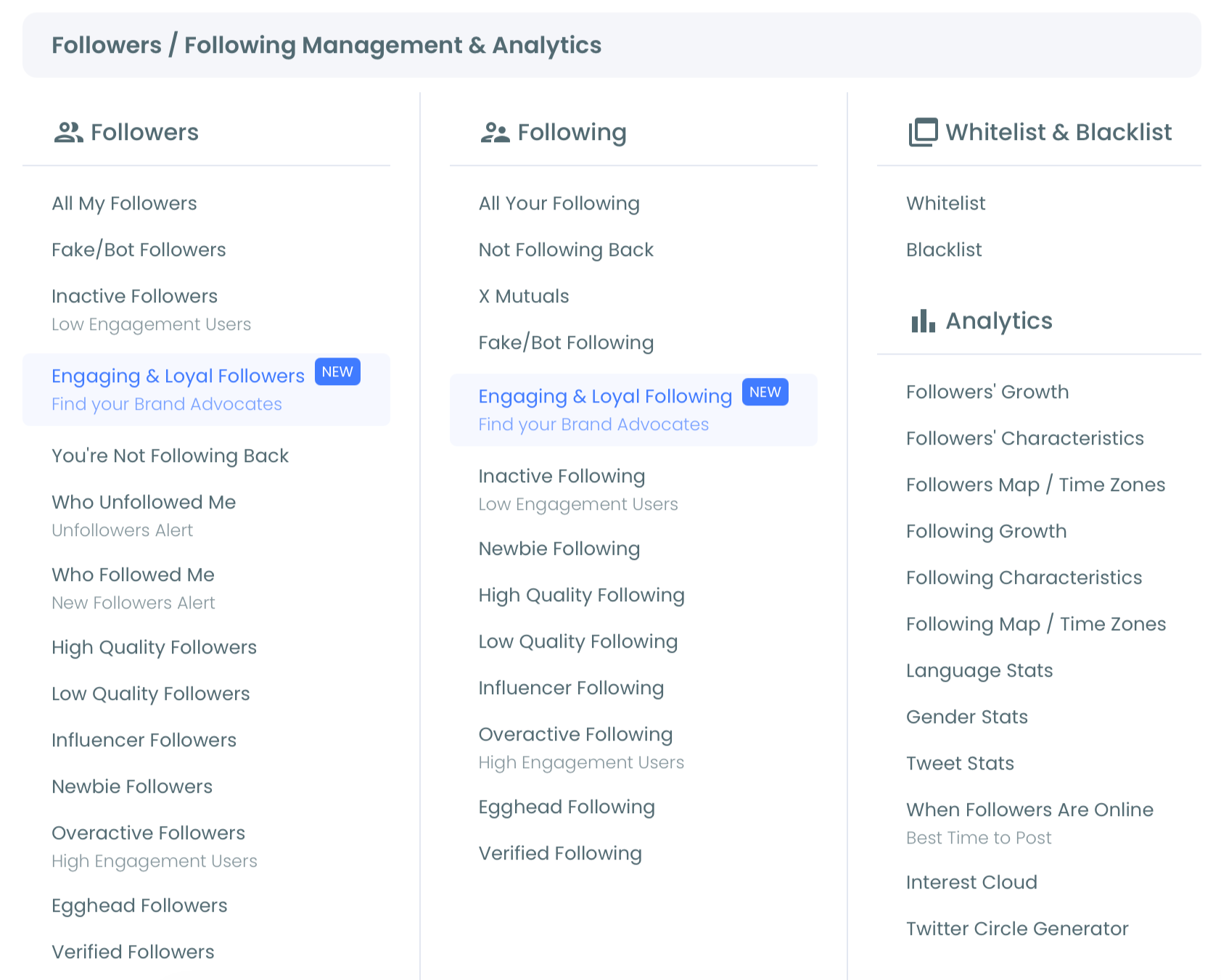
- Open the Follower-Following Management and Analytics menu and click Fake/Bot Followers to load the bot-pattern audit.
Review the scored follower list
- Walk through the flagged accounts by username, bio, follower count, following count, ratio, account age, and lifetime tweet count. The audit pre-scores the followers most likely to be bots at the top of the list, so the review starts with the highest-confidence flags.
Whitelist false positives and proceed
- Mark any account you recognize as a real low-activity follower with the whitelist function, then proceed to the bot-removal action on the remaining flagged accounts.
That ordering is what makes bot detection reliable. The OAuth login earns sanctioned API access. The menu navigation loads the bot-pattern audit. The flagged-list review is where the multi-signal scoring becomes visible per account, and the whitelist step is where false positives get caught before any cleanup runs.
Video walkthrough: the four-step bot-detection audit from OAuth login through whitelist review.
What the Bot Audit Returns and Why It Matters
The audit returns a structured list of follower accounts ranked by bot-pattern score, with each row showing the underlying signals (account age, tweet count, ratio, activity recency). That structured view makes the classification auditable, which is the property most informal bot-detection methods lack. Without the per-account signal view, the cleanup decision is a guess.
The Circleboom workflow runs against the company's official X Enterprise Developer access and stays compliant with X's platform manipulation policy throughout. The compliance layer matters because the platform watches for tools that violate its anti-spam rules, and an unsanctioned detector running at audit scale would risk account-level restrictions on the user running it.
Two adjacent surfaces complement the bot audit. The fake account checker handles the lookup-mode for individual suspicious accounts. The remove-followers cleanup surface covers the action layer once the audit produces a cleanup list.
Pew Research on American Twitter use gives platform-level context on the share of real versus suspicious accounts at the user-population level. X Help's platform manipulation rules cover the platform's own framing of the bot-detection problem and the cleanup-action constraints that apply.
Find bots in your Twitter followers is the workflow that turns the bot question from a guess into a scored list.
Related Circleboom reading on the bot-detection theme:
- Fake followers audit on Twitter on the broader audit-workflow framing.
- Does creating a new Twitter X account eliminate bots? on the new-account angle some operators consider as a reset.
FAQ
How many bots should I expect to find in a typical follower audit?
Most accounts surface 1 to 5 percent of followers as high-confidence bot flags. The share is higher on accounts that have grown through viral content or follow-back campaigns, and lower on accounts that grew through niche-community engagement.
Can the audit produce false positives?
Yes, which is why the whitelist step exists. The most common false-positive pattern is real low-activity accounts that look like bots on one or two signals. The combined-signal scoring reduces but does not eliminate false positives, and the review step is the safety net.
Will removing bot followers help my account's reach?
Yes, mechanically. Removing bot followers shrinks the engagement-rate denominator without changing the numerator, which improves visible rate. The algorithmic effect (better signal density per post) takes a few weeks to surface in feed distribution.
Is the bot audit safe to run repeatedly?
Yes. The audit is read-only until you trigger the removal action, and the API rate limits prevent any unsafe burst behavior even when the removal runs. Quarterly audits are a common rhythm.
Does the audit work on private X accounts?
Yes. The bot-pattern scoring uses public follower-side data, which is visible to the account owner regardless of whether the account itself is public or private.
Why the Multi-Signal Detection Approach Matters More Than Speed
The reason multi-signal bot detection produces useful results where single-signal detection produces noise is that bot operators have learned to optimize against any single bright-line rule. A bot pattern that defeats a one-signal detector still leaves multiple other signals visible, which is the structural property that makes combined scoring robust. The audit does not try to outsmart bot operators, it just looks at enough signals that the combined pattern is hard to disguise.
The practical reinforcement is that the audit produces an auditable cleanup list rather than a black-box "trust me" verdict. Every flagged account in the audit shows the underlying signals that contributed to the score, which is what lets the operator make informed decisions about which accounts to keep and which to remove. Run the bot-detection audit and the bot question moves from speculation to a scored, auditable list.