
Searching a keyword on X gives you a feed. What you usually need is a roster: the accounts saying the thing, each one listed once, with enough profile data attached to decide whether to reply, follow, or ignore. The gap between those two outputs is where most keyword research quietly dies.
What this walkthrough gives you.A live keyword collection anchored to a start date you control.A filter set that removes low-signal accounts before you review anything.A deduplicated account table you can follow, list, or export as CSV.
Circleboom collects matching live posts on X through official API access and extracts the accounts behind them, so the roster builds itself instead of being copied by hand.
→ find accounts tweeting about your keyword
Why your last keyword search did not produce a list
Native search treats every matching tweet as an independent result.
Three posts from the same account are three rows, not one person mentioned three times, and there is no view that collapses them.
That design is fine for reading and useless for building.
The moment your goal shifts from "what are people saying" to "who is saying it," you need deduplication, sortable profile columns, and a way to get the result out of the browser.
Manual collection fills the gap badly.
Copying handles into a sheet works for a handful of accounts and breaks down the moment a conversation gets busy, which is exactly when the conversation is worth watching.
By the time the sheet is finished, the window has usually closed.
A real-time tweet tracker inverts the flow. It collects the posts for you, reads the author off each one, removes the duplicates, and hands back the roster.
The tweets are still there if you want them, but they stop being the deliverable.
Anyone who has pushed X's own operators to their limit already knows where the ceiling is. If you have not, how to use Twitter advanced search maps what the native syntax can and cannot do before you reach for anything else.
How to find accounts tweeting about keyword step by step
See the account table appear: the clip below runs a keyword search on X and ends on the extracted profile list.
https://www.youtube.com/watch?v=OAbQZmQ1z2Q
The process, in order.
Build the search and anchor it to a date
- Open Circleboom Twitter and connect the X account you want to run the search from.
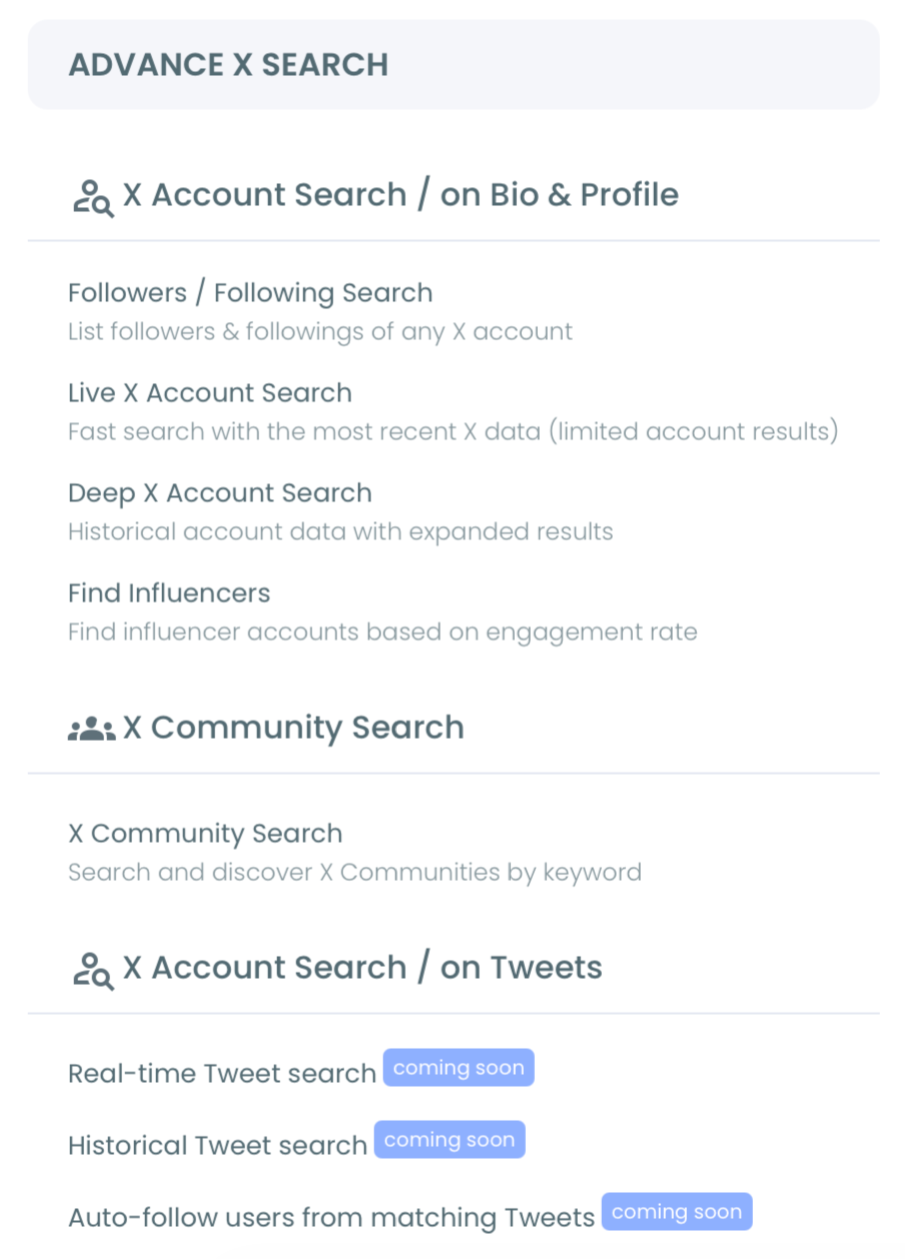
- Go to the Advanced X Search menu and select Real-time Tweet Search, which sits alongside the historical and account-level search features.
- Describe the tweets you are looking for in plain language. The search accepts a normal sentence instead of operator syntax, shows chips summarising how it read your request, and proposes AI-refined variants. Pick a variant or open Advanced Search to set the fields yourself.
- Pick a start date and a tweet count. Last 24 Hours, Last 7 Days, Last 30 Days, and custom dates are all available, and the date you choose is where collection begins rather than where it ends. The tweet count sets how much you collect and how many GetTweetTokens the run spends.
Filter the stream, then pivot to accounts
- Set the filters before you read a single result. Keyword match type shares the Filters panel with exclude terms, language, replies, links, hashtags, cashtags, verified-only, media type, and engagement floors and ceilings. Whatever you pick stays printed in the Active Filters bar, so a thin result never leaves you guessing about the cause.
- Hit "Display Profiles of this search" to change what the table shows. Posts give way to the people who wrote them, and each row now reports join date, tweet count, follow ratio, following count, follower count, and whether the account still shows signs of life. Follow, unfollow, Add to List, and Export sit on every row and run in bulk over a selection.
The sequence works because filtering happens while the data is still cheap to discard. Filter at the tweet layer and you throw away noise once; filter after extraction and you are reviewing accounts that never deserved a row.
Anchoring the start date first is what keeps the whole result current rather than merely large.
What each filter actually changes
Minimum engagement is the single highest-leverage setting. Live conversations attract a long tail of near-invisible posts, and a floor of even a few likes removes most of them without touching the accounts you care about.
Exclude terms handle collisions.
Say the phrase you are chasing also means something else entirely in a hobby community; naming two or three of that community's giveaway words in the exclude field usually clears it out of your results.
Language keeps the list to accounts you can write to.
Replies and links, toggled off, bias the result toward people starting conversations rather than reacting inside someone else's.
Media type narrows to images, video, or text-only when the format itself is the signal.
Circleboom runs this collection as an official X Enterprise Developer, which matters in two concrete ways. The profile fields arrive complete rather than partially guessed, and the connected account never touches an unauthorised endpoint.
Tools built on scraping can promise neither.
X's own developer documentation describes the same underlying capability in its recent search quickstart. It is a useful reference if you want to see what a live query is doing beneath the interface.
With the filters in place, track live tweets by keyword as often as the topic justifies. Saved searches stay in the log, so opening an earlier result again spends nothing.
If you want to narrow further on account attributes rather than post attributes, Twitter advanced search filters covers the profile-side controls that pair with these.
Reading the account table before you act
The profile view is a qualification screen, not just a list, and four of its columns do most of the deciding.
Follow ratio separates broadcasters from collectors.
An account following far more people than follow it is usually indiscriminate, which means a match on your keyword says less about intent than the number suggests. The inverse pattern, far more followers than followings, means a reply from that account carries reach.
Join date flags freshly created accounts. A cluster of accounts opened in the same recent month, all posting the same keyword, is a pattern worth pausing on rather than following.
Tweet count separates dormant accounts from active ones. An account with a handful of posts total is not going to see your reply, however well its single matching tweet fits your search.
The active or inactive classification is the fastest filter of the four.
It is a computed signal rather than a platform label, so treat it as a strong hint rather than a verdict, but a list sorted by it puts the reachable accounts at the top immediately.
Sort before you scroll. Every column header in the table sorts on click, so a long result list collapses into a workable shortlist in two clicks, without opening a single profile.
The inline search bar adds one more pass worth knowing about. It searches across name, username, and account bio, so an account whose bio contains your term will surface even when its matching tweet was ambiguous.
That is a useful second signal: a keyword in the tweet says what someone is doing today, and the same keyword in the bio says what they do generally.
Two accounts can match the same keyword for completely different reasons, and the table is where that difference becomes visible before you spend a follow on it.
Is a live keyword search safe for my X account?
Yes, when the collection runs through official API access and the actions you take afterwards are paced.
Reading public posts is not the risky part.
The risk lives in what you do with the account list: following two hundred people in a burst looks nothing like normal behaviour, and X's platform limits apply to your account regardless of which interface issued the request.
Bulk actions are processed gradually for exactly that reason.
Auto Follow deserves a specific warning.
Pointed at a live keyword stream, it keeps following every account that matches for as long as the stream runs, which is powerful when the filters are tight and expensive when they are not.
Set engagement minimums and quality filters before you enable it. The keyword-safe alternative to Twitter auto follow walks through the guardrails worth having in place first.
Three habits keep a live workflow clean:
- Review the tweet view before acting on the profile view, so you can see why each account matched.
- Add uncertain accounts to a list instead of following them, then decide later.
- Export early, because live posts can be edited, deleted, or made private within minutes.
When a live search beats a historical one
Choose by how long the signal stays useful, not by how much data each returns.
A live search is right when the window is short and the context is shared: an outage, a launch, a conference, a piece of news moving through your industry.
Reaching someone while they are still in that moment is a different conversation from reaching them a month later, and the account list only has that property if it was collected during the moment.
A historical search is right when the pattern matters more than the timing. Finding everyone who complained about a category of software over the past year is an archive question, and search Twitter history is the flow built for it.
Running both on the same keyword answers a question neither answers alone: whether today's spike is genuinely new or the fourth repeat of something seasonal.
Teams that watch several keywords continuously usually pair this with one of the best social media monitoring tools for the standing view, and use live search when something specific breaks.
Keyword coverage on X is not limited to plain words either. Hashtags behave as their own collision-free strings, and following a hashtag on Twitter is worth reading if event tags are a large part of what you track.
A third case sits between the two. When the keyword is your own brand or product name, what you want is neither a one-off live collection nor an archive sweep, but a watch that never stops.
That job belongs to track Twitter mentions. Running a live keyword search on top of it is what you do when one mention starts moving faster than the rest.
What to do next
Pick the branch that matches your situation.
If a moment is live right now, set the start date to when it began, cap the collection small, filter for minimum engagement, and pivot to profiles before the conversation cools.
If you are setting up an ongoing watch, define the keyword narrowly, run a 24-hour test collection first, and only widen the window once the sample looks clean.
If the deliverable is a list for someone else, run the search, export the profile view as CSV, and check your token balance before the export rather than after.
Accounts worth keeping can also go into a Twitter List Manager group, so the result survives past the campaign and stays reviewable after the moment ends.
Whichever branch applies, the keyword is only the doorway. The account list is what you came for.
One habit is worth carrying into all three branches: write down the exact keyword, exclusions, and start date you used.
A live result is not reproducible later, because the conversation it captured has already moved on, and the search parameters are the only record of what you were actually looking at when you built the list.
→ Launch a real-time keyword search on X
What to know before your first live keyword search
How many tokens will one search cost me?
Tokens are spent in proportion to the tweets collected, and the balance is shown while you set the search up. Export spends tokens separately from collection, so budget for both if you intend to download the result rather than read it on screen.
What happens if my token balance runs out mid-collection?
The search stops at that point and the partial results are saved. Nothing is lost, and the result you did collect stays accessible in your search log.
Can I search a phrase exactly rather than loosely?
Yes. Keyword match type offers exact phrase, contains, and partial matching, so a multi-word product name can be locked down instead of being broken into separate words.
Do the engagement numbers keep updating after collection?
No. Likes, retweets, and impressions are captured at retrieval time and will drift as the conversation continues, so treat them as a snapshot taken at collection rather than a live counter.
Will a protected account show up if it used my keyword?
No. Only public posts from public accounts are returned. Protected, private, and restricted accounts stay out of both the tweet view and the profile view.