

X indexes five things about a person that you can search against: the display name, the @handle, the words in the bio, the location typed into the profile, and the text of their public posts. An email address is not one of the five.
That single gap explains why the last hour you spent pasting an address into "reverse lookup" pages produced nothing you could trust. It also points straight at the method that does work.
Can you find a Twitter profile by name or email?
By name, yes. By email, no. Circleboom searches X display names, bios, and post keywords through official X Enterprise APIs and hands back a filterable list of real accounts, while no compliant tool converts an email address into an X handle, because X never published that mapping.
→ find a Twitter profile by name or email
Can you find someone on X with just their email address?
No. The reason is structural, not temporary.
X treats an email address and a phone number as account credentials and contact-matching keys. They are not public profile fields, they are not returned by any public endpoint, and there is no search box anywhere on the platform that accepts one.
The only place an email address does anything discovery-related is the contact-upload path, and that path runs in the opposite direction from what most people assume.
Here is the actual mechanism. If someone has switched on the discoverability toggles in their privacy settings, and you already have their address saved in your own address book, and you upload that address book to X, then X may suggest their account to you.
X documents both halves of that in its guidance on how to control who can find you on X. Two limits follow immediately.
The match only fires on contacts you already hold. And it is opt-in, so a person who left those toggles off stays invisible to it no matter what you upload.
That is a directional match against your own address book, not a lookup. You cannot type a stranger's email into anything and get a handle back.
What the "reverse lookup" services are actually selling
Almost every page ranking for this question sells you around that fact instead of stating it. Several of the tools you will find sit on scraped or brokered contact databases assembled outside X entirely.
That is a different product with different accuracy and a different legal posture, sold under a headline that implies X answered the query. It did not. A service that claims to resolve an arbitrary email to an X account is guessing from data X never handed over, and you have no way to check the guess.
So the practical move is to stop treating the email as a search key and start treating it as context. You almost always know more about the person than the address itself, and everything else you know is searchable.
That is what the Twitter Account Finder is built to work with. If you are early in the process and still mapping options, the walkthrough on how to find someone on Twitter covers the ground-level tactics before the tooling.
What X actually indexes, and in what order
Rank your identifiers before you run a single search. The person you are looking for has left a specific set of traces, and those traces are not equally findable. Working down the list in order saves the two hours most people lose to trial and error.
- Full display name plus one qualifier. Strongest input by far. "Sarah Chen" is hopeless alone; "Sarah Chen" plus "oncology" or "Denver" resolves fast.
- A phrase you know sits in their bio. Job title, company name, credential, hometown. Bios are short, so the words in them are high-signal.
- A topic they post about repeatedly. Historical post text is indexed, so someone who has written about a niche for years is findable through it.
- Location. Weak alone, strong as a filter layered on the two above.
- Email or phone. Not indexed. Useful only as the thing that tells you which name and employer to search for.
The ladder is the part most guides skip. They hand you a list of tools and leave you to work out which input to feed them.
Notice that the top of the ladder is not more technical than the bottom, it is just more public. Everything X will help you find is something the person chose to publish about themselves.
Published identity is verifiable, brokered data is not
Searching on published identity rather than private contact data also makes the outcome verifiable.
You can open the profile, read the bio, check the join date, and decide whether this is the person you meant. A brokered email match gives you a handle and nothing to check it against. Most of the mistakes people make while performing a Twitter search trace back to that same root: starting from the wrong input and then trusting the output.
If bio text is your strongest lead, Circleboom's search Twitter bios and profiles page is the narrower entry point for that exact query shape.
One more thing the ladder buys you: a fallback order. When the full name returns nothing, you drop to the bio phrase. When the bio phrase returns nothing, you drop to the topic they post about. Each rung is a real attempt rather than a repeat of the failed one, which is why the process ends instead of looping.
How to find a Twitter profile by name or email, step by step
Circleboom is an official X Enterprise Developer company. Every account it returns comes from sanctioned API access rather than a scraped index, and every profile field you read is the live value at retrieval time.
That distinction is the whole reason a name search beats an email guess. You can act on what you see.
When you search for an X profile by name, the follower count, the join date, and the bio in front of you are the current ones. The decision to reach out or move on is made on facts, not on a database someone assembled two years ago.
Short demo: what an X account search returns when the only thing you hold is a name and the topic that person works in.
https://www.youtube.com/watch?v=MSzX_EGGReg
The flow, in order.
Connect your account and open the search menu
- Log in to Circleboom Twitter and connect your X account through official OAuth.
- Open the Advanced X Search menu from the left sidebar of the dashboard.
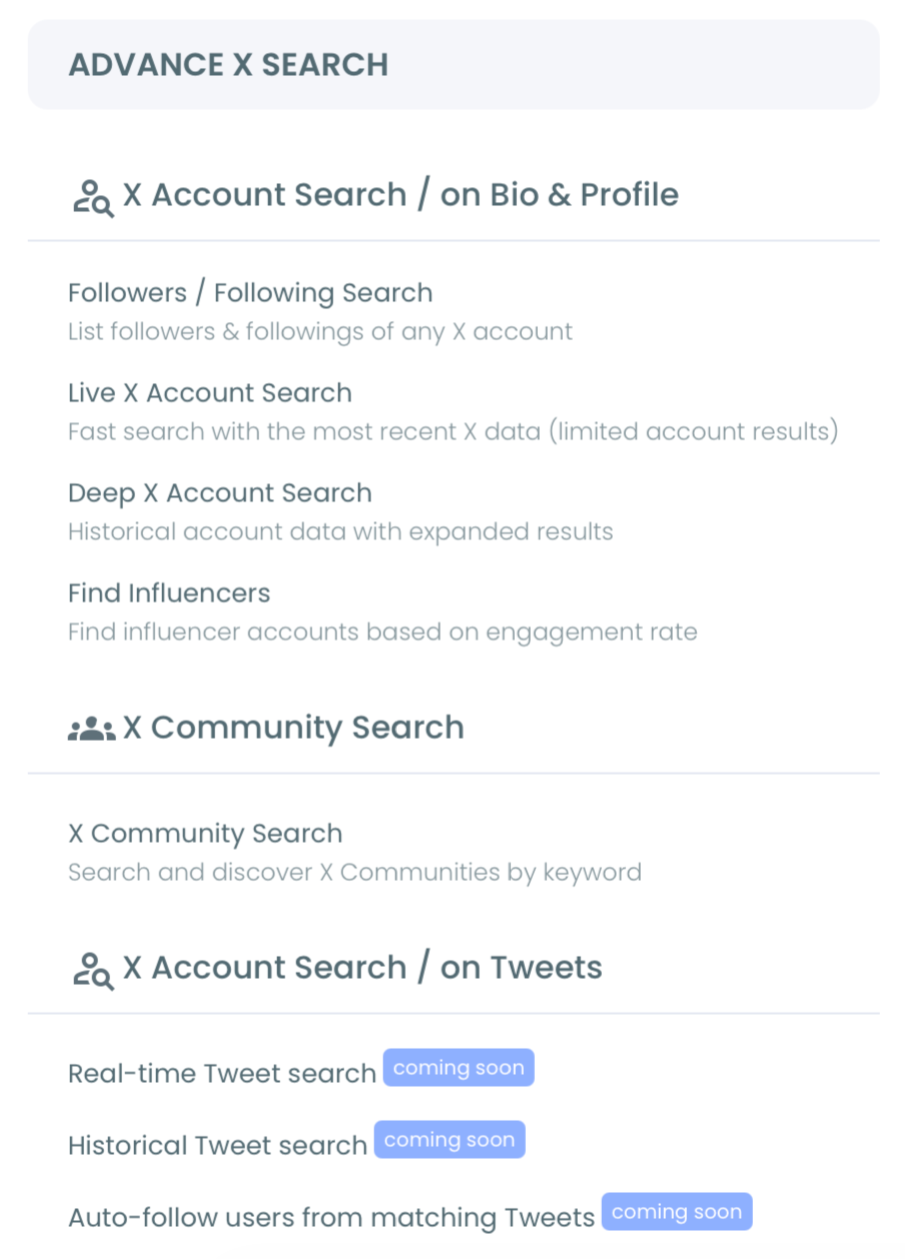
Search the fields X does index
- Pick live account search when the person is currently active around a topic, or deep account search when you need the fuller historical set. Deep search reads bios and older post history and returns up to 5,000 accounts per query, paginated across as many as 50 pages.
- Enter the strongest identifier from your ladder. A full display name, an employer plus a role, or a phrase you are confident appears in the bio. Run two or three wordings rather than one; people describe themselves inconsistently, and "founder," "co-founder," and "building" pull different sets.
Narrow the results to one person
- Open Filter Options and apply what you already know. The panel gives you follower count, following count, tweet count, follow ratio, join-date range, verification status, and a free-text location field, and all of them combine with AND logic.
- Layer a second term through the Find in Bio and Name field on the results screen, then open the profiles that survive both passes and confirm against something you can verify.
That ordering holds up because each step trades breadth for certainty in the right direction. The login earns official API access, the identifier choice sets the widest honest net, and the filters cut the set down using facts you already have rather than facts you are hoping for. Reverse the order and you end up filtering a result set that never contained the right person.
Quick recap:
- Connect the account through official OAuth.
- Open the advanced search menu.
- Choose live or deep by whether recency or coverage matters more.
- Search the name, the employer, or the bio phrase.
- Filter by location, join date, and follower range.
Where a name search still comes up empty
Some people are genuinely not findable, and knowing which case you are in stops you wasting a second afternoon.
A protected account never appears in results, because only public profiles and public posts are returned. Someone posting under a handle unconnected to their legal name, with an empty bio and no location, has left nothing to match on.
An account dormant for years may also sit far enough down a live search that only a deep historical query reaches it. Circleboom's Twitter account lookup is the better tool once you have a candidate handle and want the profile detail behind it.
One boundary worth stating plainly. These methods are for reconnecting with someone, checking that a business contact's account is real before you reply to it, or building an outreach list from people who publish openly about their work.
They are not for finding someone who has chosen not to be found. A protected account, a scrubbed bio, and discoverability toggled off are three deliberate signals, and the right response to all three is to stop searching.
The lateral route when the direct search fails
If you know one account the person almost certainly follows, a professional body, a conference, a former employer, search that account's follower list with your filters applied rather than searching the platform at large. The pool shrinks from hundreds of millions to a few thousand, and a common first name stops being a problem.
That approach also works in reverse when you have a candidate but no certainty. Look at who the candidate follows. A cardiologist in Lisbon follows a recognisable set of medical accounts and Portuguese-language ones, and a namesake in software follows neither. The follow graph is public and it confirms identity faster than the bio does.
When the display name is common, the fastest disambiguator is a bio phrase rather than a better name. Two people share "Sarah Chen," but only one of them has "pediatric oncology" sitting in a 160-character bio, and that phrase is indexed. The deeper treatment of that query shape lives in the best way to search Twitter bios and profiles.
What changes once you stop chasing the email
The workflow gets shorter and the result gets verifiable. Instead of feeding one address into six services and comparing three contradictory answers, you run one search against fields X publishes, then confirm the match by reading the profile.
There is a second gain that shows up later. A name-and-bio search does not return one person, it returns a set, and the set is often more useful than the individual you started with.
Looking for one supply-chain analyst usually means you want to know the other forty in the same niche. That result is filterable, exportable to CSV, and can be pushed straight into an X List for ongoing monitoring, which turns a one-time lookup into a standing view of a segment.
That is the shift worth keeping. The email was never going to find one person, and the bio search finds the whole category that person belongs to, so you pick from it.
Sharpening the query matters more than picking a different tool. The walkthrough on performing a Twitter user search the right way is the better next read for that.
The time saving is real but secondary. The durable change is that your answer now has a profile attached to it, and a profile is something you can read, question, and reject before you spend anything on it.
The cost of guessing
Skip the ladder and you pay twice. First in time, feeding an email address into services that return a handle they cannot substantiate.
Then in credibility, when the outreach message lands on an account belonging to a different person with a similar name, and the contact you actually wanted hears about it secondhand.
A name-and-bio search costs a few minutes and produces a profile you can read before you act on it. That is the entire trade. X's own guidance on finding people points at the same fields, and Circleboom runs them at scale with filters attached.
→ Find someone's X account by name
What to know before you search
What if the person's display name is really common?
Add a second axis rather than a better name. Location, join-date window, and a bio keyword each cut a large result set down fast, and the filter panel combines them with AND logic so three weak signals become one strong one.
Is it safe to run searches like this on my X account?
Yes. Searching reads public profile data through official API access and changes nothing about your account. The rate-limited operations are the follow and unfollow actions you might take afterward from the results screen, and those are paced deliberately.
How many accounts does one keyword search return?
A live search returns a smaller, recency-weighted set, usually enough for a quick shortlist. A deep search returns up to 5,000 accounts per query across as many as 50 pages, which is the right choice when you would rather over-collect and filter down.


)
