
To filter your Twitter following by country, load the accounts you follow into a structured table and apply a location filter that reads the profile-location field on each account. That single move turns a scrolling list into a country-segmented dataset you can sort, export, and act on.
The catch most guides skip: the location field on X is whatever the user typed, so the filter is a starting point, not a verified border.
That distinction matters more in 2026 than it used to. X now shows an automatic country label on profiles, and that label has been visibly inconsistent for older accounts.
Self-entered bio locations are no more reliable. So the smart way to filter your Twitter following by country is to treat location as one signal you combine with others, not a fact you trust blindly.
To filter your Twitter following by country, Circleboom pulls your full following list from X through official, sanctioned API access and lets you segment it by the profile-location field, then sort, whitelist, or export any country group. It reads the bio-location text each account entered, so you build a real geographic view of who you follow instead of guessing from memory.
→ filter your Twitter following by country
Keep reading for the exact filter path and the accuracy caveat that changes how you use it.
Why Filtering Your Following by Country Is Worth the Effort
Your following list quietly shapes two things: the feed you read every day and the public network you signal to anyone who visits your profile. Both drift by geography over time.
You follow local journalists during one campaign, regional creators during a market push, and event accounts from a conference in another country, and none of them ever get reviewed again.
A country segment surfaces that drift in seconds. Maybe you are a brand shifting focus to a new market and want to see how many accounts you follow are actually based there.
Maybe you are cleaning up a feed cluttered with accounts from a region you no longer cover.
Either way, the manual path is brutal. X gives you a reverse-chronological following list with no country grouping at all, so you would open hundreds of profiles one by one to read each bio location.
Circleboom removes that manual grind entirely. As an official X Enterprise Developer company, it retrieves your complete following list through sanctioned channels and hands you a filterable table.
Segmenting by country becomes a text-field search instead of an afternoon of clicking.
If you want the same geographic split as a visual, the Twitter Followers and Friends Map plots where your network sits on an actual map.
The Accuracy Caveat No One Mentions
Here is the insight that changes how you should use any country filter: X never verifies where an account is really based. The profile-location field is free text, so someone in Berlin can type "New York," leave it blank, or write a joke.
Even X's own automatic location label proves the point. Rolled out in late 2025, it shipped with acknowledged errors for older accounts and accounts created through a VPN, according to TechCrunch's reporting on the About This Account feature.
If the platform itself struggles to pin down location, a bio field certainly will.
What that means in practice is simple. A location filter catches accounts whose bio text matches your search term. It cannot catch an account that hid its location or wrote something vague. So a country segment is a strong lead, not a census.
The fix is to layer signals. Combine the location filter with follow ratio, tweet language, join date, or engagement level, and the group you end up with is far more trustworthy than location alone would give you.
A handful of weak signals stacked together beats one signal treated as gospel.
This is also why a country filter is a screening tool, not a verdict. Use it to surface candidates worth a closer look, then confirm with the accounts that actually matter before you unfollow or reorganize anyone.
How to Filter Your Twitter Following by Country with Circleboom
The flow below reads your bio-location field across the whole following list and returns a clean country group. It runs entirely through official access, so nothing here risks your account.
You can segment the accounts you follow by country in about the time it takes to read this section.
Open Circleboom and connect your X account
- Log in to Circleboom Twitter and connect your X account with official OAuth.
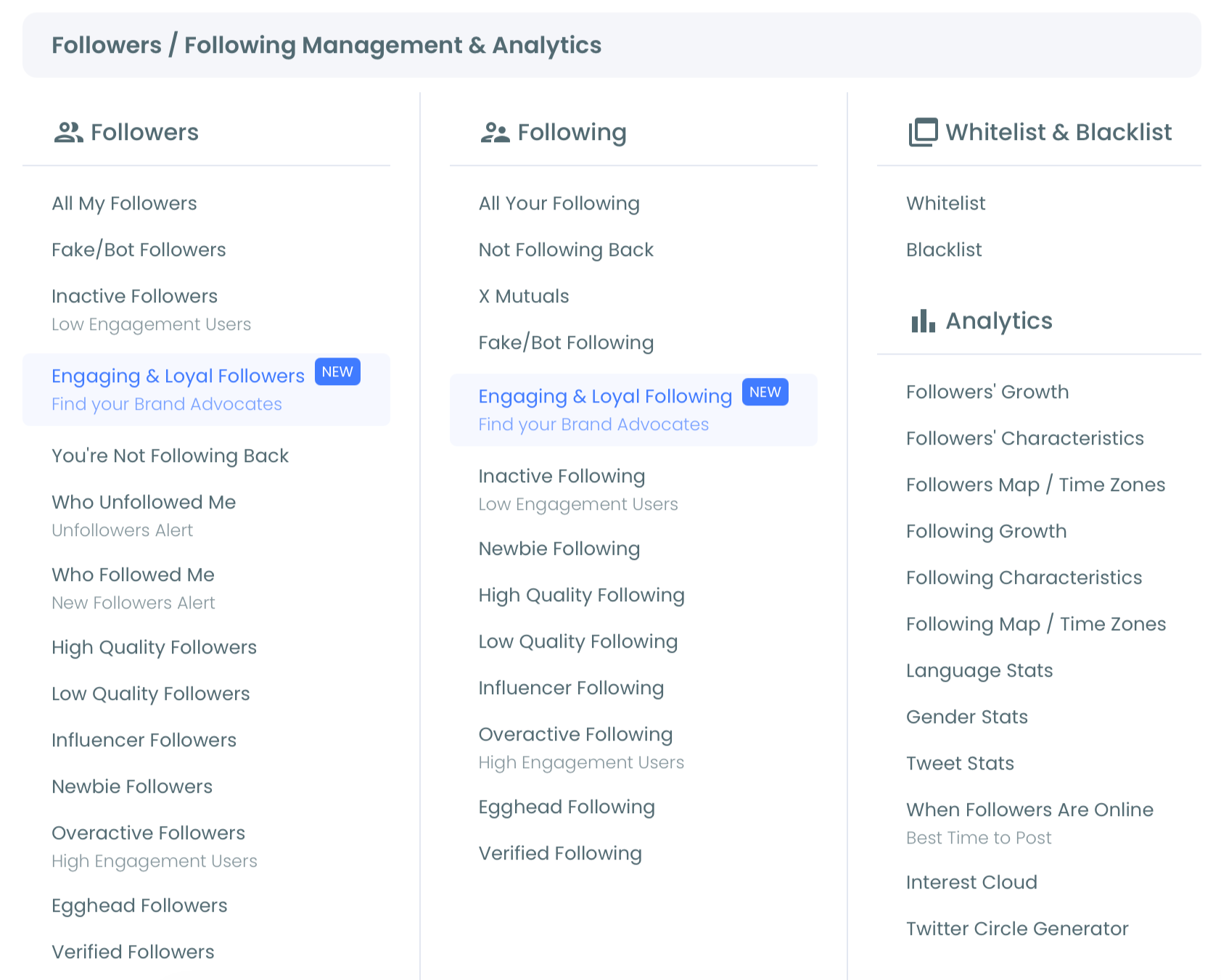
- Open the Follower and Following management menu where your audience tools live.
Build and refine the country segment
- Select All My Following to load every account you currently follow into the table.
- Open Filter Options and type a country or city into the Filter by Location field, for example "Canada" or "London," to narrow the list to matching profiles.
- Stack a second filter for confidence, such as tweet language or follow ratio, so the segment reflects more than one self-entered field.
- Sort, whitelist, or export the country group you built, or send valued accounts to a Twitter List for ongoing monitoring.
That order works because it earns official access first, loads the complete dataset before you narrow it, and layers a second signal on top of the unreliable location text so the final group actually holds up. Skip the second filter and you inherit every blank or joke bio in your results.
See it visualized: how your following spreads across countries on a live geographic map inside Circleboom.
What You Gain From a Country-Segmented Following List
A country view converts a vague sense of "I follow people everywhere" into a decision you can act on. You see exactly how much of your network sits in your target market and how much is legacy follows from regions you have moved on from.
From there the options open up. You can whitelist the local accounts you never want to lose, move regional sources into a dedicated Twitter List, or export a country group to CSV for a campaign brief or CRM.
If your interest is the follower side rather than the following side, seeing your Twitter followers by country works the same way. The follower demographics report then turns those numbers into a dashboard you can revisit.
The deeper payoff is strategic clarity. Marketers chasing a regional audience often assume their network already reflects that focus. A country filter tests the assumption directly, and the answer is frequently a surprise.
It is the same reason you might filter your X followers by follower count to weigh reach by region rather than raw numbers.
A full Twitter friends demographics breakdown then rounds out the geographic picture beyond country alone.
Each filter answers a question native X leaves you guessing about. You can find influential Twitter users within a specific region once you know where your network sits, or weigh gender alongside geography with the gender demographics report.
The Bottom Line
Filtering your Twitter following by country takes a self-entered location field, groups your entire following list around it, and gives you a geographic map of who you actually follow, all through safe, sanctioned API access. Treat the result as a strong lead rather than a verified border, stack a second signal on top, and you get a segment you can trust enough to act on.
Ready to see where your network really sits? → start segmenting your Twitter following by country
Common Questions About Filtering Following by Country
Is the country data on X accurate enough to trust?
Not on its own. X never verifies an account's real location, and the profile-location field is free text the user typed, so a country filter only catches accounts whose bio matches your search term.
Combine it with tweet language, follow ratio, or engagement level for a group you can actually rely on.
Can I unfollow or organize accounts after I filter by country?
Yes. Once you have a country segment, you can unfollow the group in bulk, whitelist accounts you want to protect, or add them to a Twitter List.
Unfollow actions run through official API access at safe, rate-limited speeds, so your account stays compliant with X's rules.