
Take a following list of 3,000 accounts. If a fifth of them have gone quiet since the day you followed them, that is 600 dead entries shaping what your timeline serves you, and the Following tab will not tell you which 600.
That is the case for pulling the list out of X entirely.
Scrolling ranks accounts in an order X chooses. A file lets you rank them in an order you choose, and the ranking is the entire point.
How do you export the list of accounts you follow on Twitter?
Circleboom pulls the full following list of any public X account over the official X API and writes it to CSV, one row per account, carrying account age, follower and following counts, and quality flags. That file is the segment the Following tab will not hand you.
→ Check your Twitter following list export
How I export my Twitter following list, step by step
Seven steps, and two of them are the ones people rush.
Open the account whose following list you want on file
- Log in to Circleboom, connecting whichever X account will be running your exports.

- Go to the Essential Toolbox menu.
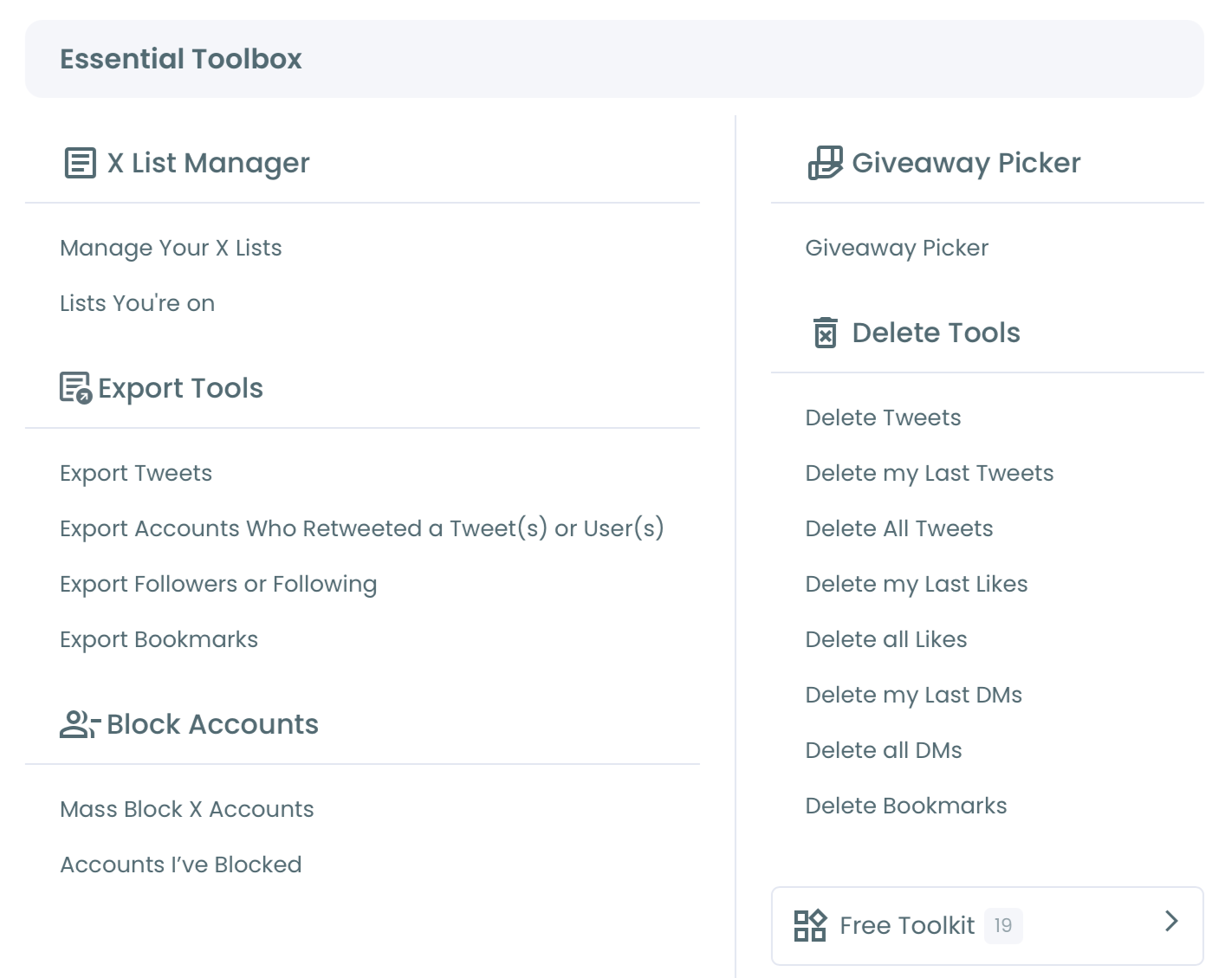
- Open Export Tools, then select Export Followers or Following, the sub-menu built for account lists rather than posts.
Confirm the account before you spend anything
- Put a public X username in the search box. Back comes a profile preview card carrying display name, bio, days on Twitter, and the following, follower, and post counts.
- Read the remaining token balance printed on the page. Export cost scales with how many accounts sit in the list, so a 400-account following list and a 40,000-account one are not the same charge.
Choose following, not followers, and take the file
- Select Export Following rather than Export Followers. The two buttons sit beside each other and produce opposite datasets.
- Click Export. Tokens are consumed and the CSV is generated for download.
That order holds because two of the steps commit you to something.
The username decides whose network you are about to study, and the balance check decides whether you can afford the list before you spend anything on it.
Confirm both against the preview card and the export runs once instead of twice.
Quick recap: log in, open Essential Toolbox, pick Export Followers or Following, confirm the username, read the balance, choose Following, export.
Screen recording: where the Export Following button sits relative to Export Followers, and what the preview card shows before either one runs.
https://www.youtube.com/watch?v=aHwKj1qtwr8
What the Following tab hides that a CSV does not
The Following tab is a scroll, and a scroll has no memory. You cannot sort it, you cannot filter it, and you cannot compare today's version against last quarter's version, because there is no version. There is only what loads when you open it.
That limitation is why so many people end up hunting for a Twitter following list viewer rather than reading their own list directly. The view is the workaround for a list you cannot hold.
X does keep a copy of the relationship. Request your X archive and the zip includes a list of accounts that you are following, alongside your posts, your media, and your direct messages.
But an archive is an errand. You request it, X prepares it, and you wait for the notification.
The archive answers "who am I following." It does not answer "which of them still matter."
That second question is the one that changes behavior, and it needs a row per account with something on the row worth sorting by.
So I stopped treating the export as a backup and started treating it as the first move of an audit.
Before I unfollow anyone, I want the whole list on disk, in a format that survives the cleanup. You can start from the export Twitter following list screen, the same one you would use to export followers.
Why Chrome extensions only capture what loaded
The browser add-ons people reach for instead are a fair comparison to make. A round-up of Twitter following export Chrome extensions shows the shape of that market clearly enough.
They read the rendered page. So they collect whatever the page happened to render, and nothing that was never on screen.
The sixteen fields that make a following list sortable
Every row in the file carries sixteen columns, and roughly half of them are the ones that do the work.
The identity block is what you would expect: ProfileId, Username, Name, Location, and Bio. The metrics block gives you CountTweets, CountFriends (their following count), CountFollowers, and CreatedAt, the full account creation timestamp.
Then the part that separates this file from a handle dump:
- IsInactive, the flag for accounts that have stopped posting.
- IsFake, Circleboom's quality signal for accounts that read as manufactured.
- IsEgghead, the flag for accounts with no profile photo.
- IsOveractive, for accounts posting at a volume that will bury everyone else in your timeline.
- IsVerified and IsProtected as booleans, plus Verified_Type, holding blue, business, government, or none.
The column that ends the audit early
IsProtected is worth a second look, because it is the same wall described from the inside in whether a protected Twitter account hides your following list. A locked row in your file is a row you can read but never audit further.
Those flags grade the accounts you chose. That is the difference nobody mentions.
Follower exports get all the attention because they look like audience research. Your following list is not audience data at all.
It is a record of your own attention, decision by decision, going back to whenever you opened the account. The flags let you see which of those decisions aged badly.
Circleboom is an official X Enterprise Developer company, and it retrieves the list through official API access rather than by reading the rendered page. That is why the flags arrive attached to the row instead of being guessed from a profile screenshot.
The same signals drive Circleboom's Twitter follower quality and following quality views inside the app. The export is what lets you take them somewhere the app cannot follow, which for most teams means a spreadsheet, a CRM, or a client report.
Open the Twitter following list downloader once and you will see the sixteen columns land in one file rather than sixteen separate lookups.
What can you actually do with a following list CSV?
Four things, and they are worth naming because the file has no value until one of them is decided.
Sort by IsInactive and you have a prune list. Filter to the accounts that no longer post, review them in the spreadsheet, and only then act.
That review order matters more on the following side than the follower side, because unfollowing is a decision you made in reverse, and X notices patterns in it.
Sort by CreatedAt and you have an account-age view. It is the same signal behind building a Twitter following list with accounts created before 2020. The difference is that you are applying it to a list you already have rather than one you are constructing.
Filter by CountFollowers and you have a shortlist of the larger accounts in your network. That shortlist is what I work from when deciding who belongs in Twitter List Manager for closer monitoring.
Or compare two exports taken months apart, which is the only way to prove the composition changed rather than assume it did.
The pair of exports that actually proves something
One export tells you what your following list looks like now. Two exports, taken far enough apart, tell you what you have been doing.
That second thing is harder to get and worth more.
Run the export, date the filename, and put it somewhere you will find it again.
A quarter later, run it against the same account and open both files side by side.
The comparison is a spreadsheet job, not a Circleboom job, and that is fine, because a CSV is exactly the format that makes it a spreadsheet job.
What the pair shows you is composition drift. Not "my following count went from 3,000 to 2,700," which the profile already tells you, but which flags moved.
If the IsInactive share fell while the raw count barely changed, your pruning worked and your new follows were live accounts. If IsInactive held steady while the count dropped, you removed the wrong 300.
A count tells you the size of the list. A pair of exports tells you the quality of your judgment.
There is a second use for the pair that has nothing to do with self-improvement. If you manage X accounts for anyone else, the before-and-after files are the evidence that the cleanup happened and did what you said it would.
Client reports built on a screenshot of a follower count are arguments. Client reports built on two dated CSVs are records.
Where a following list export goes wrong
Three failure modes, and all three are about expecting the file to be something it is not.
The row count can come back lower than the number X shows. The API hands long lists over in batches, so the file records whatever the retrieval window returned before it closed. On an account following a few thousand this never arises.
On an account following six figures it does, and what you are reading is paging behavior rather than a failed run.
Protected accounts are not accessible. A locked profile puts its lists out of reach entirely, and following the account yourself does not change that.
The file is a snapshot, not a feed. Every value in it, bios, follower counts, quality flags, reflects the state at retrieval time. Follow relationships that change after the export will not appear in the downloaded copy.
An export from four months ago will confidently tell you about accounts that have since gone dormant, changed handles, or unfollowed you back.
I treat anything older than a quarter as a historical record rather than a working file.
The manual alternatives break down on the same point. People who try to scrape a Twitter following list end up with a stale, partial file and no flags on it, which is the worst of both options.
One last thing before you unfollow anything
The export is cheap. Deciding what to do with it is the part that takes judgment, so here is the short version of what has worked.
- Export the whole following list before any cleanup run, not after.
- Sort by IsInactive first, because it is the flag with the clearest action attached.
- Check CreatedAt on anything you are unsure about, since a new account with a large following is a different risk than an old one.
- Date the filename, because two exports three months apart are worth more than either one alone.
- Re-run the export after the cleanup so the before-and-after pair exists.
None of that works without the file. You can kick off your export of accounts you follow on X and have the CSV in hand before you decide anything.
What to know about the edge cases on the following side
Can I export someone else's following list, or only my own?
Any public X account works, not just your own. You type the username into the search field, confirm the preview card, and export their following list the same way you would export yours. Protected accounts are the exception, since the API will not return their lists at all.
Does exporting my following list change anything on my account?
No. The export is a read operation. Nobody is followed, unfollowed, or notified, and the accounts in your list have no way of knowing the file exists. The only thing that changes is your token balance.
Why is the number in my file different from the number on my profile?
Two reasons, usually. Long lists are assembled from several API pages, so a big account's file can finish with fewer rows than the profile advertises.
And the profile number is live while the file stopped updating the second the retrieval ended, so any follow or unfollow after that point is invisible to the CSV.