
X hands you no bulk delete for direct messages.
You can remove one conversation at a time from the inbox, and that is the entire toolkit, which turns a years-old message history into an afternoon of clicking.
The gap bites hardest at the exact moment you need speed: an account handover, a privacy reset, a sudden reason to stop storing old conversations on a platform you no longer control.
How do you erase all your Twitter messages at once?
Download your X data archive, upload the direct-messages.js file to Circleboom, then confirm the delete. Circleboom clears your entire Twitter DM history from that file, including conversations far older than the 30-day window the API alone can reach.
→ erase all Twitter messages
Why X gives you no button to erase all Twitter messages
The inbox is the one area of an X account that fills up with no management layer over it at all.
Every conversation you ever opened stays there: inbound pitches, expired partnerships, old customer threads, strangers who messaged once in 2019.
X provides no bulk delete, no archiving, no expiry, and no folders. It provides a three-dot menu on one conversation at a time.
The scale problem is easy to picture without exaggerating it.
If your account opened years ago and you exchanged messages with even one new person a week, the inbox now holds several hundred separate threads, each needing its own menu tap and its own confirmation.
That is why people reach for a tool to clear your entire X message history rather than working through the native interface.
It is also why the same readers usually want to delete your digital footprint in the same sitting. DMs are one of several stores of old account data, and clearing them alone leaves the others in place.
There is a second constraint underneath the first one. The X API only exposes direct messages from the last 30 days, so any tool working through the API alone can never see, and therefore never delete, the conversations that predate that window.
Recent cleanup and full-history cleanup are two different jobs with two different data sources.
What erasing your Twitter messages actually removes
Deleting a DM conversation removes it from your inbox only.
The other person keeps their copy, and they are not notified that you deleted anything. X states this plainly in its own Direct Messages help documentation: a deleted message or conversation is deleted from your account, and others in the conversation still see it.
Most articles on this topic mention that in a footnote. It deserves a map, because there are four separate places your messages live and a bulk delete touches only some of them.
Your inbox. Cleared. Every conversation matching your filters disappears from your side, and the threads stop loading in the messages tab.
Their inbox. Untouched. This is X platform behaviour and no third-party tool can change it, including Circleboom.
The archive ZIP on your computer. Still complete. The file you uploaded is a full transcript of everything you just erased, sitting in your downloads folder in plain readable form.
A future re-upload. Still usable. Circleboom removes already-deleted items before applying filters, so you can upload the same file again in a later session with different filter settings and it will not try to re-delete what is gone.
Your downloaded archive is now the sensitive file
That third row is the one nobody warns you about, and it inverts the usual advice. The moment the delete finishes, the downloaded archive stops being a backup and becomes the only surviving copy of that history on your side.
Encrypt it, move it off the machine, or destroy it deliberately once your filtered passes are done.
Treat the archive ZIP as the sensitive artifact, not the inbox you just emptied.
If you want a readable record rather than a raw dump, run the Twitter DM downloader route first. Keep the export somewhere deliberate, then clear the inbox.
How to erase all Twitter messages with Circleboom, step by step
The upload step and the confirmation modal, recorded start to finish.
https://www.youtube.com/watch?v=vz_jyYJ3msU
The process runs in three stages: connect the account, get the archive file into your hands, then scope the deletion before you confirm it.
Connect the account and open the delete tools
- Open Circleboom Twitter Management and connect the X account whose inbox you want cleared.

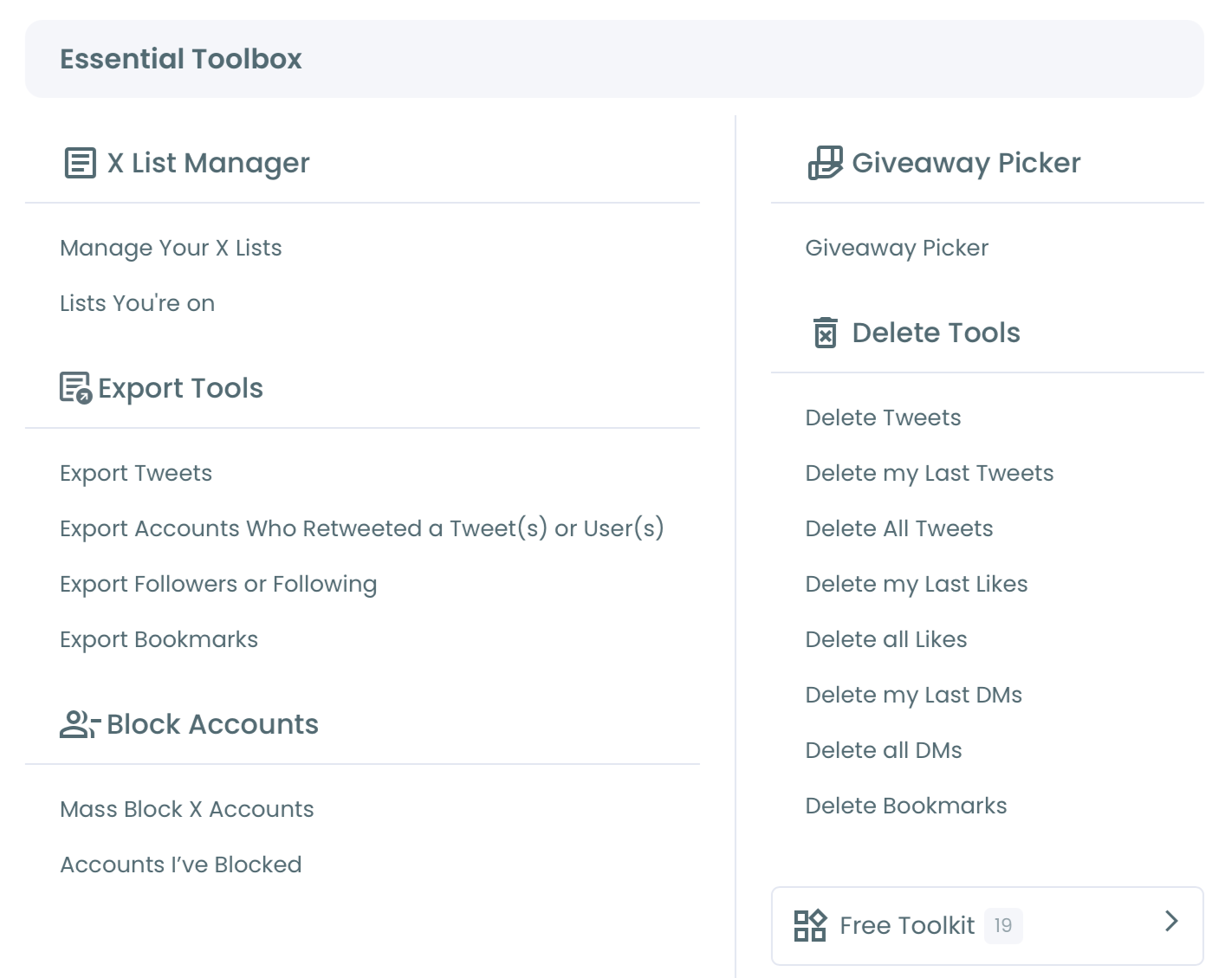
- Go to the Essential Toolbox menu and pick Delete Tools, where the Delete All DMs option sits alongside the other bulk cleanup utilities.
Get the archive out of X and find the message file
- Request your X data archive from your account settings on X and wait for the download link, which usually arrives by email within a day or two.
- Unzip the archive, open the
datafolder, and takedirect-messages.json its own. Upload that single file in the wizard's UPLOAD step, never the whole ZIP. If the file is larger than 100MB, an extra preparation step is required and the page links the guide for it.
Scope the deletion and confirm it
- Apply filters in the FILTER step, or skip them entirely for a full wipe. The panel offers a start and end date, a keyword search across message text, media-only and URL-only checkboxes, and an exclude list of @usernames whose conversations must survive.
- Read the count in the Approve and Delete panel, then confirm the modal. Circleboom shows how many DMs will be deleted and warns that deleted items are not recoverable once processed.
That sequence is what keeps the operation reversible right up to the last click. The connection comes first so the deletion has authorised access, the archive supplies the history the API cannot see, and the filters narrow the scope before anything is destroyed.
Reverse the last two and there is nothing left to filter.
The whole run, compressed:
- Connect the account, then open Delete Tools in Essential Toolbox.
- Download the X archive and pull out
direct-messages.js. - Filter by date, keyword, media, URL, or excluded accounts.
- Confirm the count, then accept the irreversibility warning.
Which filters to use when a full wipe is too much
Most people who search for a way to erase everything actually want a scoped clear once they see the options. The filter panel is where that decision gets made, and each control answers a different worry.
A date range handles the "everything before I rebranded" case. Set a start and end date and the deletion covers both endpoints and every day between them, which leaves recent working threads intact while the old account phase goes.
The keyword filter searches message text, so it fits the case where one topic, one project, or one person's name is the thing you want gone rather than the whole inbox.
The media and URL checkboxes narrow to conversations carrying attachments or links, which is the fastest way to strip the heaviest and most exposing content without touching plain text chatter.
Readers who want the same treatment applied to their public posts usually pair this with a pass to delete all Twitter media as well.
The exclude filter is the safety control.
Enter the @usernames whose conversations must survive and those threads are protected even when they fall inside the date range or match the keyword. Each excluded account appears with its profile photo and a remove button, so you can read the list back before you commit.
Run several narrow passes instead of one wide one
The same file can be re-uploaded in a new session, so these are not either-or choices. You can run a keyword pass this week and a date pass next week against the same archive, and Circleboom skips whatever the first run already removed.
That changes the shape of the decision. Instead of one irreversible judgement about a whole inbox, you get a series of small ones, each easy to reason about on its own.
Start with the pass you are certain about, look at what is left, then decide whether the next pass is still needed.
Manual deletion offers nothing like this. Every conversation you handle in the native interface is a fresh decision made under fatigue, and fatigue is exactly when people delete the thread they meant to keep.
The same staged logic works on the public side of the account. A Twitter archive eraser pass over old posts pairs naturally with a DM pass. Both read from the same downloaded archive, and both answer the same question about what an old account should still be storing.
Ready to scope your own run? Here is where to erase all Twitter messages, or narrow it down first.
Is it safe to erase all your Twitter messages?
The operation is safe for your account, and unsafe for your records. Those are two different risks and they need separating.
On the account side, nothing here strains X's rules. Because Circleboom is an official X Enterprise Developer company, you can leave a years-long deletion running and come back to an account in exactly the state you left it: no lockout, no rate-limit penalty, no policy warning waiting in your notifications.
On the records side, the risk is real and worth respecting. An inbox that old is usually the only place a few working details were ever written down: what a price was, who signed off, what a candidate was told.
A full wipe takes those with it, and there is no undo.
Three checks before you confirm anything:
- Confirm no live customer, legal, partner, or hiring thread depends on the inbox.
- Coordinate with anyone else who has access to the account.
- Decide where the archive file is going to live afterwards.
If you only want the recent window cleared, the lighter path is to delete multiple Twitter DMs at once inside the 30-day API range. That route needs no archive download and no waiting.
Prep the run before you start it
Clearing an X inbox is a privacy action, not routine maintenance, and it rewards a few minutes of preparation more than any other cleanup task on the platform.
The one-sided nature of DM deletion is the part to internalise before you start, because it changes what the operation can promise you.
Work through this before you confirm:
- Request the X archive now, since the wait is the only slow part.
- Decide whether you want a full wipe or a filtered pass, and write down the filter.
- List the @usernames going into the exclude field.
- Export or screenshot anything with a commercial or legal life.
- Plan where the archive ZIP lives once the deletion is done.
For the honest picture of what deletion reaches on the other person's side, read whether you can delete Twitter messages from both sides before you commit. It takes five minutes and it settles the expectation.
Manual deletion asks you to make the same decision several hundred times. The archive route asks you to make it once, carefully.
Once the checklist above is clear, a single filtered run finishes the job.
Questions worth settling before you confirm
How far back can I erase Twitter messages?
To the beginning of the account. The archive file holds every conversation since you opened the account, which is why the upload step exists at all rather than a straight API call limited to the last 30 days.
Do I have to upload the whole archive ZIP to Circleboom?
No, and you should not. Only direct-messages.js from the archive's data folder is needed. The rest of the ZIP holds your tweets, media, and account metadata and has no role in DM deletion.
Can I get my messages back after deleting them?
No. Deletion is permanent, and the confirmation modal warns that deleted items are not recoverable once processed. The archive file you uploaded is the only remaining transcript on your side, which is why the modal is worth reading rather than clicking past.
Will the other person know I deleted our conversation?
No notification is sent. The thread simply stays in their inbox as though nothing happened, since their copy is independent of yours and neither party can reach into the other's account.